

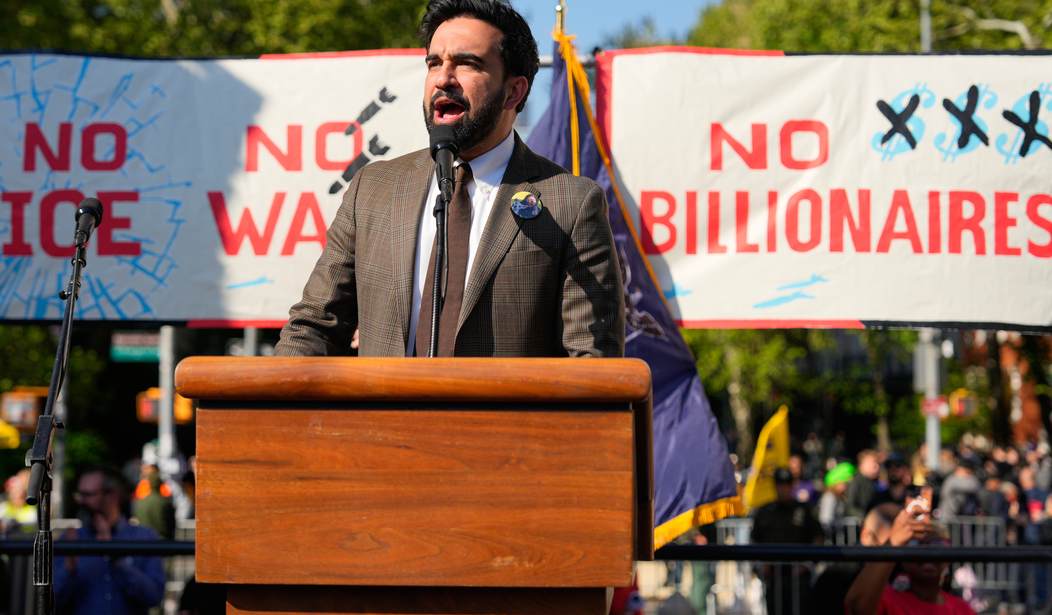

Zohran Mamdani won his election largely by promising tenants control over rents and property ownership. The proletariat would prevail over the bourgeoisie, Mamdani promised. Once in office, Mamdani pushed a series of punitive policies aimed at his socialist housing goals.
Tenants in East Harlem bought into Mamdani's rhetoric and strategy so fully that they staged rent strikes against Emerald Equities, a key landlord in the area of New York City. They expanded their campaign to target all of the company's real estate holdings, frightening off prospective renters, in an effort to lower rents and improve the properties.
How did that work out? City Limits reports that the tenants forced Emerald Equities into bankruptcy, only to find that they also scared off prospective investors, including the NGOs Mamdani promised would backstop them. The tenants are left twisting in the wind as Mamdani's government watches impotently from the sidelines. Paula Pant sums it up:
This is incredible. Tenants went on a rent strike. When the owner got foreclosed on, tenants launched a "buyer beware" campaign to scare away investors. They hoped a nonprofit would step in. Instead, the building failed to sell at auction. "Auctions closed without a bid, sending them back to the bank for just $500 apiece," the article says. The city tried to intervene by backing a proposed bid from one selected group. But the creditor rejected the bids, which did not match the "upset price" -- the size of the judgment the bank holds. The tenants are now "trying to get repairs on their neglected buildings." But there's no money for it. The building is being managed by a court-appointed receiver. https://t.co/5Xe5DLbN6O
— Paula Pant (@AffordAnything) November 19, 2026
"Auctions closed without a bid, sending them back to the bank for just $500 apiece," the article says.
The city tried to intervene by backing a proposed bid from one selected group. But the creditor rejected the bids, which did not match the "upset price" -- the size of the judgment the bank holds.
The tenants are now "trying to get repairs on their neglected buildings."
But there's no money for it. The building is being managed by a court-appointed receiver.
City Limits' Patrick Spauster reported yesterday that only one of 27 buildings at the auction attracted a bid that would cover the existing liabilities:
It’s part of a nearly 900-unit portfolio of 39 mostly rent-stabilized buildings, once owned by Emerald Equities’ Isaac Kassirer, many of which went up for foreclosure sale last week, despite the efforts of Washington, her tenant union, and Mayor Zohran Mamdani’s administration.
Of the 27 buildings in the portfolio up for auction over the past two weeks, 26 attracted no bids. One building on East 114th Street sold for $826,000, splitting the tenants and throwing their plans—to steer the properties to their preferred buyers, who could work to preserve the apartments—into uncertainty.
It’s another twist in the Mamdani administration’s efforts to intervene in the sales of distressed affordable housing.
Another "twist"? Well, one could call it that. It might also be called "economic reality triumphing over Marxist ideology." While the tenants might have legitimate complaints, the rent strike created an economic hole for these properties that no one will assume, even without the activist tenant groups calling the shots. Investors will be particularly disinclined to sink that much capital into lower-income housing while the Mamdani administration makes very clear that it will side with the activist tenants and stoke rent strikes like the ones that crippled Emerald Equities.
It gets even worse for Mamdani and his Marxist cabal. Not only are they radicals, they are incompetent radicals when it comes to finding solutions to their own chaos:
Tenants called for a responsible owner—preferably a nonprofit that would help them turn some of the apartments into affordable coops—to take over. The city took notice, and backed a bid from preservation buyer Spatial Equity.
But the city’s efforts to push for a sale failed, as the creditor, Sabal Investment Holdings, rejected Spatial Equity’s offers of $68 and $110 million in July and October, according to reporting by both City Limits and Gothamist.
If banks holding the roughly $250 million in debt on the properties hoped for a better deal at auction, it didn’t materialize Tuesday. Instead, tenants are back to the drawing board, trying to get repairs on their neglected buildings.
The only property that sold went to someone named "Matt," who bid just a thousand dollars over the "upset price," the value of the judgment held by the creditors. None of the other bids received on the other buildings matched or exceeded the upset price. Spauster notes that the outcome has "alarmed" other landlords, who may now realize that electing a Marxist mayor who promises to put tenants in charge has seriously diminished the value of the properties they now hold. Even before Mamdani got elected, the rental-property business was difficult enough under New York City's onerous rent-control regulations. If rent strikes become the norm, the business model will completely collapse.
And when that happens, where will tenants be? Struggling just to maintain the status quo that the renters rebelled against in the first place. Spauster notes that the NGOs that Mamdani and others see as the key to Tenant Nirvana won't have the money to buy these properties at market value, let alone have capital to invest in rehabilitation and upkeep:
Nonprofit owners may face some of the same challenges as their for profit peers, with rising maintenance and insurance costs.
“Purchasing or rehabbing rent stabilization is hard. The amount of money in it is really hard,” said Brian Peters, executive director of the El Barrio Community Land Trust. “So anybody who’s going to commit to it, it’s got to make financial sense. And clearly, for a for-profit entity, it’s not making sense—99 percent of people [are] saying this doesn’t make sense to buy at these prices.”
This is how Marxism fails, in practical application if not theoretically. Marxism imposes central planning on markets with myriad complexities, most of which get worked out between market participants through honest pricing. Government intrusions into markets tend to warp those outcomes, and in most cases create shortages that eventually push capital to the sidelines and create artificial crises that generate demands for even more authoritarian policies. In housing markets such as these, rent controls combine with restrictions on housing and punitive policies for construction and renewal. Put more simply, price controls create shortages, and then create even worse policies to shift blame to capital rather than the socialists who created the problem.
The economist F.A. Hayek provided the road map for socialist failures in his seminal book The Road to Serfdom. Perhaps the tenants in East Harlem should have read that before their tenant strike. The voters of New York City should have read it before electing a DSA snake-oil salesman as mayor. After these midterms, Hayek should be required reading for voters across the country, with the East Harlem fiasco one of the key business cases for the next elections in 2028.