This morning’s Gospel reading is Matthew 22:1–14:
Jesus again in reply spoke to the chief priests and elders of the people in parables, saying, “The kingdom of heaven may be likened to a king who gave a wedding feast for his son. He dispatched his servants to summon the invited guests to the feast, but they refused to come. A second time he sent other servants, saying, ‘Tell those invited: “Behold, I have prepared my banquet, my calves and fattened cattle are killed, and everything is ready; come to the feast.”’ Some ignored the invitation and went away, one to his farm, another to his business. The rest laid hold of his servants, mistreated them, and killed them. The king was enraged and sent his troops, destroyed those murderers, and burned their city.
Then he said to his servants, ‘The feast is ready, but those who were invited were not worthy to come. Go out, therefore, into the main roads and invite to the feast whomever you find.’ The servants went out into the streets and gathered all they found, bad and good alike, and the hall was filled with guests. But when the king came in to meet the guests, he saw a man there not dressed in a wedding garment. The king said to him, ‘My friend, how is it that you came in here without a wedding garment?’ But he was reduced to silence. Then the king said to his attendants, ‘Bind his hands and feet, and cast him into the darkness outside, where there will be wailing and grinding of teeth.’ Many are invited, but few are chosen.”
When we RSVP for the feast, do we prepare ourselves for its true meaning?
Quite a few years ago, I participated in two liturgical ministries as a Eucharistic minister and a lector. The parish was large, and that allowed us to schedule our volunteer service. Generally speaking, I did one Sunday a month in each, not usually at the same Mass (occasionally it crossed over), and that allowed me to prepare by arriving early … and dressing appropriately. The rest of the time, however, I dressed in a much more casual manner, as did most of our parish community.
One Sunday in the middle of a Minnesota winter, I had come to Mass in the layered mode – thermals, flannel shirt, heavy jeans, and a bulky coat. I had not been scheduled for any ministry at that Mass and figured I'd just blend into the congregation. Five minutes before Mass started, however, it became apparent that several of the Eucharistic ministers scheduled for the Mass had not been able to attend. The others were desperate to find trained EMs, and one of them spotted me in all my junky finery. When asked to volunteer, I tried to beg off, saying – accurately – that I was not dressed appropriately for it, but they insisted that the necessity was too great and that mattered more than my presentation.
And so I served as an EM that Mass, looking like I'd prepared more for snowmobiling than the celebration of Jesus' sacrifice. No one commented on that; in fact, several of them thanked me for agreeing to help. However, the lesson stuck with me that I had been generally missing the point and the meaning of Mass, not to mention laboring under an assumption that attendance was all that was necessary.
This is the lesson Jesus teaches in this parable, and He isn't subtle about it. His point is broader than just the Mass, which had not yet been instituted at this point, but it certainly includes it. The Mass is a re-presentation of Christ's sacrifice that frees all of us from sin and provides us with eternal salvation, as long as we embrace Jesus as our Savior and profess His lordship. The Liturgy of the Eucharist is modeled on the Wedding Feast of the Lamb in Revelation, making this parable particularly apt in application to the Mass.
In its general application, Jesus teaches that we do not know when we may be called to this feast, nor can we say for certain who will be called to it. Jesus makes that point particular to His audience at the telling, the chief priests and elders who assumed that the Lord would accept His chosen people without reservation. In the first part of the parable, Jesus warns that the people who rejected and persecuted the Lord's prophets would not receive an invitation, but that everyone else would be invited before them. Jesus' intent in this and other parables spoken to the temple authorities of the time is to give them an opportunity to repent and return to faith in the Lord rather than rely solely on their status as the remnants of the Davidic kingdom.
However, Jesus offers all of us a warning about preparing ourselves properly for that feast in the latter part of this parable. It is not enough to just show up at the end without preparing ourselves to partake in the eternal feast and celebration when Jesus marries Himself to the Church, allowing us to enter the divine life. In the parable, far too uncomfortably close to my actual experience at that Mass, a man shows up without bothering with the minimal preparation of dressing to honor the occasion. The king has him bound and tossed into the darkness in response to this disrespect.
Does this mean we should dress formally for every Mass? It means we should act with intention when coming to Mass, and that starts with understanding what the Mass is. The Mass is our wedding feast in time and space in which we prepare ourselves to be the bride of Christ. We form ourselves in preparation for our final call to the eternal feast. Each one of us comes to Mass not just to worship the Lord but also to marry ourselves to Him in a real sense.
Would you show up to your own wedding in cargo shorts and a Pittsburgh Steelers T-shirt? (Yes, I wore that to Mass once, too.) Of course not. It would disrespect your spouse and the hospitality of the Host.
This goes well beyond wardrobe, however. Jesus uses the lack of a wedding garment as an analogy for a lack of preparation. When we come to Mass as an obligation and barely participate in it, we are figuratively shedding that wedding garment and showing our lack of interest in the feast. Preparing ourselves for the feast means not just dressing for the occasion, but also seeking out the proper catechesis on the Gospel and scriptures. It means focusing on the altar with knowledge of what the ritual means and represents. We are called to know the material, in other words, and to apply it in our own lives so as to prepare ourselves for the wedding feast each Sunday.
This has been my struggle, perhaps more so since that one Mass where I realized the importance of preparation. Ever since, I have dressed more intentionally – not in a tux, of course, but in presentable wardrobes where I can be available to assist in liturgical ministries when called. I have also written these reflections in part to prepare myself for the Mass by understanding the readings and thinking through them carefully. (I write these on Saturday mornings now that I attend and sing at Saturday evening Mass with the choir in my new parish.) Where I constantly struggle, however, is in keeping my mind on what the Mass truly is and preventing it from wandering through any number of other topics. The discipline of singing helps with that, but at times I still feel like the guy who showed up to the feast looking like a lumberjack who's heading to the chow wagon.
And of course, the grace of Jesus Christ comes to our rescue when we struggle. This analogy does not require everyone to be the perfect guest at the feast. Jesus tells this parable to remind us that we have to try to form ourselves for eternal salvation, but that His grace will be enough when we fall short. We cannot ever prepare well enough to make ourselves worthy of salvation on our own, but Christ will carry us the rest of the way when we stumble in earnest desire for His love. And that is truly the Good News of the Gospel.
Addendum: For those who want to read more about the Mass and its connection to Revelation, I highly recommend the book Coming Soon: Unlocking the Book of Revelation and Applying Its Lessons Today by Michael Barber. It's very entertaining and informative, a great read even for those with less immersion in theology. Scott Hahn's The Lamb's Supper: The Mass as Heaven on Earth is also very good, a bit more rigorous but filled with great insights and joy.
Previous reflections on these readings:
- RSVP for the feast, or the meal: Sunday reflection (2023)
- Dress for success: Sunday reflection (2020)
- Dressing for success: Sunday reflection (2017)
- Sunday reflection: Matthew 22:1–14 (2014)
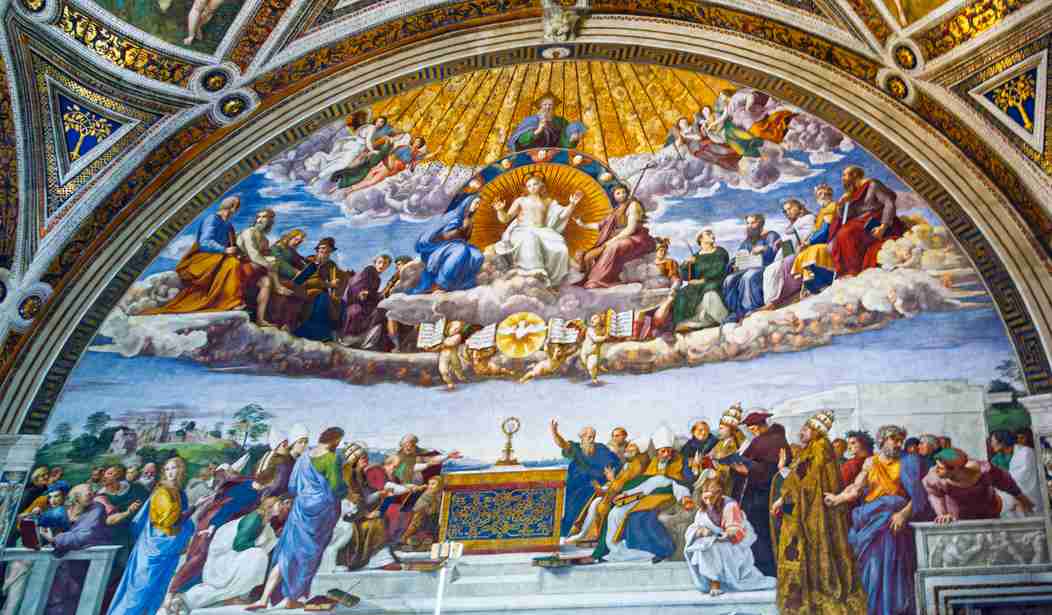
The front page image is "The Disputation of the Holy Sacrament" by Raphael, c. 1509-10. Fresco located in the Vatican Museum. From the personal collection of Ed Morrissey.
“Sunday Reflection” is a regular feature that looks at the specific readings used in today’s Mass in Catholic parishes around the world. The reflection represents only my own point of view, intended to help prepare myself for the Lord’s day and perhaps spark a meaningful discussion. Previous Sunday Reflections can be found here.
Editor's Note: Our Sunday Reflections are free to all readers, but our VIP members help keep this platform going for everyone. Join the effort by using the promo code FIGHT to get 60% off new memberships and upgrades to VIP Gold and VIP Platinum!












Join the conversation as a VIP Member