Alternate headline: First Western Leader to Inform Tehran He's Not Falling For No Banana In a Tailpipe.
The IRGC has spent decades building proxy terrorist armies to carry out its encirclement strategy for the Middle East. The Iranian regime has funded and defended the interests of Hamas, Hezbollah, and the Houthis, but has escaped direct consequences for their terror activities, even while everyone understands that Tehran has the ultimate authority over them. Iran has made this particularly clear since the October 7 massacres, attacking Israel directly over the war in Gaza, and of late, insisting that any ceasefire deal include Hezbollah in Lebanon.
Now the Houthis want to join the war. This morning, the Yemeni terror army claimed to have attacked two Saudi oil tankers transiting the Red Sea, spooking investors and sending oil prices shooting upward:
Oil prices are racing back toward $100 this morning after Tehran-backed Houthi militants claimed attacks on two Saudi tankers in the Red Sea, threatening another important route for oil flows and stoking fears that the U.S.-Iran conflict could escalate further.
Brent crude futures jumped 5% to $99 a barrel, $25 more than in early July. That's pushing government bond yields higher, with the 10-year Treasury yield topping 4.7% for the first time this year amid fears that inflation could heat up again.
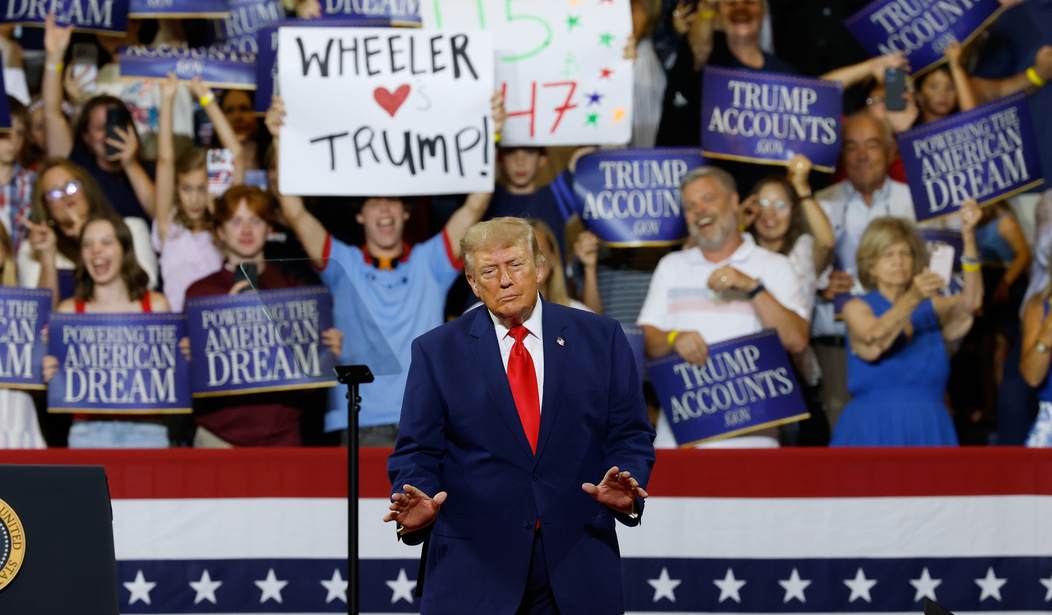
Within the last hour, Donald Trump made clear that the US would not stand for an expansion of the war. Trump didn't threaten the Houthis with retaliation. Instead, Trump made clear that any attacks in the Red Sea would have "major military" consequences for the IRGC in Iran, dispensing with the regime's proxy strategy to avoid direct blame:
A year ago the United States of America attacked, very powerfully, the Houthis, for their interference with commerce and trade, by shooting at ships. Since that time, and during our conflict with Iran, they have acted very responsibly. Unfortunately, now they are starting up again, shooting at two Saudi Arabian ships last night. Please let this TRUTH serve to represent that if they do this again, the U.S. will hold Iran responsible, in that the Houthis are a Surrogate and/or Proxy of Iran, and major military punishment will be inflicted upon Iran and, of course, the Houthis, themselves, who I am very disappointed with in that they have, until now, acted very professionally and smart. Thank you for your attention to this matter! President DONALD J. TRUMP
Is this finally a recognition of the IRGC regime's centrality to these terror networks? Trump referred to the pounding delivered by the US after the earlier crisis in the Red Sea, but at that time, even Trump didn't deal directly with Iran over those attacks. Our response at the time followed the same strategy that Western and even Middle Eastern powers have used since 1979, namely, to treat each terror entity as independent from Tehran while knowing exactly what the mullahs wanted.
In other words, we kept falling for the banana in the tailpipe. We kept falling for it even though we knew Iran was shoving bananas up our tailpipe for over 40 years, starting when Hezbollah killed over 240 Marines on a peacekeeping mission in Beirut and then started kidnapping Americans for most of the 1980s. Why did we pretend to keep falling for it? In large part, presidents from Ronald Reagan to Trump himself didn't want to deal with the implications of being honest about the source of the threat and attacks, because to be honest would have meant dealing with Iran directly rather than attempting to deal with its proxies. One can even argue that Trump still got ensnared in that impulse during the MOU, blaming Israel for continuing to respond to Hezbollah attacks as though the IRGC wasn't directing their actions in an attempt to play the US against Israel.
If nothing else, the current war (or at least its current phase) has introduced a little more honesty and directness into the situation. The Houthis are working in concert with the IRGC; it is no coincidence that the Iranian regime recently visited the Houthis in Sana'a, which the Saudis attempted to interdict. The Iranians want to use their proxy strategy to both escalate their threat and distract the US. Trump is refusing to play along this time, and instead will apparently move Bridge and Power Day closer to Infrastructure Week to play escalatio too. At this point, though, it might take the loss of territory to get the IRGC thinking twice about bananas and tailpipes, such as Kharg Island or the Iranian positions in strategic points like Abu Masa, Larak, or Qeshm.
Time to start shoving bananas in Iran's tailpipes for a while instead.
Editor's Note: For decades, former presidents have been all talk and no action. Now, Donald Trump is eliminating the threat from Iran once and for all.
Help us report the truth about the Trump administration's decisive actions to keep Americans safe and bring peace to the world. Join HotAir VIP and use promo code FIGHT to get 60% off your VIP membership.








Join the conversation as a VIP Member