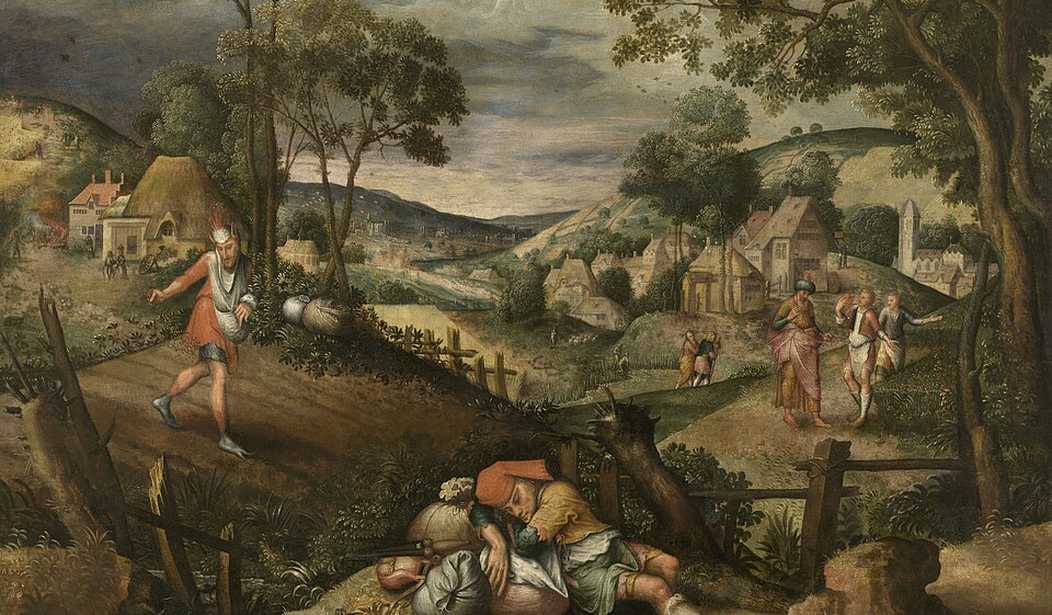
This morning’s Gospel reading is Matthew 13:24–43:
Jesus proposed another parable to the crowds, saying: “The kingdom of heaven may be likened to a man who sowed good seed in his field. While everyone was asleep his enemy came and sowed weeds all through the wheat, and then went off. When the crop grew and bore fruit, the weeds appeared as well. The slaves of the householder came to him and said, ‘Master, did you not sow good seed in your field? Where have the weeds come from?’ He answered, ‘An enemy has done this.’ His slaves said to him, ‘Do you want us to go and pull them up?’ He replied, ‘No, if you pull up the weeds you might uproot the wheat along with them. Let them grow together until harvest; then at harvest time I will say to the harvesters, “First collect the weeds and tie them in bundles for burning; but gather the wheat into my barn.”’”
He proposed another parable to them. “The kingdom of heaven is like a mustard seed that a person took and sowed in a field. It is the smallest of all the seeds, yet when full-grown it is the largest of plants. It becomes a large bush, and the ‘birds of the sky come and dwell in its branches.’”
He spoke to them another parable. “The kingdom of heaven is like yeast that a woman took and mixed with three measures of wheat flour until the whole batch was leavened.”
All these things Jesus spoke to the crowds in parables. He spoke to them only in parables, to fulfill what had been said through the prophet: I will open my mouth in parables, I will announce what has lain hidden from the foundation of the world.
Then, dismissing the crowds, he went into the house. His disciples approached him and said, “Explain to us the parable of the weeds in the field.” He said in reply, “He who sows good seed is the Son of Man, the field is the world, the good seed the children of the kingdom. The weeds are the children of the evil one, and the enemy who sows them is the devil. The harvest is the end of the age, and the harvesters are angels.
“Just as weeds are collected and burned up with fire, so will it be at the end of the age. The Son of Man will send his angels, and they will collect out of his kingdom all who cause others to sin and all evildoers. They will throw them into the fiery furnace, where there will be wailing and grinding of teeth. Then the righteous will shine like the sun in the kingdom of their Father. Whoever has ears ought to hear.”
Why did Jesus teach mainly through parables? And what did Jesus have in mind in those moments when He taught more directly? Was it only to fulfill prophecy, or does His parable in this passage speak to a deeper reason?
Both of our other readings today shed light on the purpose of parables and the context in which Jesus employed them. Both the first reading from Wisdom 12 and chapter 8 in Paul's letter to the Romans speak to our weakness and the mercy of the Lord in meting out justice. In Wisdom, the prophet hails the Lord as the sole and omnipotent God of creation, who has the "care of all" despite His immense power and holiness. It is only in that holiness that God tempers his power in mercy, as all power remains in His hands. This expression of holiness is what the Lord calls us to adopt through His example, to the extent of our own power as His children:
There is no god besides you who have the care of all, that you need show you have not unjustly condemned. For your might is the source of justice; your mastery over all things makes you lenient to all. For you show your might when the perfection of your power is disbelieved; and in those who know you, you rebuke temerity. But though you are master of might, you judge with clemency, and with much lenience you govern us; for power, whenever you will, attends you. And you taught your people, by these deeds, that those who are just must be kind; and you gave your children good ground for hope that you would permit repentance for their sins.
Jesus refers to this expression of holiness as "meekness," which carries a somewhat different meaning than it commonly takes in modern times. In biblical terms, "meek" does not mean lacking power, but rather the judicious setting-aside of power to benefit the weak. Meekness does not mean weakness, as I have written before, but rather the orientation to put a premium on mercy where one's power could choose to impose harsh justice instead. We are far weaker than the Lord, although He has given us dominion in this world as stewards and partners in creation. The Lord's love tempers His judgments, even when we abuse His forgiveness and mercy and refuse to show either to His other children.
We do that because of the stain of original sin, which is our arrogance in attempting to make ourselves equal or superior to the Lord. We shut ourselves out of the Lord's mercy by failing to recognize our true relationship in Creation. Only when we begin to orient ourselves properly and understand our relative weakness in the Lord can we receive His Spirit, as Paul writes to the Romans:
The Spirit comes to the aid of our weakness; for we do not know how to pray as we ought, but the Spirit himself intercedes with inexpressible groanings. And the one who searches hearts knows what is the intention of the Spirit, because he intercedes for the holy ones according to God’s will.
It is through prayer and humility that we open ourselves to the mercy of the Lord, as prophesied in Wisdom. When we make ourselves into idols and demand supremacy over the Lord, as Adam and Eve did, we preclude ourselves from the Lord's mercy. The Lord, in His love, allows us to make that choice of free will, but that choice distances us from Him in a way that makes direct prophecy much less effective.
That brings us to the Gospel reading and the use of parables. Jesus uses parables when teaching larger crowds, but shares the meanings of them with His disciples. Why? The disciples have received and accepted a special call to become the foundation of Jesus' new church. They have opened their hearts and minds more fully to the will of the Lord, and as such can process direct truth more fully than the crowds to whom they all minister. At times, Jesus teaches directly as well, but usually only through healings or very specific situations. The Samaritan woman at the well would be one such example where Jesus spoke more bluntly for a specific purpose, which fully converted the woman and provided her salvation. The Sermon on the Mount would be another event where Jesus spoke directly on how the Lord wanted His people to form themselves to His will of mercy and love.
However, another example of direct teaching to a crowd demonstrates why Jesus needed to speak in parables as a way to engage the lost sheep of His flock. In John 6:51-69, Jesus teaches a large crowd of "disciples" directly on the need to eat His flesh and drink His blood for salvation. Even the twelve disciples were shocked by this teaching, and most of Jesus' followers refused to accept it. "From this time," John testifies, "many of his disciples turned back and no longer followed Him." The Twelve remained, however, in part because they had been given special gifts to understand Jesus' teachings, but also because they had oriented themselves to trust entirely in the Lord through Jesus. As Simon Peter responds on behalf of all twelve, "Lord, to whom shall we go? You have the words of eternal life."
These episodes make clear that Jesus' parables are an act of mercy. They call to the lost without overwhelming them, a soft voice of love and mercy that the hard-hearted can process as a start to unlock their trust in the Lord. Jesus came to the world to save all those who would choose salvation, and so loved us that He tempered truth with mercy by offering it in stories that we could easily understand and embrace.
This brings us to today's parable of the weeds in the field. The Lord has the power to smite those who would choke off His word and His will, but that imposition of brute will would damage and kill the innocent and those who wish to "grow" to Him. We see that in the Gospel passage in John 6, even with only words and truth rather than the force that the Lord could summon to impose untempered justice on the lost. This is true meekness, the servant love of Him who holds all power but withholds it to give us a chance to choose Him over our own weakness and ambitions.
Once again, I refer to the beautiful allegory from the Talmud as quoted in the 1981 film The Chosen as a way to see this relationship:
There is a story in the Talmud about a king who had a son who went astray. The son was told, ‘Return to your father.’ The son replied that he could not. The king then sent a messenger to the son with the message… ‘Come back to me as far as you can, and I will meet you the rest of the way.'
The parables are the Lord's way to meet us where we are, and to guide us back to Him, while keeping His full power and might at bay so that we may not be daunted at the journey before our strength returns. That is the mercy of a Gardener.
Previous reflections on these readings:
- Spring cleaning, in our hearts and lives: Sunday reflection (2020, 2023)
- Sunday reflection: Matthew 13:24–43 (2017)
- Sunday reflection: Matthew 13:24–43 (2014)
The front page image is "Satan Sowing Tares" by an artist credited as Master of the Prodigal Son, c. 1530-60. On display at the Royal Museum of Fine Arts Antwerp. Via Wikimedia Commons.
“Sunday Reflection” is a regular feature that looks at the specific readings used in today’s Mass in Catholic parishes around the world. The reflection represents only my own point of view, intended to help prepare myself for the Lord’s day and perhaps spark a meaningful discussion. Previous Sunday Reflections can be found here.
Editor's Note: Our Sunday Reflections are free to all readers, but our VIP members help keep this platform going for everyone. Join the effort by using the promo code FIGHT to get 60% off new memberships and upgrades to VIP Gold and VIP Platinum!











Join the conversation as a VIP Member