






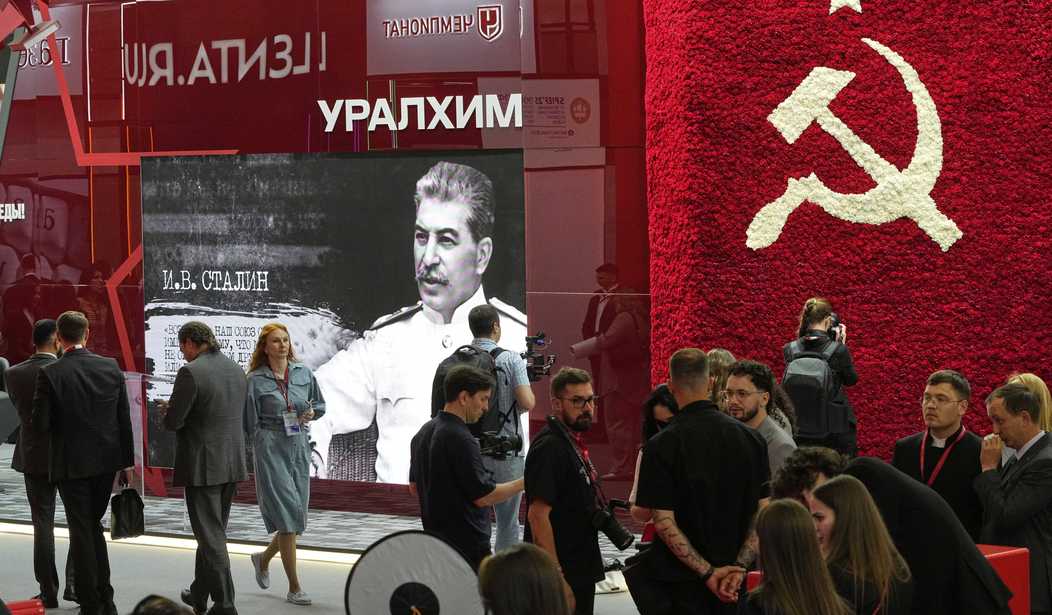
Our upcoming Anti-Communist Film Festival continues to gain notice and enthusiasm. We hope the festival will be both a fun party and a chance to remind people, through the immersive art form of film, of the evil of communism. Academics, Hollywood, and the media would like us to forget.
A great new book has just been released that can serve as summer reading before the October screenings of The Lives of Others, Hail, Caesar!, and other classics. Stalin's Apostles: The Cambridge Five and the Making of the Soviet Empire by Antonia Senior is a brilliant and captivating book about the “Cambridge Five,” the notorious British soy group that during the Cold War sold out to Stalin and the Soviet Union.
Stalin’s Apostles is beautifully written and also offers a fresh perspective. The book explores the Cambridge Five, the notorious double agents who passed British secrets to their Soviet handlers. Five students from Cambridge University — Kim Philby, Guy Burgess, Donald Maclean, Anthony Blunt, and John Cairncross — betrayed Britain and the West from the 1930s through the early years of the Cold War.
Senior brings new anger to the story of the Cambridge Five, whose crimes are too often explained away as the result of their position in the British class system. She writes:
The Five mined their leftist friends, many of them [pro-Stalin] Apostles, for nuggets to feed their Soviet masters. They traded on the very camaraderie that being young and Marxist had engendered in the febrile 1930s. Yes, they were shielded by their membership of a clubbable world. But they also escaped detection because they were good at hiding and because it seemed impossible that the hold of a fashionable ideology on young minds could be so intense, so persistent, that they would betray their country, their friends, and their families in its cause. Only the uncovering of the Cambridge Five bridged the imagination gap that had allowed that same spy chain to flourish. Framed solely as a heist on a staid establishment, the Five’s crimes have become easy to underplay, even to glamourise. But there were forgotten victims of their treachery.
Many of the victims were in Eastern Europe, millions of innocent people who suffered because the Cambridge Five were sending secrets to Moscow. “In this game of tactical class war,” Senior worries, “espionage was crucial: outwitting a penetrated enemy is easier than a blind fight. Stalin wanted insight. He wanted, from his best spies, the chance to eavesdrop on Winston Churchill and Franklin Roosevelt. He wanted to hear the whispers between his allies that were meant to exclude him. This is what the Cambridge Five gave him: an unprecedented and unreplicated peephole into the West’s decision-making at the highest levels. In one horrible section of Stalin’s Apostles, Senior describes a woman being tortured by the Soviet secret police in the last years of World War II as the Apostles “funneled secrets to the Soviets and enjoyed cushy pensions.”
Throughout the book, Senior torches the Cambridge Five and the notion that their Britishness somehow made their actions understandable or less evil:
They were motivated by the conviction that the violent expansion of communism across the globe, in a manner that subjugated sovereign nations to Soviet control, was justified and necessary in the cause of international revolution. The Five were vehement anti-imperialists, steeped in the language of the Left that blamed society’s ills on an unholy alliance of capitalism and colonialism. And yet they were untroubled by Stalin’s own vision of a muscular, imperialist role for the Soviet Union in advancing world revolution. If America claimed hegemony, it was evil imperialism; if Stalin dominated, he was gifting utopia.
After the Nazi-Soviet pact of August 1939, which carved up eastern Europe between Hitler and Stalin had access to intelligence from the Cambridge Five. Before Kim Philby, one of the Five, defected to the Soviet Union in 1963, one of the covers he blew was that of David Cornwell, later known as John le Carré, who included a fictionalized version of Philby in Tinker, Tailor, Soldier, Spy - a film would like to screen at the Anti-Communist Film Festival. “Just a naturally bent man,” le Carré said of Philby in a 2010 television interview. “I wouldn’t have trusted him with my cat for the weekend.”
Editor's note: We now have the room to run outside commentary by some of our favorite and most provocative thinkers on the Right. That only happens because of the support of our readers, who ensure that we have the resources to keep providing an independent platform and independent voices in a sea of Protection Racket Media domination.
Help us maintain that fight! Join Hot Air VIP and use promo code FIGHT to get 60% off your membership.

Join the Conversation
VIP members get the ability to comment on articles.