Earlier this month I wrote about the leader of the French Green Party, which is currently called the Ecologists. Marine Tondelier is best known as the person who helped gather together all of the Left-wing parties into a single bloc during the 2024 election. That bloc was called the New Popular Front and its goal was simply to keep the right-wing National Rally, led by Marine Le Pen, out of power.
But as I mentioned here, the New Popular Front is currently full of strife and division because, outside of opposition to the National Rally, the various parties really don't agree about much else.
Among the wave of memes and posters produced by supporters of France’s leftist parliamentary alliance last summer, one of the more memorable ones featured a column of hearts with the message, On s’engueulera plus tard, or “We’ll argue later.” It was meant as a lighthearted plea for left-wing politicians to stop bickering and to focus on their common foes—but today, it reads as a grim statement of fact.
Seven months after unexpectedly winning a plurality of votes in snap legislative elections and denying the far-right a chance at governing the country for the first time since the Second World War, the New Popular Front (NFP) coalition—made up of France Unbowed (La France Insoumise, LFI), the Socialist Party, the Greens, and the Communist Party—is on the brink of collapse. As Sandrine Rousseau, a Green MP in the National Assembly from Paris, told The Nation in an interview, “the NFP isn’t dead, but it’s on life support.”
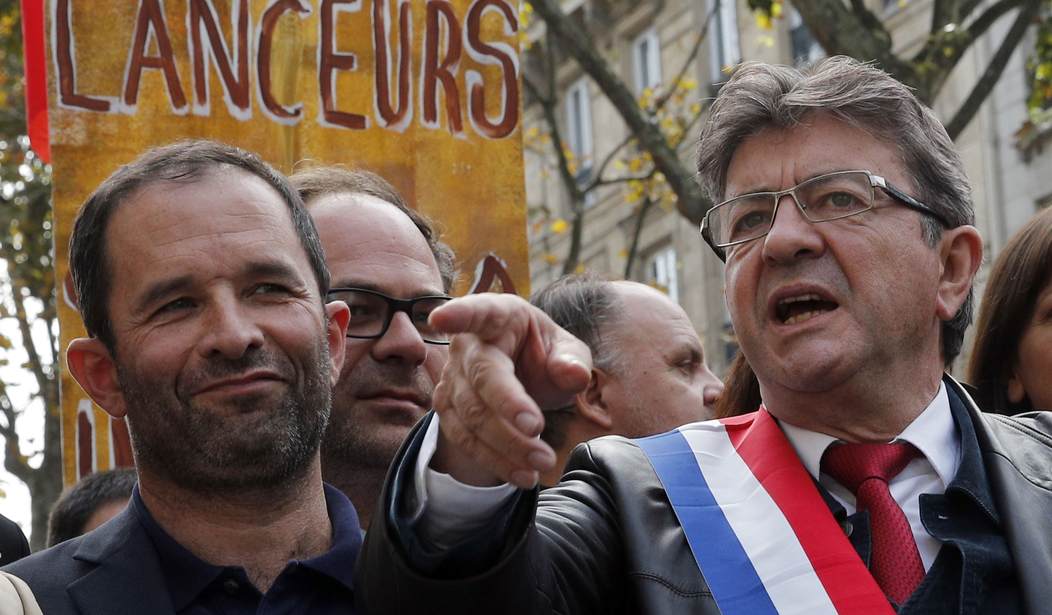
This week, the French Left is trying to renew its union by focusing on environmental issues. At the forefront of that is the leader of the far-left party France Unbowed, Jean-Luc Mélenchon.
Jean-Luc Mélenchon, LFI's presidential candidate, used the party's summer gathering as a show of strength in terms of turnout, just as he did during his first rally in Saint-Denis, a northern suburb of Paris, on June 7. Above all, his address centered on climate action. He advocated for "environmental planning," detailed his vision for "eco-regions" and proposed an "environmental conscription" to bolster civil protection forces in times of crisis. The emphasis is partly strategic, aimed at winning over the Greens and their supporters. But climate action has long been a key concern for Mélenchon, who has often promoted the concept of "ecosocialism."
This shift in discourse from Mélenchon, who has set aside more controversial themes such as his idea of a "new France" and refrained from attacking other left-wing parties, does not erase the doubts over his candidacy. Chief among them are his various provocations with antisemitic undertones and his troubling authoritarian tendencies, both toward the press and within his own organization. The same goes for his geopolitical stance, notably its ambiguity toward authoritarian regimes.
Mélenchon is not universally well-loved, and despite running for president of France three times he has never made it to the second round of voting. And that may be the biggest problem the left is currently facing.
Jean-Luc Mélenchon, the leader of the hard-left France Unbowed, and Olivier Faure, the leader of the Socialist party (PS), have both ruled out the idea of backing a single candidate. Efforts by the Greens to broker talks between progressive parties have fallen on deaf ears.
The obvious danger, as the most important election in the history of the Fifth Republic looms, is that chronic division will ease Ms Le Pen’s path to the Élysée. The 75-year-old Mr Mélenchon is a deeply polarising figure who has failed three times to reach the second round of a presidential race. But in a fractured field, the loyalty of his base among the young, the urban precariat and ethnic minority voters gives him a credible chance of making the runoff this time. At which point, polls predict, France’s traditional “Republican front” against the far right would disintegrate, handing Ms Le Pen a crushing victory.
...as the 2027 campaign begins in earnest, [Le Pen] enjoys a 20-point lead in the polls, and another place in the second round is all but assured.
The question, therefore, is who can rally enough support from across the political spectrum to stop her becoming president. A united left would have had a far better chance of coming up with a convincing answer. But that is not the left France currently has.
So Mélenchon's desire to face off against Le Pen means that a) he probably will get that chance but also b) he'll almost certainly lose badly, making her the Prime Minister. If the Left could unite again around a candidate other than Mélenchon, they might be able to stop her as they did in 2024 but that no longer looks likely.
Editor's Note: Do you enjoy HotAir's conservative reporting that takes on the radical Left and woke media? Support our work so that we can continue to bring you the truth.
Join HotAir VIP and use promo code FIGHT to receive 60% off your membership.