I know. I'm frustrated, too.
Last weekend, it was all I could do to resist pulling up X on my cellphone while watching the Tesdeschi Trucks Band absolutely rock the world-famous Red Rocks venue in Morrison, Colorado last Friday and Saturday night. It seemed like the knockout blow to the Iranian rump regime's remnants and infrastructure was imminent and I was afraid I'd miss the fireworks.
When I got back to the hotel and learned that at the request of Mohammed bin Salman in Saudi Arabia, President Donald Trump had yet again called off the big strike in search of a quick deal, I wanted to throw my phone out the window.
Here we are a week later, and there's still no deal. No surrender by the IRGC-led regime in Tehran, nothing other than rhetorical bluster that the Iranian toll booth in the Strait of Hormuz is going to be gold-plated by this time next year.
Hawks on what to do with Iran, like me, are disappointed at no resumption in meaningful kinetic action, strikes sensitive enough to not only remove their capacity to fight back, but their will as well. Doves on Iran see a glimmer of hope that the junta may finally have defeated the powerful American military by sheer will of defiance. Trump haters simply looked at events in the last week as ineptness and incompetence.
What to make of the state of the Strait? My column a couple weeks ago said that Iran was on a path to ultimate extinction. I stand by it, and nothing this week has led me to believe any different outcome is probable, even though the promised grand finale series of strikes I believe would hasten the regime's collapse has been delayed for now.
In the Oval Office yesterday in front of a gaggle of reporters present to watch him sign an executive order ending birth tourism, a question got asked about the potential for a deal with Iran. President Trump had this to say.
"I don't think they can go much longer," he said, based on what he's seen. I know what I've seen in the open source world of late, and that assessment squares with what I read, and I'm sure the President gets intelligence far greater than what is publicly available.
Let's take a look at life currently in Iran. Miad Maleki is a former United States Treasury official, Air Force veteran, and a senior fellow at the Foundation for Defense of Democracies who follows the Iranian economy like very few others.
A pause in strikes buys the Iranian regime time, not relief. The regime's most crippling reckoning isn't with the U.S. or Israel but it's with its own people. Barely 35% of working-age Iranians actually have a job and the current minimum wage covers barely a quarter of actual living costs.
Iranians know their country's true economic potential and know they deserve better, the Islamic Republic's revolutionary ideology is dead, even among the regime's own children.
The regime can evade external accountability, but the most punishing thing to the regime right now is to force them to go back to face domestic accountability, an economy that, when not retrained by a state of war, will show its underlying disastrous inflation, unemployment, corrupt trade, war damages, and crippled political institutions.
Iran has never been so diplomatically isolated, its share of global trade has collapsed from 2.2% to below 0.02%. That isolation will keep showing up in Iran's economy as businesses, even in friendly countries, refuse to risk trade and investment there given sanctions exposure and war risk.
Iran's official unemployment number hovers just under 10 percent, which is bad, but not calamitous...until you figure in that only four out of ten able-bodied Iranians are even in the workforce seeking jobs. The rest have given up looking for jobs that are not there. And Iran's share of the global economy plunging to less than two one-hundredths of a percent means they're not manufacturing or exporting anything these days that would necessitate employment for anyone outside of the IRGC or Basij forces, who also have been unpaid for months.
The rial's fall against the dollar has been catastrophic, and there's no bottom for it in sight, even with James Talarico's eyes seeing bottoms everywhere he looks.
The Iranian rial sinks to its lowest level ever: 1,944,000 to USD. It was 70:1 on eve of the Islamic Revolution.
— Mark Dubowitz (@mdubowitz) August 1, 2026
The Islamist regime in Iran is a human-made catastrophe.
In case you need a number to understand the rial's freefall, in six months, Iranian money has lost 99.9965% of its value.
Iran's economy is currently experiencing around 90% inflation, and it turns out the worst may be yet to come.
Iran could face a new wave of inflation within the next one or two months if the rial’s depreciation continues amid the government’s “disastrous” management of the economy, a member of parliament’s economic committee warned on Monday.
— Iran International English (@IranIntl_En) August 3, 2026
“The seeds of even higher inflation are now… pic.twitter.com/jDzSOFnsKf
Reuters, citing Iran's Fars News Agency, says the debt clock has just about run out.
👀
— Richard Goldberg (@rich_goldberg) August 5, 2026
Iran state oil company's bank accounts frozen over debt, Fars news agency reports https://t.co/pWKXp26GMQ
And Maleki adds more detail to the debt chain reaction underway.
Nearly every part of Iran’s oil economy, the oil company, the sovereign wealth fund, the banks, and the petrochemical sector, owes massive, growing sums to each other, with no real money moving through the system to pay any of it back.
Iran’s oil sector, long seen as the regime’s most reliable revenue source, has been buried in debt by its own officials’ admission.
The company that runs Iran’s oil, NIOC, just had its bank accounts frozen over unpaid debt. NIOC itself says the underlying tax bill is so large it’s essentially unpayable and was never even budgeted for.
Separately, Iran’s Oil Ministry owes about $17 billion to Iran’s sovereign wealth fund.
On top of that, Iran’s government just rescheduled 55 billion euros of oil-sector debt owed to the central bank and commercial banks.
Iran’s petrochemical companies separately owe the Oil Ministry another roughly $8 billion, forcing the government to borrow from the central bank and print more money, worsening inflation.
You remember the Dave Ramsey horror stories of people who get a second credit card and use it to pay the minimum due on the first card that's now maxed out, and you ping pong for as long as you can until the thirty percent interest rate takes its toll and you have to open a third, fourth, and fifth card until you've maxed them all out and companies won't issue more? That's what is happening to Iran's government.
At least they've got reliable power in their grid, being that President Trump has not yet bombed it, right? Wrong.
In Iran, the authorities call it a scheduled outage. The electricity will be disconnected for two hours. The water may return later in the evening. Families are instructed to adjust their lives to temporary emergencies. But there is no pause button for daily life.
— Iran International English (@IranIntl_En) August 6, 2026
A baby does… pic.twitter.com/KjneQRGIHb
Why is it a 'scheduled' outage? Because Iran does not have the refining capacity to handle their gasoline and diesel demands, and they never really have. They were always a net exporter of oil and a net importer of refined petroleum, subsidizing it as a loss leader to keep the population from protesting in the streets. Now, they have no money to subsidize it, and because of the United States Navy boa constrictor in the Strait of Hormuz blocking ships from going in or out of Iranian ports, there's not enough fuel in Iran to run generators, pumps, or refineries 24 hours a day. I'm from California. I've had plenty of experience with brownouts and blackouts in my life. But at the Golden State's worst, it's happened when it gets really hot here, like in the mid-to-upper 90s. It's 120-plus in most of Iran. That's not conducive life with intermittent power.
And speaking of the heat, it's drying up yet another commodity — water. From Al Jazeera last month:
To sustain its freshwater resources, a country must replenish at least as much water as it withdraws for agriculture, industry, and household use.
Iran has long been on the wrong side of that equation. Decades of dam construction, intensive farming, and groundwater extraction have pushed consumption far beyond what rainfall can replenish.
In 2025, Iran’s 92 million people consumed around 100 billion cubic metres of water, nearly 13 billion more than its renewable resources could provide.
Agriculture is by far the largest consumer of water in Iran, accounting for about 91 percent of all withdrawals, compared with seven percent for households and two percent for industry. Yet much of that water is lost before it reaches crops, as ageing and inefficient irrigation systems waste a significant share of the country’s most precious resource.
Iran used to import most of its grain. They can no longer do so due to the blockade, and so they've turned increasingly to farming internally, further straining a depleted water supply caused by extended drought. In one village in a southern province of Iran to escape the heat, they're resorting to dig a small hole in the ground, filling it with what precious water remains, turning it instantly into a mud trough, and letting all the kids in the village cool off in it like a hippo.
In a village in Jazmourian, in southern Kerman province, parents have found the only cooling system available to them: holes dug in the earth, filled with a little water, where children sit out the worst hours of a heat that reaches over 48°C, about 120°F.
— Iran International English (@IranIntl_En) August 5, 2026
Seventeen families live… pic.twitter.com/r0lYpwhELo
This is what 47 years of a fanatical Islamist regime looks like running what once was Persia literally into the ground.
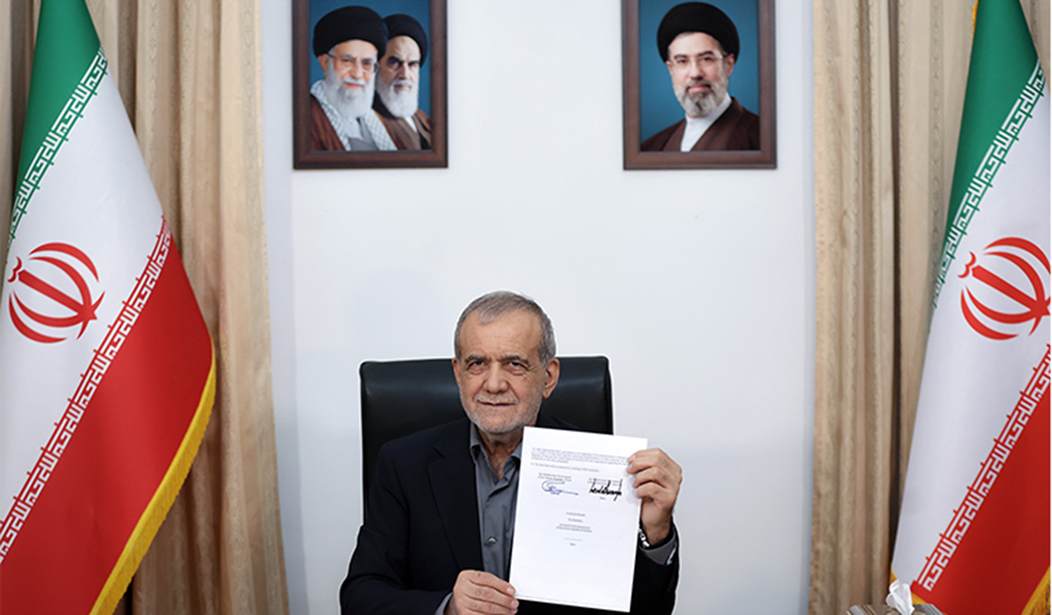
When President Trump called off the big strike a week ago at Saudi Arabia's request, the Iranian puppet president, Masoud Pezeshkian, sounded not a whole lot different than a NeverTrumper:
Iranian President Masoud Pezeshkian:
— Open Source Intel (@Osint613) August 5, 2026
They had planned to take over Iran within 48 hours, just as they did Syria.
Despite all the hardships and challenges, today Iran is spoken of as a powerful country with great dignity and honor. pic.twitter.com/8ZJKBNdRxg
No one, and I mean no one, is talking about Iran as a powerful country with great power and honor. Here's the stats.
While the exact count of Iran's air assets is unknowable through open sources, combat-ready aircraft are probably down to under a hundred planes. They probably don't have the fuel to fly them, however. Drones? Sure. Missiles? Nowhere near in the quantities as before war came to Iran, but yes, some remain. Compare that to the GCC countries with a combined armada in the air topping 2,100, and they've been willing to use them in the past few weeks in response to Iranian drone attacks.
The big card the Iranians keep playing as though it's their trump card is control over the Strait.
BREAKING: A senior Iranian official has confirmed that Iran will impose transit fees of 5% to 7% of cargo value on ships using the Strait of Hormuz—worth roughly $100 billion annually at pre-war traffic levels—with Chinese vessels exempt under the drafted deal, according to…
— The Hormuz Report (@HormuzReport) August 6, 2026
There only seem to be three flaws to this claim. First, the U.S. Navy has something to say about that.
U.S. Marine Corps aviation assets and personnel embarked aboard USS Boxer (LHD 4) support ongoing enforcement of the U.S. blockade against Iran. As of Aug. 6, CENTCOM redirected 49 commercial vessels, disabled 2, and boarded 2. pic.twitter.com/tbdPdKe7RH
— U.S. Central Command (@CENTCOM) August 6, 2026
There is one entity controlling the Strait of Hormuz, and it's not Iran.
Second, President Trump, Vice-President Vance, Secretary of State Rubio, and Treasury Secretary Bessent have all stated the idea of Iran charging tolls is a non-starter and totally unacceptable. No final deal, if there is one struck, will contain that language. If this language is being thrown around by regime types a week after Trump pulled back the reins, I wouldn't sleep too comfortably this weekend if I were one of them.
And third, and perhaps most importantly, most of the oil that used to flow through the Strait is now flowing by way of pipeline.
Saudi Aramco is routing crude around the Strait of Hormuz via its East-West pipeline as the Iran-related crisis has cut shipping through the strait to a tenth of pre-conflict levels, Chief Executive Amin Nasser said on Tuesday.
— Iran International English (@IranIntl_En) August 4, 2026
"The ongoing geopolitical crisis continues to… pic.twitter.com/gxr5iImtOK
And adding insult to injury, what oil isn't going through the pipeline is still going through the Strait, even with Iran taking occasional shots at ships. And it's not just me saying it. This is CNN:
3-5 million barrels of oil flowing through Hormuz daily, according to CNN.
— Mark Dubowitz (@mdubowitz) August 3, 2026
Other estimates: 7-9 million bpd flowing through pipelines (East-West and Fujairah). https://t.co/3FLjxT7S7Y
The war has been won. Iran has lost. Victor Davis Hanson says as much this week.
Iran is losing whether it is being bombed, sanctioned, or embargoed—or all three. Its ultimate fate now rests with the Trump administration, which apparently has not yet decided what, exactly, that fate will be.https://t.co/60h4RUlEft
— Victor Davis Hanson (@VDHanson) August 6, 2026
James Carafano of the Heritage Foundation writes this piece for 1945: Donald Trump won The Iran War
Only a year ago, the Iranian regime could threaten to shut down up to a third or more of the world’s oil exports. Even today, while fighting in the Strait of Hormuz still lingers, that is no longer true. Regional exports are rebounding, by some estimates up to two-thirds of pre-war levels. The UAE, for example, is already exporting at 85% of pre-war levels.
Nor is oil rocketing toward $ 200 a barrel like the IRGC hoped. In fact, prices are bobbing below wartime highs. Part of this is because the region is rapidly developing redundant and resilient means to move product through new cooperative initiatives, including potentially a Saudi-Israeli pipeline. The prospects that Iran can hold the flow of the world’s energy hostage are now nil.
Are there threats in the region that could cause the Gulf to get messy again in the very near future? Absolutely. Saudi Arabia, presumably out of fear of an Iranian or Iranian proxy-led attack on Kingdom infrastructure sites like desalinization plants, oil resources, or electrical generation, asked the President to hold off. A week ago, they took matters into their own hands with Houthis in Yemen threatening the other strait feeding the Red Sea, but are queasy about being caught in the proverbial crossfire. How was that effort to pull Trump back from the brink received by the regime remnants in Tehran? About as one would expect.
Saudi official tells CNN Saudi Arabia expects "multiple coordinated attacks" by Iraqi militias working with Iran-backed Houthis. https://t.co/yBx4Xdpxfs pic.twitter.com/ljpd1Czadw
— Open Source Intel (@Osint613) August 6, 2026
Iran is fixing to hit them anyway. That would seem to take MBS' reticence off the table, wouldn't it?
Late last night, it looks like Iran, in conjunction with their proxies in Yemen and Iraq, began to move. The problem is the GCC countries knew they were moving and may have preempted the attacks, although there are reports that Bahrain was hit.
In Iraq:
Iraqi Counter Terrorism Service forces have deployed to Baghdad’s Green Zone, with Iraqi Army armored vehicles and tanks also positioned near Baghdad International Airport amid fears of attacks by Iran backed militias. pic.twitter.com/wAYI9TPh1q
— Open Source Intel (@Osint613) August 6, 2026
And the Yemenis appear to have brought down Houthis drones intended for Saudi Arabia.
Several Houthi drones were reportedly downed over Marib by Yemeni air defenses. https://t.co/KtkN6alJ1v
— Open Source Intel (@Osint613) August 7, 2026
There has been a lot of online buzz about the prospects of China covertly rearming the Iranians. The fact that this news is ubiquitous online kind of betrays the whole covertness of the operation, were it to be true. If so, it's certainly not happening without Trump's knowledge and with his blessing. Xi Jinping may want to test America's will in the region, but he certainly does not want to arm Iran so that they can pick off oil infrastructure in neighboring GCC states that China is currently sourcing, along with the United States, for oil. That doesn't make sense.
The last mud thrown against the wall of the Pentagon this week by American media this week was an unnamed leak from inside the Trump administration that we are almost out of ammo. That apparently is also fake news.
I was at Camp David with President Trump and Secretary Hegseth. This literally never happened, and we told the Washington Post that repeatedly. This B.S. story was shopped to many outlets by someone clearly out to disparage the Secretary, for whatever reason. Unfortunately for… https://t.co/BUwn11nC52
— Karoline Leavitt (@PressSec) August 6, 2026
Vice-President Vance appeared on Hugh Hewitt's show Thursday afternoon to talk about his book, Communion. Keep in mind that Vance, along with Marco Rubio, Steve Witkoff and Jared Kushner, have been the negotiating team. For the pause this week, President Trump said he's been more personally involved in negotiations. But Vance only brought up Iran in passing at the beginning, and did not signal that there's any deal in the offing.
Just reading the tea leaves, after Trump began the week by saying the pause was going to only last if there's a quick deal, we're now five days later into Friday, and publicly, the Iranians are still talking tolls and fees. It would not be a shocker to see kinetic action resume this weekend after being strung along by the Iranians again.
But the point must continually be made. Even without the mother of all bombings, without targeted regime strikes, the Iranian economy and the fate of the regime have one foot in the grave and the other on a banana peel. Each successive week of withering sanctions and blockades choking them to death, the reality is Iran no longer remains a regional or global threat. They're a regional nuisance that has been exposed as a paper tiger after having their nuclear program destroyed.
And each week this goes on, the paper in that tiger gets thinner and thinner.
Editor's Note: For decades, former presidents have been all talk and no action. Now, Donald Trump is eliminating the threat from Iran once and for all.
Help us report the truth about the Trump administration's decisive actions to keep Americans safe and bring peace to the world. Join HotAir VIP and use promo code FIGHT to get 60% off your VIP membership.










Join the conversation as a VIP Member