





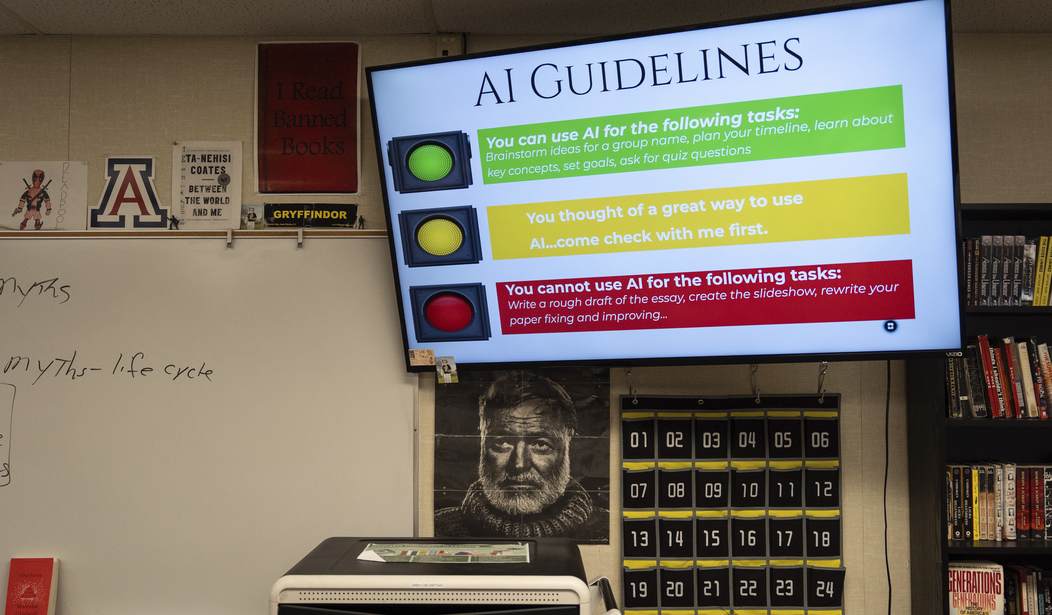
Democrats didn't generate a midterm blue wave solely because of discomfort over artificial intelligence. High gas prices, the dragged-out Hormuz crisis, and Donald Trump fatigue played larger roles in the backlash against the status quo.
However, grassroots NIMBY objections to AI data centers may have provided a significant shift in the turnout model seen in Tuesday's midterm elections. James Talarico's final ads made an issue of Ken Paxton's glib remark that Texas had plenty of room for these facilities, while yard signs popped up around central Texas demanding an end to their construction. I personally saw more anti-data center signs in yards than campaign signs in my corner of the state.
Democrats certainly understood their mandate to include opposition to AI and data centers. So did Wall Street, which laid an egg yesterday on tech stocks once the ramifications of Democrat control on their industry became apparent. Investors lost over $2 trillion this week on AI, although the news is better today:
The AI trade has for now stopped spiraling, after a bruising selloff that set back the Nasdaq by about $2.5 trillion yesterday.
The tech-heavy index is gaining more than 1%, reversing some of Thursday's historic losses. The Dow, on the other hand, is about flat on the day after paring morning losses.
The stocks that were hardest-hit this week, including data-center firms like CoreWeave and chip companies Intel, Nvidia, Micron and ARM Holdings, are all climbing. ...
The losses came as sentiment toward the AI trade had already grown more fragile. After Democrats' sweeping midterm victory, the question now is whether this week's selloff was a temporary stumble, or the start of a longer-lasting unwinding of the AI trade.
That question will depend on what Democrats do with AI in Congress, and what Democrats who took over states like Texas will do as well. What are their plans for AI now that voters put them in charge?
Unfortunately, as Rogé Karma explains at The Atlantic, Democrats have no plan at all except demagoguery. Like a dog that chases a car, just because he catches it doesn't mean he can drive:
Among the many gifts that Donald Trump bequeathed to Democrats ahead of the midterms was allowing them the exclusive political use of the AI backlash. Now that Democrats have decisively won control of Congress, voters will expect them to follow through on their rhetoric. The problem is that Democrats don’t actually have a plan to regulate AI. In fact, they don’t even agree on what problems need to be solved in the first place. ...
So Democrats might be able to get something done about AI. They just don’t seem to know what that something should be. This is true even when it comes to the one AI-related issue that, politically speaking, most obviously needs to be addressed: data centers. Voters are overwhelmingly opposed to the construction of data centers in their communities. Several candidates, including James Talarico in Texas, Abdul El-Sayed in Michigan, Sherrod Brown in Ohio, and Annie Andrews in South Carolina, placed their opposition to data centers at the core of their campaign. But opinions differ widely about what the precise problem with data centers is and what ought to be done about them. Some politicians focused on rising power bills and proposed making data centers pay for their own electricity generation and grid upgrades. Some seized on the fact that many data-center deals are done in secret, and argued that they should be subject to local approval. And others proposed getting rid of data-center tax breaks. A few candidates, such as Gina Hinojosa, now Texas’s governor-elect, and Andrews, campaigned on a full data-center moratoriums. These proposals varied widely in how long they would last and under what conditions they would be lifted.
Some of the data-center issues don't really have federal jurisdiction. Democrats controlling states would likely take control of those issues. In Texas, continued GOP control of the state Senate will present a check on those efforts, but Republicans who saw the blue wave roll through the Lone Star State might be ready to negotiate on this issue. At the federal level, though, Democrats still aren't sure where to start:
Beyond data centers, the questions get harder still. For starters, the party doesn’t have one shared view of what aspects of AI need to be regulated. Some are worried about the possibility of mass job losses caused by automation, others about AI deepfakes or children becoming overly attached to chatbot companions. Considerable disagreement exists over how to address each of these concerns. Take “AI safety”—the set of fears that ranges from rogue AI agents carrying out cyberattacks to the possibility of superintelligent systems wiping out all of humanity. Many Democrats believe that something needs to be done to prevent AI from causing problems in the real world. But the ideas for how to do this are all over the place, and each has its own drawbacks.
In other words, Democrats helped whip up hysteria on an issue they don't fully comprehend, and as a result, investors – including people with retirement accounts – lost a lot of money in the short run. That may force Democrats to sober up, but having raised the expectations and hysteria of these voters, climbing down may be very difficult over the next two years. And that puts Democrats in the same overpromising-and-underdelivering predicament that Republicans just experienced this week.
Even if Democrats craft a coherent policy, the industry will likely outsmart them. Evan Gardner explains this at the Free Press:
The tech titans who built trillion-dollar companies around tools we could have never imagined now face a much more concrete and human challenge: How can they keep building this critical infrastructure that American people hate? And where on earth can they put them?
Happily for the tech companies, there are a number of pioneering ventures attempting to come up with answers. In Butler County, Pennsylvania, Iron Mountain built a 15-megawatt data center inside a former limestone mine, 220 feet below ground. In San Francisco, a tech company and a construction company are collaborating on building small in-home data centers, discreetly tucked into the notches of your roof. Last month, Google collaborated with Planet Labs on one small step toward launching data centers in space.
The entire essay is worth your time. Two major innovations are already transforming the industry. One is to create residential mini-centers, which may remind people of crypto-mining operations run by individuals. Another strategy involves seaborne data centers, where cooling water is not an issue and solar energy can run the operations. The UK has already dabbled with residential distribution of data centers, and the response thus far has been cautiously favorable as voters share in the economic benefits:
A start-up in the UK has made a radical proposal to ordinary people. Since 2017, Heata has built a network of mini data centers that are small, quiet, and slide neatly into a customer’s kitchen. Specifically, they attach to your kitchen sink, so that the heat they generate can be channeled into free hot water.
Of course, those who are opposed to data centers because of what they represent—a techno-dystopia over which the everyman has no control—will never feel favorable about them, whether they’re underground, among the stars, or inside their neighbor’s cupboard. But according to Charlie Beharrell, the company’s commercial director, Heata’s solution is “the best way of getting communities to buy into [data centers], because you’re sharing some value with them.”
So far, the company’s models are in over 100 homes, and it’s working on partnerships with some of the UK’s top energy providers to increase that number tenfold. There’s a long wait list of people keen to participate. “It is a mix of people who are tech-interested, early adopter types, and people who are just genuinely struggling to pay their bills,” said Beharrell.
Imagine if the White House had pursued this strategy over the past year and ran pilot programs for residential centers in areas where grassroots opposition had emerged. Could that have changed the midterms? Probably not in the final result, but it might have limited the scope of the losses. At the very least, it would have demonstrated a recognition of the concerns over large-scale AI data centers and offered a way to partner with people in sharing the benefits of the industry directly rather than ignoring their concerns.
It seems doubtful that Democrats could sell those benefits now, at least not without alienating the part of the grassroots turnout that resulted from AI panic. They caught the car, and now that they're in the driver's seat, they now have the liability for the damage they do.
Editor's Note: The mainstream media continues to gaslight, spin, and lie about President Trump, his administration, and conservatives.
Help us continue to expose their left-wing bias by reading news you can trust. Join HotAir VIP and use promo code FIGHT to receive 60% off your membership.


Join the Conversation
VIP members get the ability to comment on articles.