





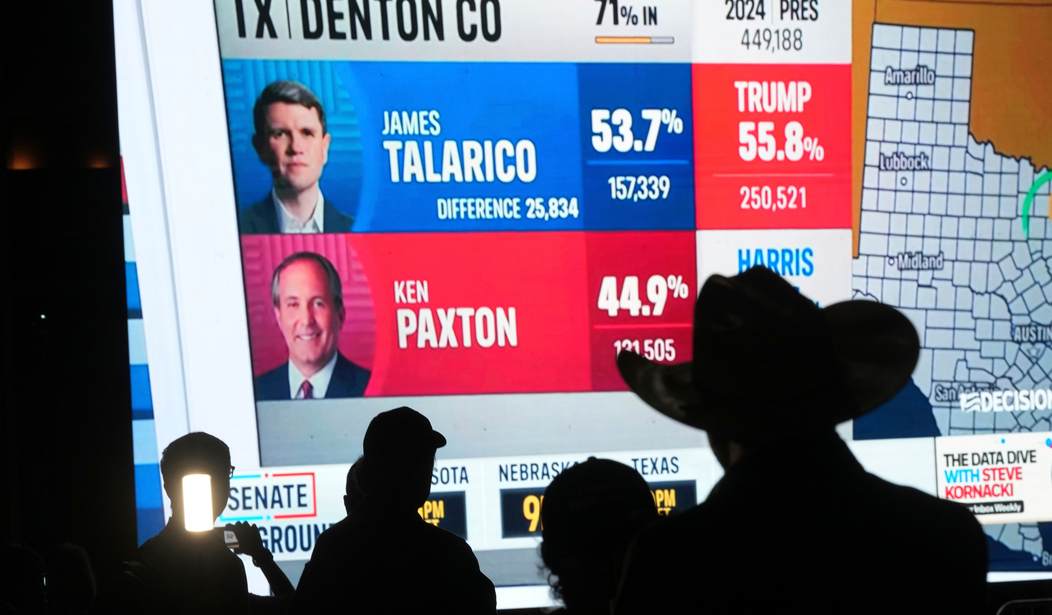
Just how tough a night did Republicans have in the midterms? The toughest incumbent ended up losing her seat on the way to a significant rebuke from voters to Donald Trump and the GOP. Susan Collins, the GOP incumbent who spent the last two decades defying expectations, finally surrendered to the political reality of blue-state consequences:
Democrat Troy Jackson unseated Republican Senator Susan Collins in Maine’s U.S. Senate race on Tuesday, riding a blue wave to defeat a longtime incumbent in what was expected to be among the most competitive races of the midterm elections.
Maine was viewed as one of the Democrats’ top pickup opportunities, as it’s a state that President Donald Trump lost by about 7 percentage points in 2024. The race was seen as competitive, despite the state’s Democratic lean and difficult national environment for the GOP, due to Collins’ bipartisan image and personal popularity that helped propel her to previous victories in the state.
Simply put, Maine reverted to form. As of this morning, Collins trails Jackson by eight points in the voting. Collins won her last election by the same margin. She and the GOP hoped to pull one last rabbit out of a hat in a state that has long since shifted left, but that magic had already dissipated. In that sense, candidate quality didn't matter at all; blue state voters wanted a Democrat. Graham Platner might have won by a similar margin if he'd stayed on the ballot.
That only explains some of the map from last night, however. It does not explain why Texas Republicans lost their first statewide elections in 32 years for both the U.S. Senate, nor does it explain Senate losses in Kansas, Ohio, Iowa, and possibly still in Mississippi, where incumbent Republican Cindy Hyde-Smith trails Democrat challenger Scott Colom by 0.3 points. Nebraska finally came around for Pete Ricketts over independent Dan Osborn. That was a rare bright spot on a bleak night. Republicans did not flip a single Senate seat last night, and may end up losing eight or nine in the end, a mirror image to the GOP "shellacking" of Obama and Democrats in 2014.
Alaska may end up as a bright spot, but it's still far too early to tell. Incumbent Republican Dan Sullivan – the real one – currently has a narrow lead over Democrat Mary Peltola by less than a percentage point and 68% of precincts reporting. Unless Sullivan can get to 50%-plus-one, ranked-choice voting processes will begin. The fake Dan Sullivan fraud was designed for this process, so the outcomes do not look promising. The fake Dan Sullivan only has 3,447 votes so far and 1.7% of the total, which would have been enough to push the real Dan Sullivan over the majority threshold.
The House picture looks pretty grim, too. At the moment, Democrats have already flipped 30 seats, a bit more than some people initially thought would be contestable. Our partners at Decision Desk HQ have made calls in 390 House races, meaning an additional 35 seats have yet to be called. In many of those, the Republican candidates are currently leading the vote totals, so it seems unlikely that Democrats will score a 63-seat flip as Republicans did in 2010. It does look, however, that their wave will reach the 2018 level, when they flipped 41 seats and took back control of that chamber.
The news didn't look much better in gubernatorial races, either. Republicans have lost four seats already, and Democrats lead in the three remaining contests still left to call. That includes Alaska, where RCV may take place as Democrat Jonathan Kreiss-Tomkins is at 49% of the vote, just below the majority threshold. The closest of the three Republicans on the ballot is Bernadette Wilson at 29%. If this does go to RCV, it's possible that the Republican voters will coalesce behind Wilson in subsequent rounds, but ... that's a long shot now.
It may take longer for the dust to settle around legislative contests, but given the dynamics of the vote last night, the news there will likely be grim, too. One bright note: Texas Republicans held their majority in the state senate, thanks to half the seats not being contested in this cycle. Control of the lower chamber is still up for grabs, but it looks as though Democrats may end up with a very narrow majority. Control of the state senate should allow the GOP to keep governor-elect Gina Hinojosa in check the next two years, but it will be a very difficult interregnum for Republicans.
The depth and breadth of this result make it very clear that this was about much more than candidate selection, although that certainly has been an issue for several years. The GOP wanted to make the midterms about Democrats' radicalization while Democrats wanted to make it a referendum on Donald Trump. Democrats very clearly won that argument, and did so resoundingly. Trump may be very popular among his base and may have delivered on many promises, but he remains a catalyzing figure for Democrats, and the combined effect of high gas prices and an unpopular war prompted a massive rebuke to the direction of the last two years. There's no getting around that lesson or that message.
What does that mean? The presidential sweepstakes will begin in a few weeks. Republicans will have to retool significantly if they expect to compete, likely shifting more to a populist approach and pulling back on foreign 'entanglements.' Midterm losses do not have to be the end of the world, as long as parties take the correct lessons and signals from the voters. We'll see whether Republicans can do that.
Editor’s Note: The 2026 Midterms will determine the fate of President Trump’s America First agenda. Republicans must maintain control of both chambers of Congress.
Help HotAir continue to report on the Democrats’ radicalism and inform voters as our nation faces a crossroads. Join HotAir VIP and use promo code FIGHT to receive 60% off your membership.



Join the Conversation
VIP members get the ability to comment on articles.