



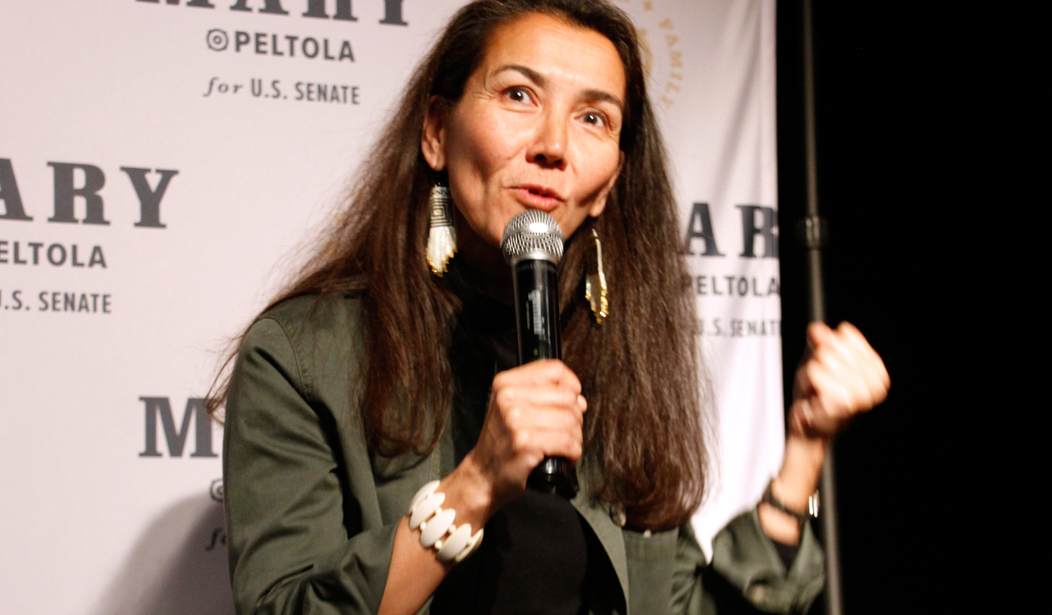
Can a political dirty trick become a crime? Do Democrats even acknowledge the Dans Sullivan as a dirty trick? Stick around to the end on that question, but first, the Wall Street Journal reports that the Department of Justice thinks the answer to the first question is emphatically yes.
The blizzard of subpoenas reported late yesterday by Fox's Bill Melugin came as no accident or PR move. Prosecutors see a clear case of criminal fraud and a conspiracy to deprive Alaska voters of their civil right to an effective vote. The case is apparently being run out of Harmeet Dhillon's division at the DOJ, which should give Mary Peltola and the DSCC plenty of cause for panic:
The Justice Department on Thursday expanded its ongoing criminal investigation into the alleged manipulation of the Alaska Senate race, sending dozens of new grand jury subpoenas, people familiar with the matter said.
The subpoenas seek information about an alleged effort to recruit an independent challenger with the same name as Republican Sen. Dan S. Sullivan, the people said.
A department official said prosecutors are exploring whether to bring charges alleging a conspiracy to violate voters’ rights. Federal prosecutors in Alaska and the Justice Department’s civil rights division are leading the probe.
The probe began in August after the Alaska primary put both Dan Sullivans (Dans Sullivan?) on the general election ballot. They have filed motions to have the non-incumbent Sullivan removed or to have the election results suspended if Peltola wins. Until this week, the federal court has refused to intervene. However, as I wrote this morning, the revelations from the New York Times make a clear case that the Peltola campaign and the DSCC lied to the court in the earlier responses, and that both respondents are deeply involved in this dirty trick.
The falsehoods in earlier filings might open up criminal or civil liabilities for both campaigns and their attorneys. The key question, however, is whether this dirty trick actually violates state or federal law. Will Chamberlain, senior counsel to the Article III Project, argues that it violates 18 USC 241 and that using a fake candidate to deceive voters has always been illegal:
Lots of people are calling the Alaska "fake Dan Sullivan" scheme unethical but legal. They haven't read the case law. Conspiring to trick voters into voting for the wrong candidate is a federal felony under 18 U.S.C. § 241. My full lawsplainer: https://t.co/Z2q6bMUopr
— Will Chamberlain (@willchamberlain) October 30, 2026
The statute has a few required elements, Chamberlain explains. He first produces the text of 18 U.S.C. § 241
If two or more persons conspire to injure, oppress, threaten, or intimidate any person in any State, Territory, Commonwealth, Possession, or District in the free exercise or enjoyment of any right or privilege secured to him by the Constitution or laws of the United States … [t]hey shall be fined under this title or imprisoned not more than ten years, or both.
The first element is a conspiracy. If Dan J. Sullivan had decided on his own to enter the race, even for the purpose of creating confusion to dilute the vote of incumbent Senator Dan S. Sullivan, it would not violate this statute. That is why both the Peltola campaign and the DSCC represented to the court that they had no involvement or knowledge of the phony Sullivan campaign, demanding that the court dismiss the entire matter as a purely political conflict.
The New York Times bombshell has removed that defense. That's why the DOJ acted so quickly to subpoena everyone and force them to testify under oath, as well as to seize whatever digital and paper communications referenced in the NYT report. Prosecutors need to identify a conspiracy.
Next, they must demonstrate an injury relating to the civil rights of any citizen impacted by the scheme. Chamberlain explains his theory for applying 18 USC 241:
The Department of Justice and the federal courts have interpreted injury not to require any physical act or harm. You can be injured by being defrauded or tricked, or by having your right taken from you without any violence at all. Prosecutions for ballot-box stuffing, for example, have survived motions to dismiss. In United States v. Saylor, 322 U.S. 385 (1944), the trial court threw out the indictments of election officials charged with stuffing a ballot box, and the Supreme Court reversed, holding that ballot stuffing injures the constitutional right to have your vote honestly counted.
So the question is this: can you injure someone in their constitutional right to vote by deceiving them about which candidate they are actually voting for, that is, by trying to trick them into voting for the wrong candidate when they intend to vote for someone else? The statute and the case law say yes. ...
The right at issue is best understood as the constitutional right to vote for the candidate of your choice. Trickery, deception, and fraud carried out through the mechanics of voting, including how the ballot itself appears or is printed, are sufficient to allege an injury to that right.
Based on the New York Times' reporting, that was clearly the purpose of this conspiracy: to rig the ballot so there would be two Dan Sullivans on it, and so that voters who wanted to vote for the incumbent Republican senator would be deceived into voting for somebody else.
The precedents for this go back more than a century, Chamberlain explains, and were most recently cited in U.S. v. Mackey, the notorious "meme" case in which Mackey published false claims that Hillary Clinton voters could cast ballots by text. The case against Mackey got dismissed on appeal in 2023 not because no injury occurred, but because prosecutors could not prove a conspiracy:
The United States District Court for the Eastern District of New York (Donnelly, J.) oversaw the trial, where a jury found Mackey guilty. Mackey appealed, arguing that the evidence was insufficient to prove that he knowingly agreed to join the charged conspiracy. The government presented evidence of Mackey's participation in several private Twitter message groups where members discussed strategies to influence the election, including the creation and distribution of misleading memes. However, Mackey was not a member of these groups during the critical period when the conspiracy was allegedly formed and discussed.
The United States Court of Appeals for the Second Circuit reviewed the case. The court found that the government failed to provide sufficient evidence that Mackey knowingly agreed to join the conspiracy. The court noted that while Mackey posted the misleading memes, there was no direct evidence that he viewed or participated in the relevant discussions within the private message groups. The court emphasized that mere association with individuals involved in an unlawful undertaking is not enough to prove knowing involvement in a conspiracy.
The NYT report makes very clear that a number of people actively conspired to recruit people named Dan Sullivan to confuse Alaska voters, and that a wider group of people had specific knowledge of the conspiracy and failed to act to stop it. That includes Peltola herself, not to mention DSCC officials who signed off on the plot and helped support it. One named conspirator in the NYT report, Jerid Kurtz, has suddenly disappeared off of social media, while Dan J. Sullivan has also vanished from sight.
Those are not coincidences. It seems very likely that the DOJ will go to a grand jury just as soon as the subpoenaed figures in the Two Dans Sullivan scandal get interrogated on the record. That may involve not just campaign officials from both Team Peltola and the DSCC, but Peltola herself and the attorneys that apparently lied to the court for the last few weeks.
Will this scandal have teeth in the meantime? DCCC chair Suzan DelBene got chewed up by a CNBC panel for attempting to both-sides the issue. Andrew Ross Sorkin tore into DelBene for refusing to answer the question, instead dodging with gripes about redistricting and gerrymandering, two non-sequiturs to a case of outright deception. If this is the best defense Democrats have in this scandal, they had better prepare for humiliations galore in federal court – at a bare minimum.
Wow, Democrat Campaign Chair Suzan DelBene (D-WA) TORCHED by CNBC hosts over Democrat Mary Peltola election rigging scandal in Alaska 🎥 Andrew Ross Sorkin: “You don't believe the report at all?” “You don't believe, You genuinely don't believe it happened. Do you want to know if it happened? ... As a human, as a citizen, if you're watching this play out and you say to yourself, this is crazy?” For 4+ minutes, DelBene insists she believes Peltola & her campaign had NOTHING to do with placing a fake Dan Sullivan on the ballot after bombshell NYTimes investigation, complete with text message evidence, sparking multiple federal & criminal investigations DelBene goes on a whataboutism tangent: “Well, the campaign has been clear that they deny what happened … Republicans from the very beginning have been set up trying to rig the system” ➡️Joe Kernen: “Chairwoman, it's good you got that, you know, not a lot of DelBenes around so you probably have, Democrats won't be able to find anyone to run against”
— Ben Petersen (@bennpetersen) October 30, 2026
Editor’s Note: Help us continue to report the truth about corrupt politicians.
Join HotAir VIP and use promo code FIGHT to receive 60% off your membership.

Join the Conversation
VIP members get the ability to comment on articles.