
The GOP and Trump administration got an unexpected boost on the state of the economy before the midterms. The big question will be: Did it come too late to matter?
Democrats wanted to make the midterms a referendum on Donald Trump, the economy, and "affordability." Today's GDP report shows the economy revving up to its best performance since the summer of 2025. Real GDP jumped to an annualized 3.4% rate, with inflation already calculated into the estimate. Consumer spending led the charge, as usual:
Real gross domestic product (GDP) increased at an annual rate of 3.4 percent in the third quarter of 2026 (July, August, and September), according to the advance estimate released today by the U.S. Bureau of Economic Analysis (BEA). In the second quarter, real GDP increased 2.2 percent. ...
Compared to the second quarter, the acceleration in real GDP in the third quarter primarily reflected an acceleration in investment and an upturn in government spending that were partly offset by a downturn in exports. Imports increased more in the third quarter than in the second quarter.
Real final sales to private domestic purchasers, the sum of consumer spending and gross private fixed investment, increased 4.9 percent in the third quarter, compared with an increase of 4.6 percent in the second quarter.
The price index for gross domestic purchases increased 3.0 percent in the third quarter, compared with an increase of 5.6 percent in the second quarter. The personal consumption expenditures (PCE) price index increased 2.1 percent, compared with an increase of 5.0 percent, and the PCE price index, excluding food and energy increased 2.5 percent, compared with an increase of 3.3 percent.
Consumer spending may be the best indicator of the mood as we approach Election Day. For the second straight quarter, personal consumption expenditures increased by 3.8% in real (inflation-adjusted) terms. Inflation is still a problem, but the supposed "affordability crisis" has not dimmed consumer appetites. These are the best two quarters over the last two years.
Gross private investment looks even better. This category has shown positive results over the past two years, but it has sharply ramped up in 2026. In the first quarter, GPI increased by 7.2%, then 4.6% in Q2, and it exploded in Q3 to a 19.4% increase, all quarter-on-quarter annualized. Equipment purchases have doubled-digit increases in the last three quarters, with overall nonresidential investment up 12.7% in Q3. Investors clearly see something they like, along with consumers.
The Wall Street Journal did not use the word "unexpected," but they did note that "affordability concerns" do not appear to be troubling Americans as much as politicians thought:
The Commerce Department said Thursday that U.S. gross domestic product—the value of all goods and services produced across the economy—rose at a 3.4% annual rate in the third quarter. That number is adjusted for inflation and seasonality.
It was the fastest pace in a year.
Economists surveyed by The Wall Street Journal had expected GDP growth of 3.1% for the July to September period. The economy grew at a 2.2% pace in the second quarter.
The report is the last major reading on the U.S. economy before midterm elections on Tuesday. The numbers add to evidence that, despite tariffs, an immigration crackdown and high energy prices, the U.S. economy remains on solid footing.
CNBC covered it as a surprise, however, noting that market futures had anticipated something a bit less sunny:
A Labor Department report also released Thursday showed that layoffs remain low. Initial jobless claims edged lower to a seasonally adjusted 194,000 for the week ended Oct. 24, below the estimate for 200,000 and near levels last seen in the late 1960s.
Stock market futures were negative following the releases while Treasury yields also fell.
“Net, net, economic growth is powering ahead despite the uncertainty of geopolitical risks and the damage posed to many sectors of the economy by higher energy costs,” said Chris Rupkey, chief economist at Fwdbonds. “The economy was thought to have been a lost cause during much of the current Administration’s time in office, but real GDP has bounced back above a 3 percent run rate in Q3 2026 for the first time in a year.”
Ahem. Why was the economy thought to be a "lost cause"? Granted, GDP growth has not been spectacular and inflation is a little higher than the 2% target, but inflation was far worse in the previous administration, and this inflation is clearly linked to the Hormuz crisis, not a supply-chain crisis. For the most part, wages have kept close to that pace, and GDP has not gone negative during the past two years. The summer and fall of 2025 produced strong growth – 4.0% and 3.9% in the second and third quarter – and growth has been above 2% in the first and second quarter of this year.
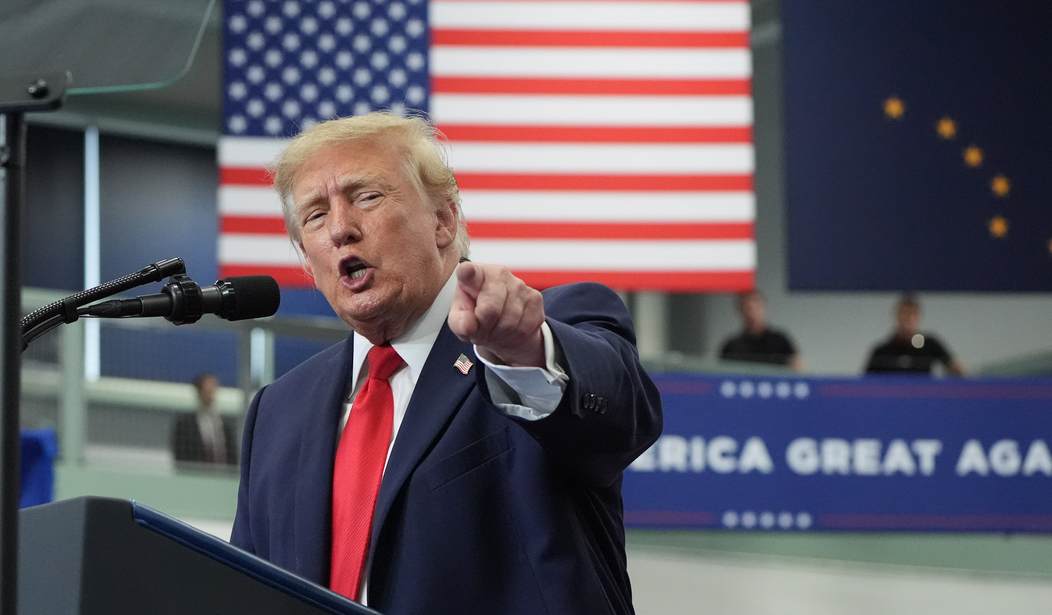
The media invested itself in the "lost cause" narrative, along with hyping up an "affordability crisis" that barely got mentioned in the 2022 midterms when inflation ran at nine percent. That narrative has done some damage this cycle too, although Trump has been adamant about defending his economic record in his full-court midterm rally campaign across the country.
Is this report too little, too late? Maybe. A significant percentage of the electorate has already cast ballots in this election. If those were motivated by the "affordability crisis," the news of solid economic growth is definitely too late to matter. However, Republicans tend to be far more inclined to vote on Election Day anyway, and this may negate the demoralizing impact of the "lost cause economy" narrative on those who have sat on the sidelines. Perhaps that would provide enough of an edge to win a couple of close races that may have otherwise been lost.
Trump remains on the road. Expect this to become the headline topic in the remaining rallies.