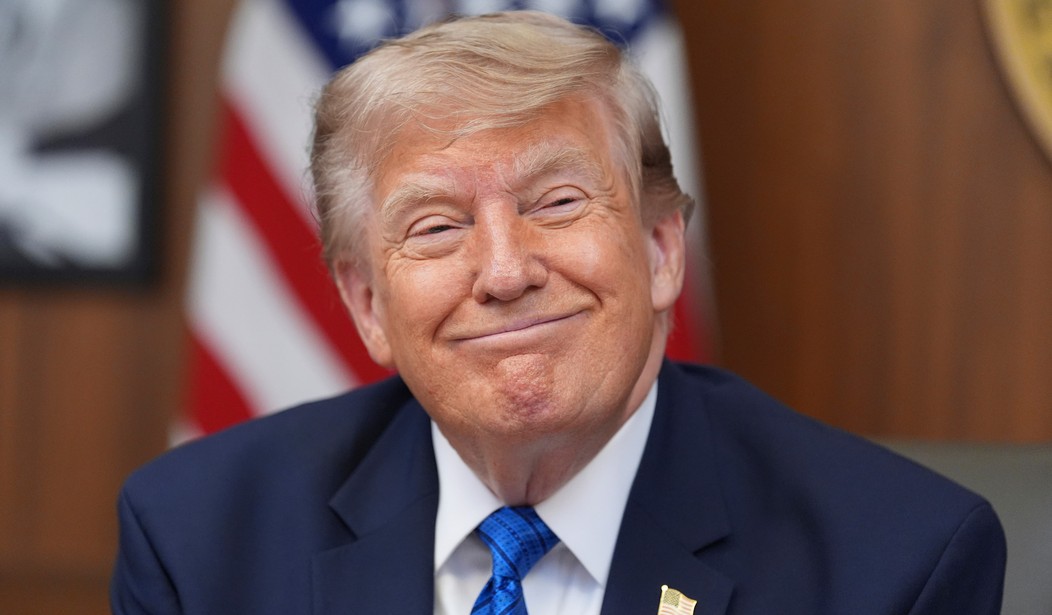
Donald Trump told reporters this week that he would use a "low-key' approach to the conflict with Iran. What does that mean? It didn't mean standing pat, as events this morning proved.
Earlier today, a Panama-flagged container ship decided to test the definition of "low-key" by attempting to run the US Navy's blockade on Iran. Big mistake. American forces quickly disabled the ship, forcing its crew to transfer vessels, and sending a message about the real meaning of "low-key":
U.S. forces fired on a Panama-flagged ship that attempted to run the American blockade of Iranian ports early Tuesday, a U.S. official said, stepping up enforcement as the Trump administration attempts to squeeze the regime economically.
A U.S. military helicopter fired at the rudder of the ship after its crew ignored warnings from American personnel working to enforce the naval blockade of Iran’s ports, the official said.
There were no immediate reports of any casualties in the incident, which took place before dawn on Tuesday. The U.S. official said the ship appeared to be attempting to transfer its crew to another civilian vessel after the attack.
Earlier Tuesday, maritime security firm Vanguard reported that a Panama-flagged containership called Vela Nova was struck by a missile fired from a helicopter while transiting westbound through the Gulf of Oman about 71 nautical miles from the coast of Pakistan.
Iran has ramped up its demands over the last 48 hours for ending the Hormuz crisis. On Saturday, the IRGC demanded not only that the US Navy withdraw from the region but also that the US pay reparations for the war and sign a commitment to non-aggression. These are the same demands the Iranian regime has made since March, and they're just as likely to succeed now.
Yesterday, the Nepo Babytollah reportedly reshuffled regime leadership to give 'hardliners' more power, in what was seen as another response to diplomatic efforts to end the war:
In a sweeping overhaul of the government’s top echelon on Sunday and Monday, Iran named seasoned hard-liners to run the country’s security policies and institutions of repression.
It marked the most significant government reshuffle under Mojtaba Khamenei, who hasn’t been seen in public since the war began. U.S. intelligence agencies say he is alive but severely injured, and top Iranian cabinet members say they have never met him since he took office. Iranian officials say he was injured but in good health.
Analysts said the appointments signaled Khamenei’s determination to hold fast in a showdown with President Trump, who is seeking concessions on Iran’s nuclear program and the Strait of Hormuz.
“The regime is preparing for a more confrontational posture at home and abroad,” said Kasra Aarabi, an expert on the Islamic Revolutionary Guard Corps, a powerful paramilitary force, at United Against Nuclear Iran, a policy organization that opposes Iran’s government.
Is the Cardboardatollah really in charge? The regime published a dodgy photo of Mojtaba meeting with the IRGC yesterday as a way to offer proof of life, but it hardly looks convincing. For one thing, the regime had claimed that Khamenei fils had suffered major maiming wounds in the February 28 attack on his father's palace, but the image published showed no signs of any injuries. It looked like an AI concoction meant to cover up the IRGC's usurpation of 'divine' religious authority while attempting to push back against any coup attempts from civilian factions within the regime. The only part missing was Ahmad Vahidi's arm up Mojtaba's backside.
Either way, though, Trump appears uninterested in the machinations. It didn't even rate a mention on Trump's Truth Social account, although Trump has certainly been active on it for the last 24 hours. Iran can be as confrontational as they want, it seems; the US Navy will continue its blockade and just wait out the regime. That may be a winning strategy, and a low-cost as well as "low-key" approach. US forces are assisting traffic through international waters while maintaining the blockade, but without the larger-scale, punitive 'kinetic actions' that Trump has threatened and which haven't done much to force the IRGC to concede.
This approach requires strategic patience rather than a desire for a death blow or a bad deal, as I wrote yesterday:
What changes if the US refuses Iran's demands? Nothing. Iran will still harass shipping, but the US will also keep the blockade in place and use Iran's frozen assets to compensate shippers. Hezbollah will continue suffering destruction from the IDF in Lebanon. The Israelis will still pursue the remaining 2,000 or so Gazans who participated in October 7 and fulfill Netanyahu's pledge to kill every last one of them. The IRGC will not be able to ship its oil, and therefore will not be able to pay its troops or the Basij, and eventually those operations will grind to a halt. Feed a cold, starve Vahidi.
It's slow and unsatisfying, and it requires a lot of patience, but it may be the smartest choice. That's especially true when our allies in the region demonstrate less than optimal gastric fortitude in dealing with the IRGC.
To extend the poker analogy: Iran is bluffing, and Trump is apparently about to call rather than raise.
The temptations for both remain. In fact, Pakistan has apparently decided to offer another banana in the tailpipe in an effort to end the crisis:
Pakistan's Defense Minister Khawaja Asif told Bloomberg news in Islamabad on Tuesday that the U.S. and Iran are close to "some sort of an arrangement."
"Things are shaping up again in favor of a peace arrangement or a deal," he said. "The signals in the last two three days are that we are close to some sort of an arrangement."
Er ... suuuuuuure, pal. Pakistan has acted as guarantor several times to Iranian "deals," only to act shocked when the IRGC reneges. Trump doesn't need the Pakistanis to negotiate deals with terrorists who will never abide by them. Trump doesn't really need to do anything but enforce the blockade and wait for the IRGC to suffer the consequences of a financial disaster and the internal contradictions of authoritarian regimes that can no longer pay its bills. Can Trump resist the temptation of a bad deal long enough to allow strategic patience to pay off?
Editor's Note: For decades, former presidents have been all talk and no action. Now, Donald Trump is eliminating the threat from Iran once and for all.
Help us report the truth about the Trump administration's decisive actions to keep Americans safe and bring peace to the world. Join HotAir VIP and use promo code FIGHT to get 60% off your VIP membership.







Join the conversation as a VIP Member