





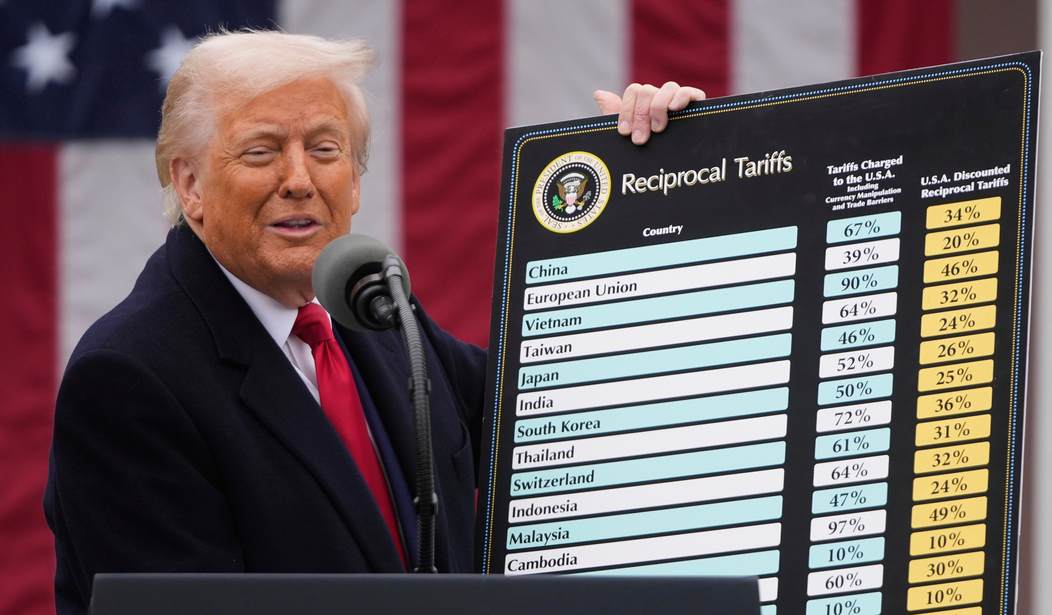
I have always had mixed feelings about Trump's tariff agenda, and here's why.
On economic grounds, tariffs are a terrible idea, but Trump had a point about many of the trade deals in place, which were often built around bribing allies into supporting us politically (or sometimes helping countries that struggle economically). Trump's agenda to renegotiate trade deals had some merit.
Exit polling on tariffs. The GOP has opposed global tariffs since WW2 and for good reason. It’s bad economics and bad politics. Article One gave tariff power to Congress and we must reclaim it. I got this from Erick Erickson. @EWErickson https://t.co/FJLfh6Rgbo
— Rep. Don Bacon 🇺🇸✈️🏍️⭐️🎖️ (@RepDonBacon) November 5, 2026
But achieving that goal required using tariffs as a club to force new trade deals, and often the tariffs went up, but the deals were not negotiated quickly or completed, so the tariffs stayed in place and drove up prices. Instead of more balanced trade deals, we ended up with higher prices and less long-term benefit than hoped, or the long-term benefits are still too early to materialize.
One silver lining from election night? Free trade was the biggest winner. Voters hated tariff policies, especially in the South and in rural America. https://t.co/AULQyyZ899
— Stephen Moore (@StephenMoore) November 4, 2026
I don't share the view that tariffs were the decisive factor in Tuesday's blowout election, but I definitely think they played a role. And there is a lot of data to back that up. You can plot Trump's decline in popularity with relative precision, and the drop started right around "Liberation Day."
Republicans got blown out because of the tariffs. People will make a million other excuses, but it was, in fact, the tariffs. https://t.co/3kCsdTuBsB
— Ryan Saavedra (@RyanSaavedra) November 4, 2026
Some of that is coincidence, but some of it isn't. Republicans have a lot of support from farmers and small businesspeople, and while most people only have a vague sense of the relationship between tariffs and prices, many Republicans actually do. Until recently, the Republicans were the party of free trade and Democrats the party of industrial policy, but on that issue, at least during Trump's term, when opposing all things Trump is the default Democrat position, the roles have reversed.
This is not a counterargument b/c there is no counterargument. Tariffs were widely unpopular, led to a significant erosion of support, & constrained pocketbooks. The Iran War compounded the tariff-related issues by imposing new costs.
— Legal Phil (@Legal_Fil) November 5, 2026
Free traders are wrong to point at tariffs and say the war didn't cause the blowout, because the war was almost certainly the driving force behind many of the voters' concerns. Many of the people who oppose the war now would have been absolutely fine with it if it had been short and victorious, of course, but success has many fathers and failure has none. And while America is far from defeated in the Gulf, the war has certainly not gone as planned or promised, and people feel the pain at the pump; the price of diesel has made life very difficult for farmers and the transportation sector.
Wow. From Raymond James. Trump approval mapped onto average gas prices. https://t.co/dcSgGg8NL6
— Mollie (@MZHemingway) November 3, 2026
I firmly believe that if Trump's tariff policies had worked as promised, they would have benefited the economy and not been an issue in the election. But in many cases, we got retaliatory tariffs, and the optics were bad. A lot of Republicans don't care that every industrialized country was blasting us, but many Republicans and Independents do, and tariffs and the raw hatred emanating from Canada and Europe made them sour.
One of the most common mistakes people make after a stinging loss is to "turtle up," or retreat into a shell and just think, "How can people be so stupid?" A better strategy is to ask, "Why did people do this thing that is so obviously stupid?" and try to address those reasons.
People are what they are, and if we want to win elections, we need to understand what motivates them. Calling people stupid is a sure way to keep losing elections.
Ted Cruz: Food is too high. Gas is too high. Diesel is too high. Insurance is too high. Life is too high. Tariffs have made everything too expensive. https://t.co/dhB2iwrZkE
— Clash Report (@clashreport) November 5, 2026
If you look at the results of ballot measures, conservative policies won (outside the maddening issue of abortion, which is now a sacrament to many people), so it's not that the country veered toward socialism, at least ideologically.
So the question is, "If Americans don't like socialism, why did they vote for socialists?" And finding the answer is the most important thing today.
Most voters blame Trump for high prices, want Congress to check prez: exit poll https://t.co/RRf8TOYIcM https://t.co/yMeMUQxEP2
— New York Post (@nypost) November 3, 2026
The two most obvious answers have to do with policies that reduced affordability: tariffs and how the war has turned out. And by that I mean energy prices. No amount of pointing at statistics about economic growth can change people's minds because, to them, the economy feels bad. They're reminded every time they go to the pump.
I don’t think anyone reasonably objective is trying to defend the war per se. Obviously it was a huge contributor to affordability (an extra dollar per gallon of gas, plus diesel), and people felt like another Middle East war was a campaign promise broken.
I guess the question I have is why you can’t see the same thing on the tariffs.
It’s both. The Iran war killed us on fuel. The tariffs killed us on commodities and consumer goods. They are the parents, together, of the unaffordability child.
And the exit polling is unambiguous on tariffs. Two thirds of voters say tariffs have made both the country and their local community less affordable. That’s the clearest policy opinion in the exit polling.
Democrats won mostly because of the affordability issue, which is why they ran on it in the first place. Whether they actually meant it is irrelevant in electoral terms.
Everybody has a pet theory regarding why Republicans got shellacked, and I get that. And it's obvious that it was not one single factor, but a combination.
I think tariffs were a big one.
Editor’s Note: The American people overwhelmingly support President Trump’s law and order agenda.
Help us fight back against the Democrats and Soros-backed DAs that refuse to enforce our laws to hold criminals accountable. Join HotAir VIP and use promo code FIGHT to receive 60% off your membership.
Join the Conversation
VIP members get the ability to comment on articles.