








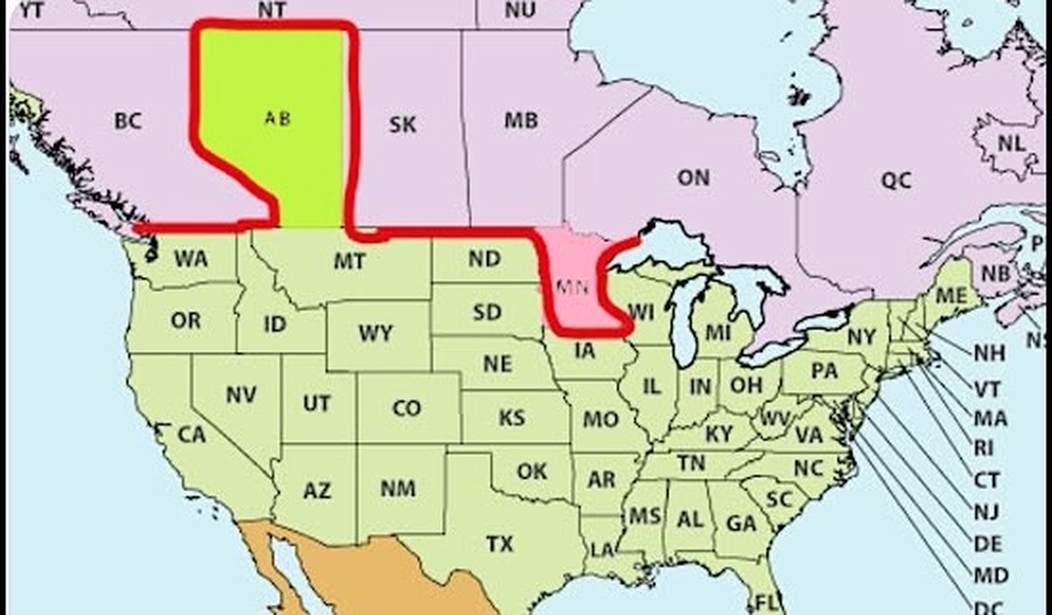

I grew up near Canada — or, as the kids say today, "Canada-adjacent". Literally, next door — my home state, North Dakota, which some Americans (I'm looking at you, New York) think actually is part of Canada (or a city in Minnesota).
And I always liked the Canadians. They were everywhere — so much so that we took Canadian currency pretty much at face value, a Loonie for a Washington (which may explain why they were everywhere which, given the fact that Canadian currency was relatively weak against the dollar back then, probably explained why we had so many of them shopping around town. And in the years before NPR built an outpost on the northern plains, my very Democrat parents listened to a lot of the Canadian Broadcasting Corporation (the CBC, Canada's state-owned broadcaster.
And they provided some useful life lessons, too. The wealthiest guy in my hometown had been a urologist in Winnipeg who'd emigrated when Canadian healthcare was nationalized. His clinic had a constant stream (as it were) of Canadian licence plates from Canadians who wanted to get treatment while they were still young enough to enjoy it. He was the father of a high school classmate, and he was happy to try to teach us — including the 16 year old, very Democrat-leaning Mitch — about the stupidity and misery of socialism.
Now, these were almost entirely folks from Manitoba, Saskatchewan and Alberta — people who were a lot like the rest of us out on the Plains. And when I'd strike up conversations I'd heard about Canadian news and politics that I'd heard on the CBC, they'd wave it off. "That's Ottawa". A whole different Canada.
Turns out Canada has a "red/blue" divide that might be every bit as fractious as our own.
Which may — maybe — culminate soon in a move in Alberta to secede from the union and join the United States.
What on earth was Danielle Smith thinking?
The premier of oil-rich Alberta, Smith has long delighted in ticking off her enemies in Canada’s faraway capital of Ottawa. She’s a conservative populist known for slamming clean energy policies and an influx of immigrants, appearing alongside MAGA figures and declaring “an end to the era of wokeism.”
But this time, perhaps, she had gone too far. In May, Smith had announced a referendum would be held later this year on whether the province should actually seek to leave Canada.
Perhaps the strangest part: Smith doesn’t even support splitting.
Separatist sentiment has long existed in Alberta amid resentment toward the federal government and its more liberal policies, although always as a fringe idea. Sure, the notion of breaking off from Canada had periodically surfaced whenever tension with Ottawa soared, but it had never been taken seriously by a sitting premier. Now, that’s changed.
Whatever Premiere Smith's motives and sentiments, the question is going to Alberta voters:
The Canadian province of Alberta will decide in a little over two months whether it will stay in the Commonwealth or begin the process of seceding...Some residents believe that Ottawa has a disproportionate say on internal matters in the province, and believe that the federal government's eco-friendly legislation has blunted progress for its oil and natural gas industry..
And the vote will be on whether to start the process to hold … another vote on the subject:
Alberta votes on pursuing separation from Canada. This isn’t an immediate secession move—if approved, it triggers a larger, future referendum. Here’s what it means, in plain terms: what changes, what doesn’t, and what comes next. Stay informed. https://t.co/LusUEwUjX2 pic.twitter.com/YrtA5n8Hwi
— Drew Grimaldi (@Grimillionaire) August 9, 2026
The vote is set to take place on October 19. Alberta Premier Danielle Smith, who has stated she supports a unified Canada, announced the vote on May 21.
According to the Alberta referendum website, the question on the ballot will be: "Should Alberta remain a province of Canada or should the Government of Alberta commence the legal process required under the Canadian Constitution to hold a binding provincial referendum on whether or not Alberta should separate from Canada?"
So it's too early to start working on a 51 star flag. Some put the odds at secession as "long".
Others, however, are making plans:
Keith Wilson, one of the co-leaders of the third-party advertiser Let Alberta Decide, also launched the Alberta Transition Council. The group describes itself as focused on “building the institutional, fiscal, and legal foundations to deliver a functioning sovereign state.”
“The primary focus of the paper is to detail what the transitional steps will look like for Alberta, if Alberta votes to become independent and moves from being a province to a country, to maintain continuity of service and normalcy of life for people and businesses,” Wilson told CBC News.
And some of the rhetoric resonates for those of us who'd studied the Declaration of Independence:
Alberta votes on pursuing separation from Canada. This isn’t an immediate secession move—if approved, it triggers a larger, future referendum. Here’s what it means, in plain terms: what changes, what doesn’t, and what comes next. Stay informed. https://t.co/LusUEwUjX2 pic.twitter.com/YrtA5n8Hwi
— Drew Grimaldi (@Grimillionaire) August 9, 2026
It'll be an interesting warmup for watching midterms in the US.