I missed this on Monday but the NY Times published a lengthy story about the Prairieland case, which offers a somewhat friendly defense of the activists who were convicted earlier this year.
We've covered this case a few times but if you missed it, a group of people in black bloc showed up at an ICE detention center in Texas on July 4, 2025. They started vandalizing cars and shooting off fireworks. The center called police and one officer arrived. As he was trying to make an arrest, he was shot in the neck by the group's leader Benjamin Song.
Most of the group were rounded up quickly but Song escaped and was hidden and transported by other members who hadn't attended the attack itself. Eventually 17 people were arrested. At trial, those facing the most serious charges claimed they had agreed to attend a "noise demonstration" and that Benjamin Song had escalated to gunfire without their knowledge. The jury didn't buy it and convicted them all.
In any case, Janet Reitman offers a very detailed account of who these people are and how they all knew each other. The connection was basically focused on far-left politics and guns.
At its heart is a charismatic leftist, Benjamin Song, who gained influence over a group of committed but inexperienced activists and channeled their idealism — and their fear. “These weren’t revolutionaries,” said Corey Lyon, a 37-year-old photojournalist and former activist who knew the group. “But the road to radicalization is a lot slipperier than people think.”
One of the people in the group, who wound up being convicted and sentenced to 50 years in prison was Zachary Evetts.
Evetts, who grew up in a upper-middle-class suburb of Fort Worth, had volunteered for Bernie Sanders’s 2016 presidential campaign and held left-wing political views he rarely discussed outside a small circle of friends. Since Jan. 6, there’d been a surge in hate crimes against nonwhite, gay and trans people in Texas, and Evetts became concerned “it could be like Hitler,” he later told the psychologist...
Evetts also joined the Dallas-Fort Worth chapter of the Socialist Rifle Association, a small but growing national gun rights group that declared itself an alternative to the “toxic, right-wing, exclusionary firearms culture” of organizations like the N.R.A....
One of the Dallas chapter’s most prominent members was Ben Song, who went by the alias Bubble. The hard-core activists all used pseudonyms to protect themselves against snitches or spies or others who sought to harm the left. In Song’s case, almost no one involved in progressive organizing knew his real name, though he was one of the most ubiquitous activists in the city. He appeared on the scene in 2020, pushing himself to the front of the Black Lives Matter protests, and had since been everywhere: volunteering at homeless camps and marching for reproductive rights, for Palestinian rights, to defund the police.
Song and Evetts also spent time together learning martial arts at a dojo owned by Song's mother.
Evetts was a regular at the dojo, where in time he’d meet many of the activists that formed the core of what Song would later call his “affinity group.” There was Meagan Morris, a leader of the local S.R.A. chapter who had a four-bedroom home known affectionately as the Big Gay House, as most of the tenants were trans or nonbinary. There was Morris’s housemate Autumn Hill, an ethereal 30-year-old who moved into the Big Gay House with her wife, Lydia. Song’s longtime girlfriend, Joy Gibson, a redheaded vegan known as Rowan, was also a regular at the dojo, as was Lynette Sharp, a 57-year-old married mother of grown children who had been protesting since 2020 and wanted to learn how to protect herself.
Among this group, Song was considered a leader because he'd been in the Marines for a while and because he'd been part of protests in Hong Kong which were shut down by the police.
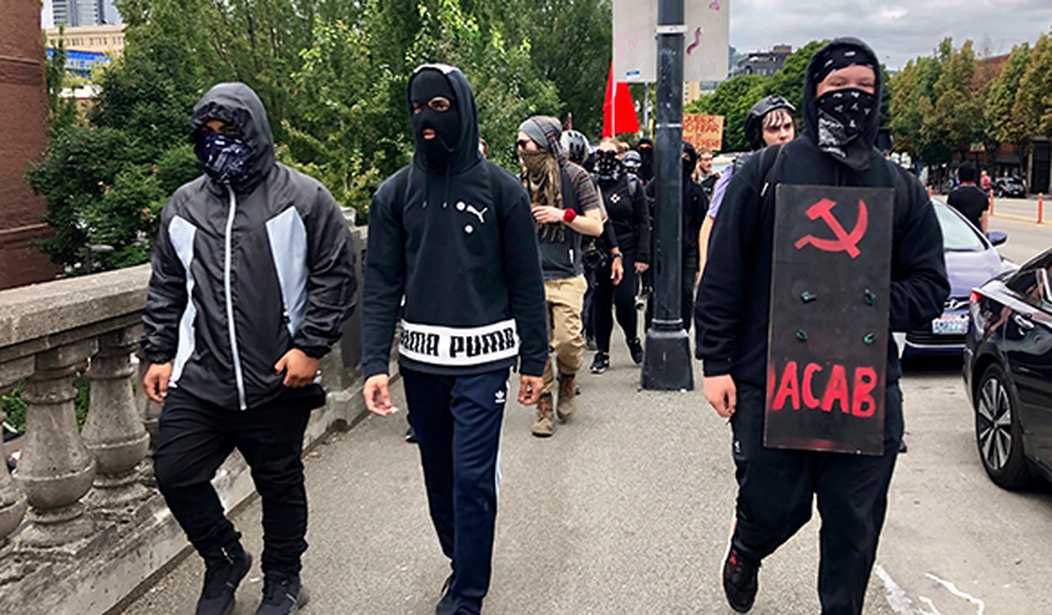
And here's where we get to the Antifa designation. They were doing their left-wing activism in Black Bloc.
Like everyone else in the scene, Evetts adopted an alias — John White — and embraced black bloc, dressing in black clothing and covering his face with a mask to avoid being doxxed by right-wingers.
Here I just have to interject that the author is letting a bit of her ignorance or partisan feelings show. Black Bloc is not intended to merely protect people from "right-wingers." It's intended to protect them from being identified by the police (who they generally consider fascists). By covering their faces and all wearing the same black outfits, it becomes difficult for police to level charges against any individual. It's camouflage to protect illegal activity.
There's no doubt that Song was an influencer within this group and his views and behavior were pretty extreme.
In Dallas, Song began recruiting people, including Evetts, to join a hard-line spinoff of the S.R.A. called the Elm Fork John Brown Gun Club, named for the 19th-century militant abolitionist. Unlike the S.R.A., whose bylaws prohibited brandishing weapons in public, John Brown members were known for showing up in military gear with long guns at protests, drag shows and L.G.B.T.Q. events around Dallas-Fort Worth...
He was even accused of pointing a gun at cops in Austin but somehow got away with it.
In August 2020, he was arrested during a Black Lives Matter protest in downtown Austin, after a large group of protesters blocked an intersection and refused to comply with police orders to clear the road. Song had a military-style rifle slung across his chest and was carrying a .45 semiautomatic pistol and two loaded magazines. According to court records acquired by local media outlets, a police officer on a bike tried to grab him, causing Song to trip over the bike. Song stood up, raised his rifle into a firing position and pointed the gun at two uniformed officers as he backed away into the crowd.
Song was arrested and charged with two counts of aggravated assault with a deadly weapon of a police officer — a standard charge in Texas for threatening a cop with a gun, according to local prosecutors. He spent two weeks in jail before being released on $10,000 bond and was never indicted by a grand jury, which found the evidence insufficient.
When the John Brown Gun Club got in trouble for fighting with police at a protest, it shut down and Song returned to the Socialist Rifle Association. That group had also fallen apart and now Song was left in charge of a bunch of inexperienced far-left extremists.
All of them were active in leftist Signal chats, where there was frequent talk of revolution. Many were also part of the Emma Goldman Book Club, a leftist reading group run by a local mechanic, Ines Soto, and his wife, Elizabeth, both well-known figures in the Latino activist community. Named after the early-20th-century anarchist-feminist writer and activist, the group met monthly to read aloud works by Karl Marx, Pyotor Kropotkin and, of course, Goldman herself.
All of these people seem straight out of central casting. Song continued his rifle training and formed what one left-winger called "a LARP militia." During one of their regular meetings, someone suggested they take action at the Prairieland ICE detention center.
Song showed the group at Morris’s house photos he’d downloaded of the building, which didn’t seem to have many security cameras. There was a guard shack that he said was never manned.
“This is going to be as easy as it gets,” he said.
“Easy for what?” Kent asked.
“We can take the place and free the people inside,” Song responded, calmly.
According to the story, the rest of the group convinced him this wasn't a good idea and they agreed instead on a noise protest. However, Song (allegedly) convinced them to bring their guns. Most of them did when the attack happened the following night, but most of the guns were in cars some distance away. Song had his rifle and used it to shoot Lt. Thomas Gross before shouting "Get to the guns!" to his comrades.
Seven individuals connected to the case would eventually plead guilty to material support for terrorism in exchange for having all other charges dropped. The rest went to trial in Fort Worth, not a great place to be on trial for attacking police. They were all convicted.
The sentences issued by the judge overseeing this case were really long.
Benjamin Hanil Song, who was convicted of the attempted murder of a law enforcement officer, was sentenced to 100 years in prison. Together, the Prairieland terrorists received a combined sentence of 450 years in prison:
- Maricela Rueda was sentenced to 70 years in prison;
- Cameron Arnold was sentenced to 50 years in prison;
- Savanna Batten was sentenced to 50 years in prison;
- Zachary Evetts was sentenced to 50 years in prison;
- Bradford Morris was sentenced to 50 years in prison;
- Elizabeth Soto was sentenced to 50 years in prison; and
- Daniel Rolando Sanchez-Estrada was sentenced to 30 years in prison.
I think critics have a point that these sentences are much longer than sentences for convicted supporters of international terrorist groups. You could cut these sentences in half and they would still be quite long.
That said, the usual bunk about this not being a real group (Antifa doesn't exist!) is tiresome. These people may not have called themselves Antifa but they clearly behaved like Antifa and practiced operational security to protect their conversations, using encrypted chats with auto delete and always using pseudonyms.
They were all left-wing extremists interested in revolution and "direct action" against "fascism." So the idea that these people aren't, effectively, part of a heavily armed left-wing cell is nonsense. If you saw the same behavior from a group on the far-right, no one would believe they were just regular people. They'd be seen as armed extremists with dangerous fringe views who'd joined a militia. And that's exactly who these people are. Everyone who joins a militia is a regular person if you look closely and sympathetically enough.
Finally, it's hard to believe that after six months of investigating this case and interviewing people involved, the author never could figure out who did the vandalism that night.
Then Baumann, who brought cans of spray paint, peeled off toward the employee parking lot where he started defacing vehicles and a guard shack with graffiti: “Bigot.” “ICE Pig.” “Traitor.” “Tyrant.” The tires on a van were slashed. A security camera was knocked over. Who was responsible for this was unclear: At first, Baumann said Sikes vandalized everything. Later, he admitted that he did the graffiti and identified Evetts as the other vandal. But everyone was wearing black and had their faces covered, and he didn’t know any of these people. Two other activists, known only by their aliases, Rose and Eagle, were also at Prairieland, and never caught.
Again, this is the point of Black Bloc, to make it impossible to identify individuals. Everyone involved is either lying to Janet Reitman to protect their comrades or she's lying to her readers to protect them. That makes me suspicious about what she promised these people. One thing I'm pretty sure of is that all of the people who were there that night (and many who were not) know who did what. The fact that they still can't tell the truth at this late date is really something.
Editor’s Note: The American people overwhelmingly support President Trump’s law and order agenda.
Help us fight back against the Democrats and Soros-backed DAs that refuse to enforce our laws to hold criminals accountable. Join HotAir VIP and use promo code FIGHT to receive 60% off your membership.









Join the conversation as a VIP Member