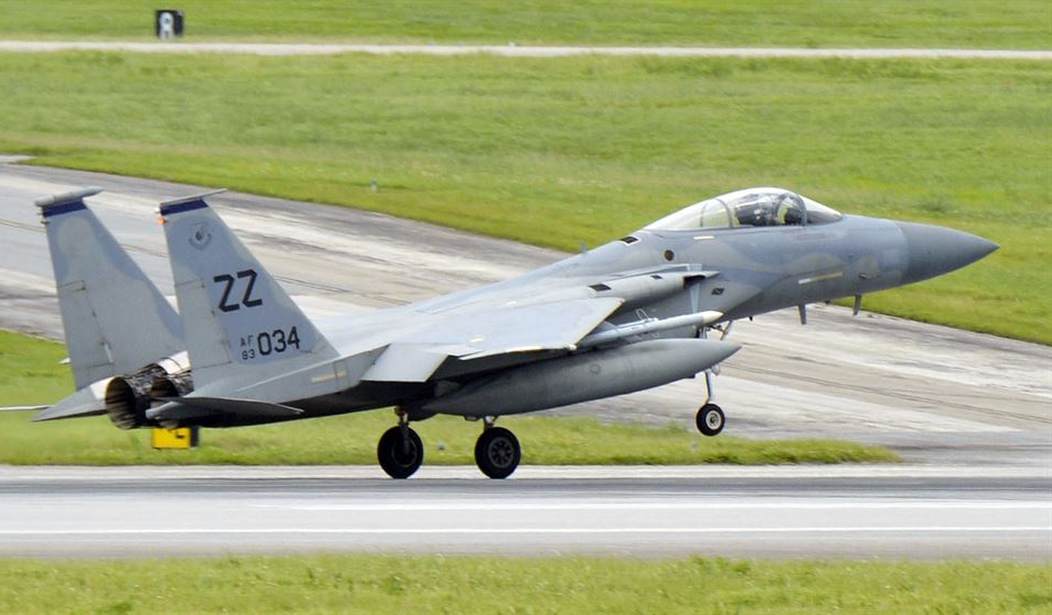
Last night 60 Minutes interviewed one of the two F-15 pilots who were shot down over Iran back in April. The weapon specialist's name wasn't given but he was referred to during the interview as 44 Bravo, his call sign for that mission.
Frequently, American media acts as a filter which removes information about people's religious beliefs from stories. But that's not what happened in this case. On the contrary, 44 Bravo presented his story of being shot down and rescued as "evidence of real life miracles."
Getting shot down and surviving seems incredible enough but in Bravo's case he had a moment of genuine terror as his seat was free falling after he ejected because his parachute had been damaged and failed to open.
Bravo’s plane was shot down by an Iranian with a shoulder-fired missile on April 3, and crashed in the Kohgiluyeh and Boyer-Ahmad province in the southwestern part of Iran near Iraq.
The impact of the missile was like “getting hit by a freight train,” Bravo said.
His crewmate and pilot, callsign Alpha, ejected them both from the $30 million jet, but Bravo’s parachute failed to inflate, he said.
“My parachute was damaged in the initial attack. At one point, when I looked up and saw no parachute, that was the most terrifying thing I’ve ever seen,” the heroic officer told O’Donnell.
As you'll see in the extended interview below, what he actually prayed was "Lord your will be done but if I'm getting through this I need help."
Apparently the chute never did open, at least not properly, because of damage it sustained when the aircraft was hit. Bravo impacted the ground at between 70 and 100 miles per hour. He broke his back, his shoulder and one arm. He had a sprained ankle as well. Despite all of that, he began moving away from the impact site and decided to climb a nearby ridge of mountains to avoid being captured. He called it a "modern day miracle."
Bravo: I'm grateful, eternally, for knowing he was there with me.
O'Donnell: Because you don't see any other explanation for how you survived.
Bravo: I don't think there can be. And I think the facts around my survival, the facts proven out by my medical records. The facts proven out by the equipment that was still there. I think they all determine that that is true.
He never talks about how much pain he was in but does say he thinks Norah O'Donnell would be surprised at the climb he was able to make despite the broken bones. He says he relied on his SERE training (Search, Evade, Resistance, Escape) which he'd been given 20 years earlier. He kept thinking he would not be a victim of the circumstances but would keep working the problems in front of him. "Never let a lack of motivation put you on Iranian TV," he said he was thinking.
Only when he'd secured himself high upon a ridgeline did he start using his radio to contact help. From his vantage near the top of a ridge, he was able to watch as search and rescue teams came and picked up his pilot, 44 Alpha, who was a few miles away. He describes an overwhelming sense of pride at seeing them carry out that mission, but they weren't able to get to him and had to withdraw. He spent a night on the mountain alone in cold temperatures and high winds.
But 24 hours later a massive mission led by the CIA was carried out to rescue him. They used some top secret technology to locate him which 60 Minutes doesn't dwell on but previous reports have called the tech "Ghost Murmur."
The CIA used a futuristic new tool called “Ghost Murmur” to find and rescue the second American airman who was shot down in southern Iran, The Post has learned.
The secret technology uses long-range quantum magnetometry to find the electromagnetic signal of a human heartbeat and pairs the data with artificial intelligence software to isolate the signature from background noise, two sources close to the breakthrough said.
It was the tool’s first use in the field by the spy agency — and was alluded to Monday afternoon by President Trump and CIA Director John Ratcliffe at a White House briefing.
“It’s like hearing a voice in a stadium, except the stadium is a thousand square miles of desert,” a source briefed on the program told The Post. “In the right conditions, if your heart is beating, we will find you.”
Anyway, there's more to the story and it's pretty incredible. What comes through is not just Bravo's faith but also his incredible gratitude for the people who spent their careers becoming experts in carrying out search and rescue missions like the one that found him and returned him home. He's still dealing with some of the physical problems from the impact but says he continues to recover and hopes he can resume his service in whatever capacity is possible.
Here's the full interview. It's nearly 30 minutes long but is worth seeing if you have the time.






Join the conversation as a VIP Member