



With a week to go until Election Day, 2026, or as we in California like to call it, only the beginning, the data and analyses flying around are so prevalent that you can fill up your timeline with all the reasons Republicans should despair, or you can find enough evidence suggesting none of the polling is going to be right based upon who is and who isn't voting thus far.
The latest average of generic Congressional polling at Real Clear Politics shows a D+8.1 environment, which if it bears out a week from today, it's going to be a very long night for the good guys. Harry Enten at CNN isn't sure he's buying it. Why? They consistently miss by overestimating Democratic turnout and underestimating Republican turnout. How many times have they come up short? Try 15 out of 16 times since 1994.
So what goes into that miss? Let's start by the age group breakdown that makes up most of these polls.
- 18–29: 14 percent
- 30–49: 27 percent
- 50–64: 24 percent
- 65+: 36 percent
Some polls have 18-29's up to 18 percent, others down to 10, but virtually all of them are in this range. At the other end of the spectrum, all these generic Congressional polls have seniors between 30 and 38 percent of the sample.
Of all the early voting data that has been released by age group, combined with services like L2 Data to 'AI' their way into age groups by analyzing states' voter files, what's shaping up is a significantly different electorate.
Age group | Share |
|---|---|
65+ | 65.9 percent |
50–64 | 18.7 percent |
40–49 | 6.3 percent |
30–39 | 4.9 percent |
18–29 | 4.1 percent |
Why does this matter? 18-29's nationally lean D+31, 30-39's lean D+12, 40-49's are about even, maybe a point to the Democrats with the inversion to Republican lean around 45-years-old. 50-64's are around R+3, and 65+ begins at R+4 and gets redder the older they are.
If the 18-29's are roughly a third of what's being modeled in all the polling, meaning two-thirds of what they expect to be saturated Democratic votes do not materialize, coupled with double the Republican-heavy voters at the other end of life, it's not hard to see why polls consistently miss in one direction.
Now could the youth vote all turn out on Election Day and make up that percentage margin? Sure. Is it likely? Not really. And it's not me saying it.
The Fall 2026 Harvard Youth Poll found only 33 percent of 18–29-year-olds say they will “definitely vote,” down from 40 percent ahead of both the 2018 and 2022 midterms. Youth registration is only modestly higher overall than 2022, with some subgroups (especially the newest 18–19-year-olds) lagging.
That age group historically has a lower propensity to vote, and this cycle does not indicate any variance to that norm. As for the seniors, not only do they have a strong propensity to vote, they already are. Why? They do not like what the socialist Democrats are selling with regards to healthcare.
In Michigan especially, there is polling from AARP, not exactly Republican-friendly, showing that Michiganders 50 and older are highly motivated to vote this cycle, with 86 percent saying they absolutely will vote, and by a 9-point margin support Mike Rogers, because healthcare and entitlements are their most important issue.
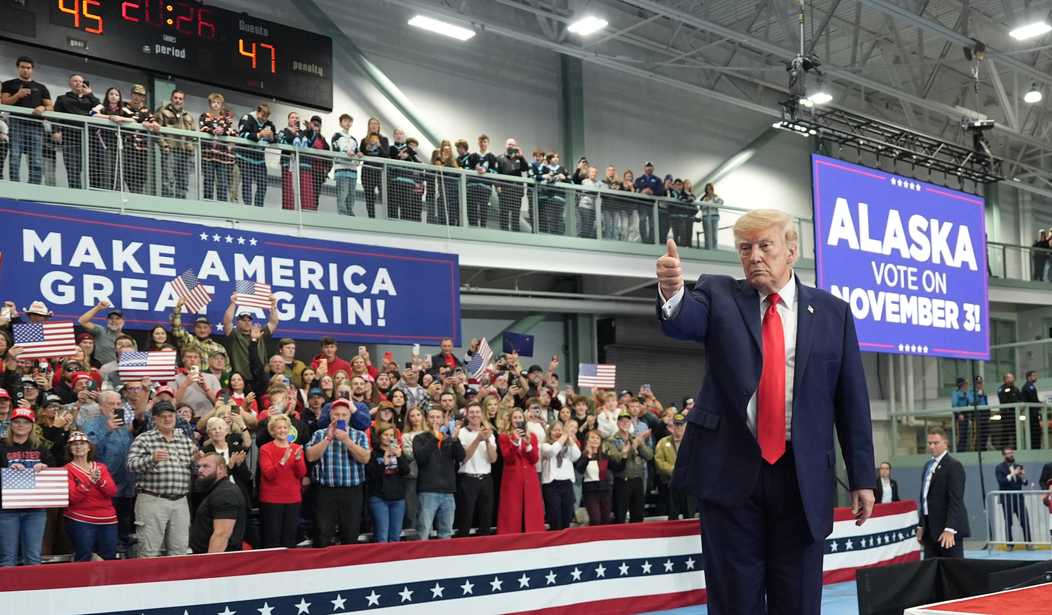
Both Donald Trump and Vice-President J.D. Vance have held several rallies in Michigan, pounding home the message of what would happen to the economy, and seniors' benefits, if socialist progressives returned to power. That message is resonating.
In Michigan, last week's early voting consisted of mail-in ballots only. 65+ ballots came in 16 times more frequently than 18-29's. In person early voting in the Wolverine State began Saturday, so there's very limited data available. In much of the country, those with the disposition to vote against Donald Trump front-loaded in early voting, with strong Democratic turnout all over the country in each state's first couple days of voting. But as is the case in Ohio, Texas, Georgia, and Iowa, Michigan may be showing the first signs of a Democrat voter roll-off.
Day 1 of in person voting went to the Democrats.
MICHIGAN Early Vote Day 1 🗳️ 🔵 Kamala counties are running at 66% of their 2024 Day 1 EV 🔴 Trump counties are running at 45% of their 2024 Day 1 EV https://t.co/XAfdNdlNPI
— Con ET Takes (@conettakes) October 25, 2026
And this was Sunday, Day 2.
MICHIGAN Early Vote Day 2 🗳️ 🔵 Kamala counties are running at 64% of their 2024 Day 2 EV 🔴 Trump counties are running at 46% of their 2024 Day 2 EV https://t.co/8Mmsu2IE7N
— Con ET Takes (@conettakes) October 26, 2026
Democrats decreased their turnout while Republicans edged up. Again, that is a two-day pattern. If this trend continues throughout the week, combined with what should be a Republican bank of mail-in ballots to offset it, Election Day turnout will decide this, with the highest-propensity Democrat voters most likely used up.
Now add in the intangibles. Blacks in Michigan, which make up around 12 percent of the electorate and historically vote overwhelmingly Democratic, aren't there in the same numbers for Abdul El-Sayed. Only 67 percent of black Democrats, according to a Washington Post-Schar School poll, supported El-Sayed. That's a big peel-off El-Sayed cannot afford in a race this close. Why don't Blacks trust him?
Black woman explains why she won’t vote for Abdul El-Sayed, and the devastation that Muslims brought to the black community in Michigan. She’s absolutely right to be wary of Arabs and Muslims. All black people should. The Muslim slave trade was 100 times worse than the Atlantic slave trade, and it’s still ongoing. Most Arabs use the term “abeed”, which means slaves, to refer to black people. https://t.co/fAIORARFkE
— Dr. Maalouf (@realMaalouf) October 25, 2026
Jews in Michigan are a much smaller voting bloc, accounting for 1.5 percent of all ballots cast. But again, historically, they've been almost monolithically Democratic until the antisemitic, DSA progressives took over the party and nominated Abdul El-Sayed, who is also an antisemite. The McLaughlin poll says the Democrat Party has lost a huge chunk of Jewish voters nationally.
2026 Generic ballot among Jewish voters 🔴 Republicans: 64% 🔵 Democrats: 33% McLaughlin poll https://t.co/LxOB6c53pf
— OSZ (@OpenSourceZone) October 26, 2026
In Michigan, that crossing over may be more pronounced. This Rebellion PAC ad run in 'support' of El-Sayed certainly won't mend the Democratic Party's rupture with Michigan Jews.
Ohio is another state where they do not release partisan data in a general election, but you can extrapolate based on voter files how they voted in previous primaries. And early voting has been underway for a long time, so you can see more days' worth of data. In short, Democrats front-loaded and built a lead, but fell off each successive day.
This is Licking County, a Trump stronghold in 2024.
I have been waiting and waiting to see if Ohio counties would see the surge in Dems and young voters that happen in this final week both in 2022 and 2024 and we again have confirmed there’s nothing there. Licking county posted its 2nd most Rep day of the entire EIP period https://t.co/3EGgotSVLw
— Latinx Adjacent Doctor PhD (@TonerousHyus) October 26, 2026
The roll-off for Democrats is consistent even in counties Sherrod Brown won handily the last time he successfully was re-elected. The state is a lot redder in registered voters than it used to be. Yes, this year might skew to the left by a couple points compared to 2024, but when you're starting with an R+11 state at best or an R+5 state at worst, a couple points still means Jon Husted goes back to Washington after next week.
Best case scenario right now is Democrats have somewhere in the neighborhood of a 48,000-49,000 vote edged they've banked. Republicans are chipping away at it daily as Democratic share of the vote decreases. In 2022, J.D. Vance's margin of victory in raw votes was 252,000 and change. In 2024, Bernie Moreno's margin over Sherrod Brown was 206,000. Donald Trump's margin over Kamala Harris was 646,000. If Republican turnout next Tuesday is between 2022 and 2024 as is expected, it'll more than cover the early vote spread.
Republicans have absolutely dominated registering voters in the last four years, so there's really not enough Democrat votes still out there to surpass the 2024 numbers. Could some Republicans stay home? Sure. Will others vote for Sherrod Brown? That's not very plausible. Will 170,000 Republicans sit this one out on Election Day? It's not indicated by how they're already early voting compared to 2022.
In the south, Texas remains a state where no Republican honestly believes James Talarico and his value set will win statewide, even against a flawed candidate in Ken Paxton. But what can be gleaned by early voting? Again, like Ohio, there is no party ID assigned in a general election. Everyone gets the same ballot. So you have to use 3rd party services to match voter rolls to how they voted in partisan primaries, if they did. In fact, there's two different ways of modeling the early vote. Both have their strengths and weaknesses, and both come to different conclusions. Let's look at them.
Theo Elections is using primary participation as a way of modeling how Texans have voted so far.
In general, participation is way up over four years ago, but not quite at the level of 2004. Democrat strongholds came out in large numbers in the first few days, but so did Republicans in their strongest counties. As the days progressed, however, Democrats seem to have rolled off like they have in other states. Precincts in South Dallas are now seeing less turnout than in previous days, while counties like Montgomery, the burbs north of Houston, are chugging along.
On X, it seemed to me that Collin County, another burb county north of the DFW metroplex, was going to be a bellwether. Between 85-90 percent of the county votes early and in person. Only 5 percent vote by mail, and under 10 percent vote on Election Day. So you can gauge how the county will go by looking at several days of early voting.
Collin has gradually changed over the last decade. It was as deeply red a county as Texas featured in 2016, but in each successive cycle, it has voted less Republican than the rest of the state, with 2024's tally 2.4 percent more Democratic than the rest of the state. What does this mean?
Let's assume the premise of a lot of polling — that James Talarico is ahead statewide by a couple points. If Collin County is slightly to the left of where the rest of the state is, you would expect Talarico to win in a county like this. He'd have to, in fact. Conversely, if Ken Paxton hangs on in a county gradually slipping away from Republicans, even if by a small margin, it's just not plausible to see how Talarico is going to build a margin big enough, especially when the youth vote is disappearing in the Lone Star State, too.
Another three days of data, and Collin County is still leaning red by five points based on primary voting propensity. https://t.co/qapb3aN2fM
— Duane Patterson (@Radioblogger) October 27, 2026
Could there be Republican crossover to vote for Talarico? Sure, it's possible. Likely? I wouldn't bet on it. And then there's the voters with no previous primary voter profile. These are either independents, or more likely, newer residents of Collin County. My timeline was full of proclamations assuring me every single one of the unaffiliated voters would be a Talarico voter, and that I should cope more. My instinct tells me a good chunk of people leaving blue states to red states like Texas with no state income tax are conservatives fleeing bad governance. I know a bunch of people from California that relocated to Texas, and California has only gotten bluer as a result. Why? Republicans are the ones leaving.
So that's one metric to model what the margins might be — looking at the voter's primary ballot history. According to that, statewide, Theo Elections have the Democrats with a very narrow as of yesterday. Excluding those with no history or those who have voted in both primaries, if every primary-registered voter stayed true in the general, Democrats would have a bank of 3,200 votes out of 3.4 million cast thus far. Insurmountable, right?
Using the same metric, primary propensity, on Election Day in both the 2022 and 2024 cycles, proven Republicans turned out twice as much as proven Democrats. That's 350-450,000 votes, depending on the turnout. Using that modeling, Paxton wins, even if every unaffiliated voter breaks for Talarico. For him to win, Republicans have to stay home on Election Day.
The other modeling is even worse for the Democrats. Instead of looking at primary history, this method locates which precinct in which the early voter resides, and predicts how they voted based on how that precinct voted in the last two cycles. Using that methodology, also just as imperfect as primary participation weighting, but still instructive, this is what you come up with after a few weeks of data.
stop dooming about Texas https://t.co/7guSe5vJNX
— Ari Daniel Bradshaw (@AriBradshawAZ) October 27, 2026
Going by who's voting in which precincts and weighting for how those precincts performed in the last few elections, Democrats are not going to have a good day Tuesday next.
Worst case for comparison. The first chart is a 2024 baseline: today’s 4.3M early voters, counted the way their precincts voted for Trump. This one scores them on 2024 Senate results (Cruz ran behind Trump) or Texas’s 2018 midterm swing, whichever is worse in each district. Statewide goes from R+11.1 to R+4.7, and TX-28 is the only seat that tips. Estimates, not a forecast. Reality is probably in between.
— Ari Daniel Bradshaw (@AriBradshawAZ) October 27, 2026
Using Republicans' worst turnout in the last ten years as a baseline — Ted Cruz's Senate run in 2024 and Texas' 2018 midterm, you still come out to just under a five-point edge for Paxton. What will the actual numbers look like next Tuesday? An honest assessment is probably somewhere in-between these two models. Either way, they both point to a Paxton win unless three things all happen — Democrats reverse their slide in early voting the rest of this week, Republicans exhaust their early voters, and Republicans stay home next Tuesday. I'm not seeing anything thus far that indicate any or all of those happening.
Looking east, or east of Texas, Georgia has limited early voting data available, but here's how it looks.
The average of polling shows Jon Ossoff with a commanding 8.2 percent lead over Mike Collins. The white-Black split in early voting is roughly what polling uses in their makeup, but the age group split so far is different. Polling estimates the youth vote will be between 10 and 15 percent, and the seniors will be under 36 percent.
After 13 days of early voting, the youth vote is under 9, and the seniors are over 40, but just barely. The polling is probably too generous to Ossoff, but Republican Election Day turnout has to be pretty dramatic for the upset to happen. In 2022, Herschel Walker won Election Day voting by over 10 points, but lost it in mail in and early voting. Collins will have to put up those kind of numbers or better to pull it off.
Out west, the two most interesting states to watch in early voting do not have a Senate seat in play. But there are indicators of whether a blue wave is forming or not. In Nevada, Republicans had built a modest cushion with in person early voting, but Democrats wiped out that lead with mail-in ballots and built a modest lead of their own. Governor Lombardo is at the top of the ticket for reelection, and his path to victory four years ago was essentially heading into Tuesday tied in early voting, and then riding a wave of Election Day Republican turnout. If Democrats burn out their high propensity votes by mail, and Republicans chip away at in person early voting keeping the early vote close, it could result in a very similar victory for Lombardo. The more Democrats vote early, the redder Election Day voters are.
In Maricopa County, Arizona, Republicans are having a nice run in early voting.
Oct 26 early vote returns non cumulative Maricopa County, Arizona per @StealthPolling 🔴 Republicans 41.1% 🔵 Democrats: 34.2% 🟡 Independents: 24.8% Total: 53,176 https://t.co/w4UiMcS7N0
— OSZ (@OpenSourceZone) October 26, 2026
It's the most populous county in the state, and if Republicans have a lead a week from now, that's probably the end of the Katie Hobbs disaster. The other county of note is Pinal County. Next to Phoenix, housing Maricopa, Mesa, and Chandler, the county has an overall Latino population of 30 percent. If there was a backlash to Trump immigration enforcement and/or ICE, you'd see Republicans in trouble in a county like this. So far in early voting, however, Republicans have a good lead.
As of around October 26, 2026 (per tracking based on county/state data):
Party | Ballots Returned | Share |
|---|---|---|
Republican | ~25,744 | 42.8 percent |
Democrat | ~19,852 | 33.0 percent |
Other/Ind | ~14,551 | 24.2 percent |
Total | ~60,147 | — |
Republican lead: about R+9.8 points in returned early ballots.
Put it all together, it's a mixed bag. There is definitely not a blue wave taking place. At least not yet. Any wave-type year would include a higher percentage of youth vote. It may happen on Election Day. If so, it'll be a long night. If they stay close to their previous norms or come in under that, the higher-than-usual turnout of seniors may have a lot of pollsters wiping egg off their faces Wednesday morning.
The electorate thus far seems to be older, a little whiter, more enthusiastic than 2022, but not quite to 2024 levels of intensity. The Trump rallies are having an impact as a lot of the MAGA base is juiced up and already turning out in states all over the country. Think about it. Trump and Vance are doing multiple rallies a day, most of which have audiences north of 25,000 each.
What are Democrats doing to compete down the stretch? Sending out Barack Obama, the guy who claims to have solved the healthcare access and affordability crisis in 2010, now begging for votes in order to, *checks notes*, solve the healthcare access and affordability crisis.
Who else is out thee to encourage Democrat voters? Kamala Harris.
Kamala attempts to articulate the value of talking to children. It doesn't go well: "I mean, if you have the chance in whatever your, you know, your circle of life to just, you know, talk to like an eight year old, that's one of the best things, you know, someone who just has that twinkle." "It hasn't been, you know, they haven't they they have the twinkle. They believe in, in all. And they're curious and - Oh, that gives me joy just because, you know, there is something I think about, looking at children to remind us of our natural nature, who we actually it is our nature, our - There is something about that." This was said at a 'reproductive rights' event. The irony here is next level. She somehow keeps managing to get worse at this.
— Western Lensman (@WesternLensman) October 25, 2026
It really is something to hear the former Veep talk longingly about the twinkle in an 8-year-old's eye while at a fundraiser for abortion clinics in New Hampshire.
There's no blue wave, but as our Townhall colleague Larry O'Connor suggests, there may be a silver wave instead. I like the message Republicans are making down the stretch versus the message coming from the fever swamp on the other side.
None of it matters unless you've voted. And if you haven't brought someone else with you to vote that might not have done so otherwise, you're not doing this right.
Editor’s Note: The 2026 Midterms will determine the fate of President Trump’s America First agenda. Republicans must maintain control of both chambers of Congress.
Help HotAir continue to report on the Democrats’ radicalism and inform voters as our nation faces a crossroads. Join HotAir VIP and use promo code FIGHT to receive 60% off your membership.
Join the Conversation
VIP members get the ability to comment on articles.