



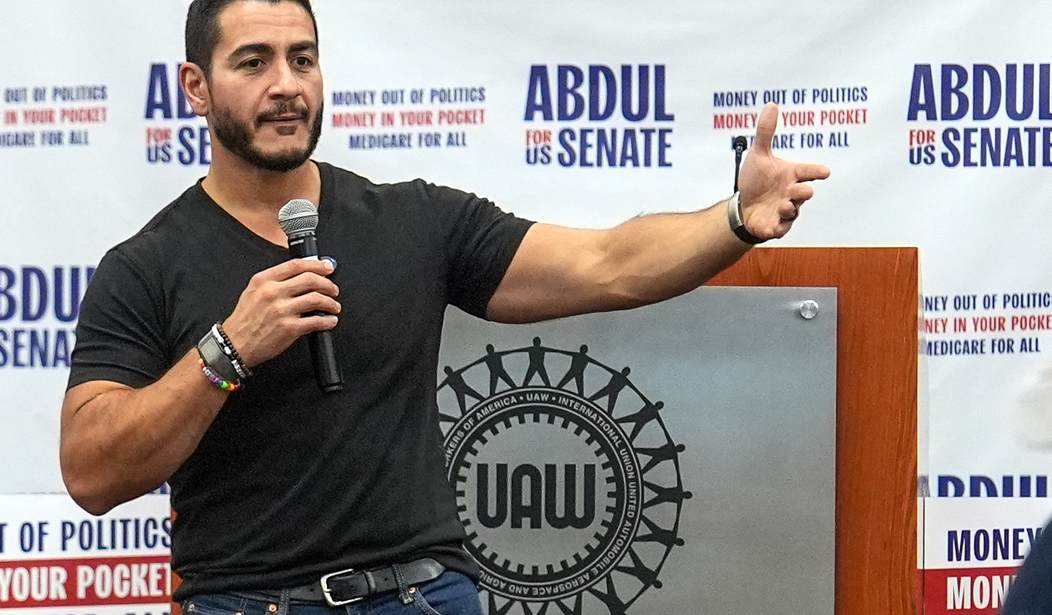
Shorter Abdul El-Sayed: Stop being bigots, black voters!
Actually, it's tough to determine who's being racist in Michigan. Is it black voters who worry that El-Sayed has much more invested in 'Palestine' than Detroit? Or is it the candidate who thinks that "gas station Abduls" have poisoned voters' minds against him?
YMMV, but I know which way I'm betting, especially about how those voters receive this pitch (via Twitchy):
Abdul El-Sayed to black voters: I am not like your "gas station Abdul" who hates blacks, catcalls women This reeks of desperation https://t.co/HfzrKViid9
— End Wokeness (@EndWokeness) October 20, 2026
EL-SAYED: Because for too many black Detroiters in particular, their experience with somebody who looks like me is not a good one. You go into a gas station, you go to a party store, you're being talked at from behind bulletproof glass. If you're a woman, you're being catcalled. If you're a kid, you're being sold a Lucy out the back, being denied a bathroom. I've always tried to be on the right side of that. But I also understand that, like, if that's your experience with someone whose name is like mine, that leaves a terrible taste in your mouth.
Wow. The arrogance here is off the charts. Black voters have not rallied to support El-Sayed for pretty clear reasons. They want a candidate who prioritizes their issues and concerns over those of the Gazans. Not only has El-Sayed consistently prioritized the 'Palestine' cause, he's barely engaged on the issues that concern black voters in Michigan, not even after losing the city by 28 points in the Democrat primary.
Even the left-leaning Slate started warning about this disconnect two weeks ago, and also pointed out its cause:
For some Black voters, the skepticism has to do with questions about El-Sayed’s progressive agenda. Others indeed cite the uncommitted movement. But the reluctance isn’t always necessarily ideological. Basil Smikle, a political strategist and professor at Columbia University, has argued that Black voters often vet candidates through a different lens than some other groups do. “The question is ultimately about familiarity, affinity, and allyship—not as symbolic gestures, but as evidence accumulated over years of shared political struggle. It is a proxy for trust,” he wrote. Stevens, many analysts noted, was a known commodity to many Black voters as a congresswoman. El-Sayed was not.
By now, many Black Democrats have made clear that they intend on voting for him. (Recently, his campaign was endorsed by the Congressional Black Caucus.) But even among them, there’s voters who say they’re doing so for the sake of coalescing against El-Sayed’s Republican opponent. Detroit attorney and former mayoral candidate Todd Perkins said he’ll probably vote for El-Sayed despite grievances about uncommitted and what he saw as patronizing outreach to Black voters. “He engages the white construct in a way that’s intelligent and everything, and then I see this commercial where he’s sitting there playing Aretha Franklin and he’s dancing a jig,” he said.
The issue isn’t so much about losing the vote among the die-hard activists in the black community. It’s about turnout, or the lack thereof. There is already animosity between that community and the relative newcomers in the Arab community, but it’s less about restrooms than it is about sucking up economic benefits from black communities and not giving anything back:
There was also a more complicated tension with the long and sometimes fraught relationship between Black and Arab communities in metro Detroit. Arab-owned gas stations, liquor stores, and other small businesses have for decades operated in predominantly Black neighborhoods, even as many of their owners lived elsewhere, producing what some Black Detroiters describe as a relationship that can feel extractive in a way that hurts their community. At a press conference in August in Detroit, an older Black man shouted, “He’s an Arab—he don’t care nothing about Black folks.” At a September roundtable with Black elected officials, Michigan state House candidate Kimberly Fisher warned that Black voters in her district brought up his race repeatedly. “Why would I vote for an Arab? Arabs don’t like us. He’s Egyptian, y’all. We don’t care. And when they see you, that’s what they see,” she said. “I’m fearful because I’m seeing more John James signs and Mike Rogers signs in the hood,” referring to El-Sayed’s Republican opponent in the Senate race.
This was the dynamic that El-Sayed thought he was addressing when attempting to distance himself from the “gas station Abduls.” However, El-Sayed’s obsession with ‘Palestine’ sets up the same “extractive” relationship with the black community as do Arab-owned-and-operated shops within Detroit and other urban areas. El-Sayed wants to suck the value from the black political economy and only offer returns to the radical Islamists of Detroit.
And now El-Sayed wants to accuse these voters of racism and bigotry for recognizing this colonization for what it is. How will that play in Detroit? If the observation in Slate about campaign signs in Motor City is accurate and representative, Jocelyn Benson may find out along with Abdul El-Sayed.
Editor’s Note: The 2026 Midterms will determine the fate of President Trump’s America First agenda. Republicans must maintain control of both chambers of Congress.
Help HotAir continue to report on the Democrats’ radicalism and inform voters as our nation faces a crossroads. Join HotAir VIP and use promo code FIGHT to receive 60% off your membership.


Join the Conversation
VIP members get the ability to comment on articles.