



Before the U.S. midterm elections, President Donald Trump repeatedly said that the price of oil and gasoline would fall pretty rapidly after the elections were over. 91 percent of Kamala Harris' 2024 voters and 30 percent of Trump's 2024 voters didn't believe him two weeks ago.
Now, the election is in the rearview mirror...except in Alaska where Mary Peltola is within a whisker of crossing the 50 percent threshold and avoiding a ranked-choice-voting round, and in California, where we tend to take at least a month to survey the landscape and determine how many more late ballots need to "arrive" in order to displace yet another Republican Congressman. Was the President correct in his prediction? Yes.
Appearing on CNBC's Squawk Box program Friday morning with Joe Kernen and Rebecca Quick, Treasury Secretary Scott Bessent laid out the stats.
For the last month, the Iranian Regime has claimed they've sunk or destroyed two tankers a day almost every day like clockwork. The reality? Oil's supply and demand righted itself for the first time in a long time. Supplies now outweigh demand. Why? More oil is moving than before the war began.
Oil prices fell on Monday as crude shipments from the Middle East through the Strait of Hormuz approached pre-war levels and the International Energy Agency (IEA) forecast a global supply surplus in the fourth quarter. Brent crude futures dropped 47 cents, or 0.49%, to $95.37 a barrel by 0145 GMT, while US West Texas Intermediate crude fell 23 cents, or 0.26%, to $88.33, Reuters reported. The IEA said Friday that global oil supply would average 105 million barrels per day in the fourth quarter, exceeding expected demand by 1.7 million barrels per day. The agency had previously forecast a supply deficit for the period. The IEA also said 71 million barrels from its members' emergency oil reserves would be made available by the end of February, including 15 million barrels of diesel, as part of a record release pledged in March.
— Iran International English (@IranIntl_En) November 16, 2026
Iran does not own the Strait of Hormuz. The United States military is in full control of the traffic transiting one of the world's most sensitive energy chokepoints. The pivot began with implementing Operation Economic Fury, the blockade of all traffic in or out of Iranian ports in the Gulf. Layered onto that was Project Freedom, which removed the Iranian mines in the Strait and created a lane of for tankers and freighters to traverse the Strait.
Added onto that was Operation Economic Outcast, which systematically removed the underpinnings from other countries that allowed the Iranian regime on the sly to access the global financial system, further tightening the squeeze.
The blockade, secondary, and tertiary sanctions have been so effective to date that the Iranians announced they are planning a budget for next year without oil sales. That's like Apple announcing a future budget without iPhone sales. What the regime has resorted to is a land route, even if at a snail's pace compared to what cargo ships and carry in and out, to keep something economic moving in Iran.
Task Force Iron Gate has now been implemented to disrupt those land routes. Where we see one, we will disabuse those on the other end of the corridor from allowing it to continue. The noose around the regime tightens further.
And yet, even in a world with zero Iranian oil hitting the global market, the market is adapting in real time, despite the supply shock from a few months ago. Several experts now look at future oil from a sell position, not a buy.
The Oil Glut Is Coming Before the Futures Market Sees It The Federal Reserve is fighting the last war. It raised rates into an oil shock that is now reversing on its own. Futures still show a market short of crude, but the physical market says otherwise, and it usually moves first. Start on the US Gulf Coast. Western Canada Select trades $26 a barrel below WTI, against a 20-year average of $17. In Houston last month the discount hit a record $23. Heavy-crude refiners are full, Venezuelan barrels are back and costly freight has made re-exporting the surplus uneconomic. Markets do not discount barrels they need. The signs are spreading. The International Energy Agency reports supply exceeding demand for the first time since the Iran war began. Inventories rose 52m barrels in October and oil at sea hit 2bn barrels. Dated Brent trades below its futures contract, and Brent’s one-month spread has narrowed from $3.87 to $2.71 in two weeks. Freight agrees: Gulf-to-China supertanker rates are down almost a quarter from October’s record, and Atlantic rates are back below prewar levels. All this with Iran exporting nothing. Iraq is pumping at a seven-year high, Saudi output is near prewar and Brent is 30 per cent off its peak. The world can live without Iranian oil; Tehran cannot live without selling it. Now take Treasury Secretary Scott Bessent at his word. He says Hormuz flows are back to pre-conflict levels, minus Iran. The IEA’s surplus assumes Gulf exports remain 26 per cent below prewar. If Bessent is right, that gap is already closing, and each barrel it closes lands in a market already oversupplied. The glut would be bigger, and arrive sooner, than forecasters expect. That is the Gulf’s real problem. Asian refiners have learnt to buy elsewhere: record Canadian barrels via Trans Mountain, plus more from the US, Guyana and Brazil. Wartime contracts outlast wars. Riyadh met such challenges in 1986, 2014 and 2020 with volume, and prices halved in 2014; watch OPEC+ on 29 November. Nor is services inflation a reason to hold firm. Services CPI has been above 2 per cent 94 per cent of the time over the past 60 years. That is its normal state, not a new threat. For investors, the energy war premium is a sell. For central banks, the lesson is older: supply shocks cure themselves. Pushing on with rate rises into the spring of 2027, while crude heads for a glut, would not be prudence. It would be extreme incompetence.
— James E. Thorne (@DrJStrategy) November 15, 2026
Refined products such as gasoline and diesel have not caught up, yet, but the gap is no longer widening. The market is adapting. Refining capacity is beginning to catch up. The market barely notices anymore when the daily 'Iran hit another two tankers' story from regime media shows up. It's treated as a 'boy cried wolf' story, except in this case, Iran is trying to be the wolf, and fewer people believe the wolf still has fangs sufficient to cause damage.
Secretary of State Marco Rubio spoke to the Federalist Society's annual dinner a couple days ago, and gave as clear an exposition on why dealing with Iran now was, and remains, vital to American interests.
Watch how well Rubio answers! Question about Iran to Rubio: You demonstrated a victorious American mentality, so at this point in the conflict in Iran, what would you consider an American victory? https://t.co/IpABOu2TuR
— Iranian American 🇺🇸 (@IranLionness) November 14, 2026
The choice in front of President Trump every day is one of four options regarding Iran.
1) Status quo-plus — Keep the blockade in place, maintain the safe corridor for oil and cargo (keeping the receipts for the bill that will come due for Europe and the rest of the world soon), and adapt to any new land route straw extending from Tehran looking for economic air to breathe by plugging it.
2) Blockade plus targeted kinetic strikes at sensitive infrastructure and/or regime assets. Trump gets that briefing option updated every single day, and those capabilities just got increased with the Teddy Roosevelt carrier group coming on station yesterday.
3) Blockade plus arming Iranian dissidents inside Tehran, and providing air support when the revolution inevitably takes to the streets. This is the General Keith Kellogg suggestion he offered over the weekend on X.
Retired US Lieutenant General Keith Kellogg, a former special envoy for Ukraine, called on Sunday for American intelligence agencies to help Iranians overthrow the Islamic Republic, while backing President Donald Trump's economic and military pressure campaign against Tehran. Speaking on Fox News' Sunday Morning Futures, Kellogg said Trump should authorize intelligence operations aimed at supporting Iranians seeking political change. "What I would like to see the president do ... is create what's called a presidential finding, which actually tells our intelligence community, okay, go help the Iranian people because they probably need help to overthrow this government," Kellogg said. He emphasized that he was not part of the administration's current decision-making circle and praised Trump's strategy of maintaining pressure on Iran without immediately resuming large-scale military strikes.
— Iran International English (@IranIntl_En) November 15, 2026
4) Pull up anchor and come home — in essence, caving to the 30 percent of the Trump 2024 neo-isolationist base who already cost the Republicans the midterms by not voting. It seems pretty obviously unwise to reward those who have already proven not have your back by giving away a war against Iran you've basically won.
The first three all are different options or tactics that have the same underlying goal to achieve — toppling the Iranian regime once and for all. The last option is the Biden regime Afghanistan preemptive defeat option, one the President is not going to choose.
Appearing on Thursday's Hugh Hewitt Show, Donald Trump seemed content with option one for now, because it's working. The regime is thrashing around violently, but it is dying every single day.
President Trump says he has NO HESITATION when it comes to STRIKING Iran if needed. “The answer is if I saw things going the other way, I would do that. And it's possible I would do it right now.” Hugh Hewitt: “So you don't hesitate to give the ready, aim, fire.“ President Trump: “No. No hesitation. We're doing very well with it. Right now, you know, we have the, we're taking out more oil now than we did before the, if you call it a war, before the war started. We're taking out more oil. And you know, think about the war. We've been fighting, you know, pretty, you know, at a pretty rapid clip for three weeks. Not seven months, but three weeks. Nobody's been killed in the last five months.” “We won Venezuela, and we control the Gulf in terms of the Hormuz Strait. We control it. Totally control it. But the answer is if I saw things going the other way, I would do that. And it's possible I would do it right now.” Hugh Hewitt: “Okay, and are you willing to stick with the blockade? Even if it takes 26 months to collapse that regime?” President Trump: “Oh, yeah. The regime is collapsing, and their press is much different than the fact. You know, they'll always make these harsh statements about we are doing well, we will fight back, we will. They are not doing well. They are at 301% inflation. Their economy is gone. They're not paying their soldiers. Their military is wiped out. Their navy is gone. Their air force is gone. Their anti-aircraft is gone. And they've lost the Hormuz Strait. They're not doing well. But they always talk with great bravado like how well they're doing. And the fake news tries to pick it up as much as possible. But even the fake news isn't saying that. No, if it doesn't, if something doesn't work out, I would not hesitate.”
— RedWave Press (@RedWavePress) November 13, 2026
With regard to the chokehold strategy on the regime, while saying he's willing to ride it out for the rest of his presidency, if necessary, the President later signaled he doesn't believe it will take that long. In fact, when pressed, he said he would accept it would be a failure if he handed over the keys to the White House to his successor with the current regime still intact.
Hugh Hewitt: “So a penultimate question. If the Iran crazies are still in power when you leave office, will that have been a defeat for you? Or is it just something that can’t be done in three years?” President Donald Trump: “You’re talking about the Iran crazies in Iran, not here, because we have Iran crazies here.” Hugh Hewitt: “Yeah, the Iran crazies if they’re still there.” President Donald Trump: “Yes, that would be a defeat. Yeah, I would say that would be a defeat. Absolutely.” My President @realDonaldTrump will FINISH THE JOB! THE ISLAMIC REGIME WILL BE DESTROYED, AND THE IRANIAN PEOPLE WILL BE LIBERATED! 🇺🇸💚🤍❤️🇮🇷 https://t.co/K5JZatuJl2
— 🇺🇸 Jake Hilton 🇮🇱 (@TheDemSlayer) November 13, 2026
The metric of success that media ought to be reporting, but largely are not, is how the regime is faring.
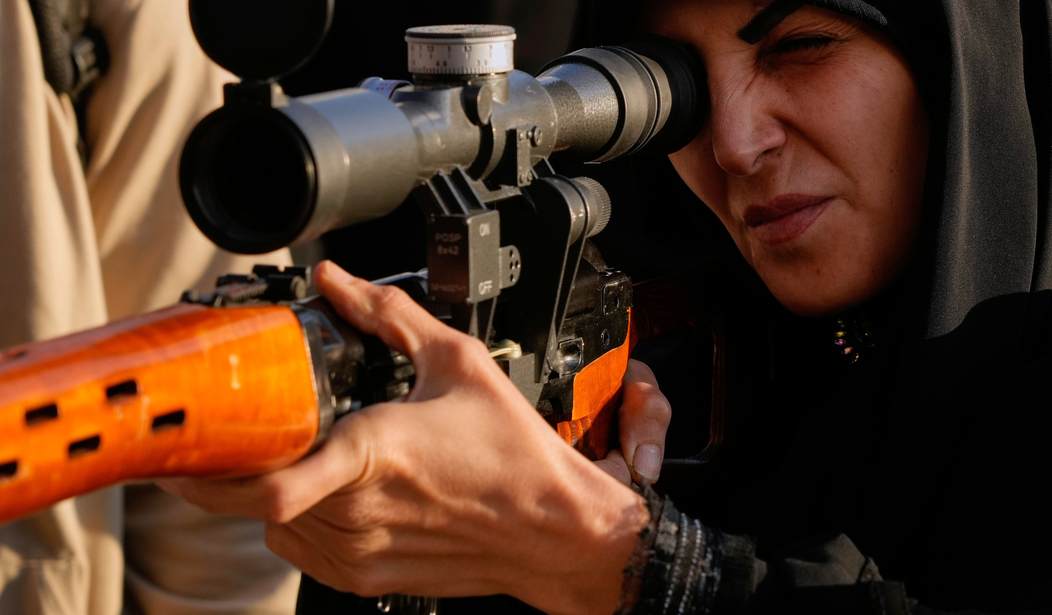
In a country where women do not have rights, and are required to appear in public wearing burqas, all of a sudden, they are being trained for a new role in society — to replace soldiers the regime can no longer pay and/or have deserted.
Women in Iran are training with firearms, air defense systems, and drones at Tehran's Azadi Square amid the war with the US and Israel. Iranian officials claim over 30 million people have registered to mobilize in case of a ground invasion. https://t.co/LIl7syIEPw
— Furkan Gözükara (@FurkanGozukara) November 15, 2026
In southwestern Iran, where the three primary oil fields are, five Iranian men between 25 and 30 years old applied for positions at an oil company. They were denied the ability to even apply, because oil production has been reduced to what can only be refined inside of Iran. And besides that, no one's really getting paid anyway. There are no new employment opportunities in oil or much of any industry these days. The women soldiers aren't getting paid, either. They just get to do something besides walk around the streets five steps behind the men.
Five young men seeking jobs at an oil company in southwestern Iran were arrested after protesting over employment opportunities, prompting their mothers to stage a demonstration demanding their release, according to Iranian rights monitors and local media. The five men, aged between 25 and 30, were detained on Saturday outside the Dana Sohrab oil company near the town of Rafi in Khuzestan province, the human rights organization HRANA reported on Sunday. Local sources said the arrests followed a complaint by Dana Energy, with the company's site manager and head of security named as complainants. The men's whereabouts, the charges against them and their legal status remained unknown as of Sunday. https://t.co/rHRAwphYRj
— Iran International English (@IranIntl_En) November 15, 2026
There are several reports of unpaid IRGC and Basij forces, and they're pretty cranky as a result.
The Islamic Republic is running out of money to pay the armed forces keeping it alive. CENTCOM Commander Admiral Brad Cooper says the U.S. naval blockade has prevented at least $25 billion in Iranian oil exports and helped freeze another $350 million in cryptocurrency. He says the regime is withholding salaries, pensions and benefits across the oil, manufacturing, construction and security sectors—including the IRGC itself. The financial reversal is extraordinary. Iran-backed militias that once depended on the IRGC are reportedly withholding pay from their own fighters and sending money back to the organization that funded them. The Algemeiner separately reports that cash-starved Iranian banks have left some IRGC and Basij personnel waiting months for overdue salaries. The exact scale remains contested and has not been independently documented across the entire security apparatus. But the wider financial crisis is undeniable. President Masoud Pezeshkian has described the pressure as a “full-scale economic war,” acknowledged severe losses in trade and discussed preparing the country for little or no oil revenue. The pressure is also expanding. The United States has established Task Force Iron Gate to target weapons, sanctioned goods and illicit revenue moving through Iran’s land borders and the Caspian Sea—reinforcing the naval blockade rather than replacing it. The regime will sacrifice ordinary Iranians before abandoning the IRGC. It can print money, raise prices, seize revenue and strip civilian budgets to keep security forces loyal. But every rial redirected toward the IRGC deepens inflation, wage delays and public anger. Every unpaid soldier weakens the machinery responsible for protecting the regime and suppressing dissent. This does not prove the Islamic Republic is about to collapse. It shows that U.S. pressure is reaching beyond Iran’s economy and into the payroll of the regime’s survival apparatus. An authoritarian state can survive unpaid factory workers. It becomes far more vulnerable when it struggles to pay the men ordered to keep it in power.
— The Iran Watcher (@TheIranWatcher) November 13, 2026
Here's one account from laid off law enforcement who says they're close to the tipping point where there's no fear or respect of police from Iranian civilians.
The Islamic Republic’s law-enforcement forces are confronting collapsing morale and public contempt as their uniform becomes associated with repression, humiliation and mass killing. A video circulating from a recently discharged police conscript gives voice to a broader crisis inside the security apparatus. He says the era of automatically respecting military and law-enforcement personnel is over. Many Iranians now view those in uniform as “mercenaries,” “repressors” and “murderers” because they participated in the January 2026 massacre—or remained silent while it happened. Estimates place the death toll at more than 45,000. The United Nations later concluded that the regime’s widespread killings, imprisonment, torture and other abuses amounted to "crimes against humanity." But public hatred was not created by the massacre alone. These are also the forces that patrol streets, harass women, arrest them over hijab compliance and subject ordinary Iranians to daily intimidation and humiliation. The uniform no longer represents public safety. For many Iranians, it represents the officer checking a woman’s clothing, the van taking her away and the armed personnel firing on protesters. This anger extends beyond senior commanders or ideological members of the IRGC and Basij. It increasingly follows police officers, regular military personnel and young men completing compulsory service. Not everyone wearing the uniform supports the Islamic Republic. Milad Moazami Goodarzi reportedly came from the military ranks but stood with the people and was killed during the January uprising. Others may privately oppose the regime while remaining trapped inside its institutions. But the regime deliberately erased that distinction by using every security branch - including compulsory-service conscripts - to control the population. When society despises the uniform, personnel lose more than public respect. Their families face shame, their communities distrust them and their own belief in the institution begins to weaken. That directly damages morale, cohesion, recruitment and obedience across the security apparatus. The Islamic Republic can force young Iranians to serve, order them into the streets and place weapons in their hands. It cannot force the Iranian people to respect them—or prevent its own forces from feeling the shame attached to the uniform they wear. https://t.co/tmJjiqqEYs
— The Iran Watcher (@TheIranWatcher) November 13, 2026
Gasoline remains a scarcity the regime cannot provide. They've never had the refining capacity internally to handle the daily demand, and the regime has compounded the problem for decades by subsidizing gas, conditioning the population to pay a price per liter well below market value. Now that they can no longer import gasoline to meet the demand, and no longer has the cash reserves to keep the subsidy going, the lines Iranians wait in only get longer as each day exacerbates the supply problem.
🚨 IRAN: Long Queues and Fuel Protests - Next Uprising on the Way? Long gas queues and protests are escalating across the country on the Nov. 2019 uprising anniversary, when fuel hikes sparked a nationwide revolt that pushed the regime to the brink. https://t.co/1QOR2Q0j2V
— Ehsan Eghbal Eslami (@Ehsaneghbale) November 14, 2026
A video sent to Iran International shows a long line of vehicles waiting for fuel at a gas station in Sadra, a city northwest of Shiraz in southern Iran's Fars province. https://t.co/61mi5HJpas
— Iran International English (@IranIntl_En) November 14, 2026
A third of Trump's base protested high gas prices by sitting on their hands, or worse, casting votes for a political party that historically views high gas prices as a feature, not a bug. Not one of them had to wait in a line like this just to buy it. How do Iranians react to their gasoline reality?
Fuel unrest has erupted in Iran as furious drivers begin blocking highways over gasoline shortages. On Friday night, residents reportedly parked their cars and blocked Rajaei Highway outside the Aftab Derakhshan gas station in Bandar Abbas after stations ran short of fuel. Videos show crowds gathering and traffic brought to a halt. The unrest remains localized for now, but gasoline has triggered nationwide upheaval before. In November 2019, a sudden fuel-price increase ignited protests across Iran within days. The Islamic Republic shut down the internet and opened fire on demonstrators. Amnesty International documented at least 304 deaths, while Reuters reported that approximately 1,500 people were killed. That history explains why the regime is tightening access gradually instead of announcing one dramatic nationwide increase. Emergency station cards are being withdrawn across multiple provinces, forcing drivers to depend on personal fuel cards. After the subsidized quotas are exhausted, additional gasoline costs 10,000 tomans per litre. The regime calls this “demand management” and an effort to combat smuggling. In practice, it is transferring the cost of fuel shortages and financial collapse onto ordinary Iranians. The contradiction is explosive: Iran possesses some of the world’s largest oil reserves, yet people in Hormozgan—a province containing major refineries—are struggling to obtain gasoline. Fuel shortages affect nearly everyone. They prevent people from reaching work, operating taxis, transporting goods and earning a living. Local anger can therefore spread far faster than protests confined to one profession or social group. The Bandar Abbas blockade does not yet constitute a national uprising. But the Islamic Republic knows that Iran’s largest protest waves have often begun with an economic grievance before rapidly becoming a political revolt against the entire system. The first highway has been blocked. In Iran, history shows how quickly a gasoline crisis can become something much larger. https://t.co/TGN7xGESh5
— The Iran Watcher (@TheIranWatcher) November 13, 2026
Cab drivers began to get into the act.
Taxi drivers have joined Iran’s growing strike wave as the fuel and cost-of-living crisis spreads across the country. Taxi drivers in Ardabil stopped working on November 14, parking rows of yellow taxis beneath an overpass in protest over rising gasoline prices, low fares and collapsing living standards. The strike follows fuel-related unrest in Bandar Abbas, where angry drivers blocked Rajaei Highway after gas stations ran short of gasoline. Bus and minibus drivers in Yazd have also stopped working over unpaid revenue and rising vehicle costs. Snapp drivers, truckers, waste workers and factory employees have held strikes or demonstrations in several other cities. The immediate trigger is gasoline, but the crisis is much larger. The Islamic Republic has increased above-quota fuel prices, restricted access to emergency station cards and forced drivers to rely on personal allocations that often do not cover their work. Taxi drivers are being crushed between higher fuel, maintenance and replacement-part costs and fares that passengers can barely afford. Working longer no longer guarantees that they can support their families. This is politically dangerous because economic strikes have repeatedly become something much larger in Iran. In late 2025, strikes and demonstrations triggered by economic collapse expanded into the nationwide anti-regime uprising of January 2026. What began with demands over wages, prices and survival became a direct challenge to the Islamic Republic. The same danger exists now. Taxi and transport strikes are particularly disruptive because they connect fuel shortages to everyday life. They affect workers, passengers, businesses, food distribution and movement between cities. The Ardabil strike remains local, and it is too early to call it the beginning of another national uprising. But the Islamic Republic is again confronting the same combustible combination: fuel shortages, unaffordable prices, unpaid wages, collapsing purchasing power and workers who no longer believe the system can provide them with a future. Taxi drivers have now joined the unrest. Iran’s recent history shows how quickly a livelihood protest can become a revolt against the entire regime. https://t.co/KBInbv6bEb
— The Iran Watcher (@TheIranWatcher) November 14, 2026
High-profile members of the regime are sparring with each other publicly.
Infighting inside the Islamic Republic is breaking into public view as Ghalibaf fights to reclaim a negotiation file increasingly seized by Rezaei. Mohammad Bagher Ghalibaf just publicly insisted that he remains in charge of negotiations with the United States, declaring: “I take responsibility as its chief” and “leading the negotiations and taking follow-up measures rests with me.” But Ghalibaf has been publicly sidelined as Mohsen Rezaei increasingly takes control of the file, dictates the regime’s conditions and emerges as its authoritative voice. Rezaei recently travelled to Russia to deliver a personal message from Supreme Leader Mojtaba Khamenei to Vladimir Putin. He discussed the war, regional security and the Islamic Republic’s seven conditions for negotiations. He then declared that the regime would neither reopen the Strait of Hormuz nor negotiate until the United States implemented those demands. JD Vance’s reported letter proposing a direct meeting was also sent to Rezaei—not Ghalibaf. That fuelled speculation that control of the file had shifted from Ghalibaf’s formal negotiating team to the Supreme National Security Council and its new secretary. Ghalibaf’s Al Jazeera interview was therefore not only directed at the United States. It was also a message inside the Islamic Republic that he refuses to accept his relegation while Rezaei assumes the more powerful diplomatic and security role. Ghalibaf insisted that the negotiating team had not changed, that the United States had failed to provide an official response and that the regime’s seven conditions must be implemented before Hormuz reopens or negotiations resume. But Ghalibaf is fighting to control a diplomatic process that the United States may no longer want. President Trump has now declared: “We don’t need a deal with Iran.” That statement does more than reject the Islamic Republic’s conditions. It undercuts the entire negotiation track and further diminishes Ghalibaf’s importance. Ghalibaf is asserting his authority as chief negotiator at the same moment Trump is saying there is no need to negotiate. Rezaei’s security-first approach therefore carries greater weight inside the regime, while Ghalibaf risks retaining a title attached to a process that has lost its American counterpart. Both men are longtime IRGC figures deeply embedded within the Islamic Republic. Rezaei commanded the IRGC from 1981 to 1997 and represents its older, more rigid military-security establishment. Ghalibaf also rose through the IRGC but became a more politically agile operator through his roles as police chief, mayor and parliamentary speaker. Neither is a moderate or an opponent of the regime. The difference is one of style, institutional power and control. Ghalibaf presents the regime’s demands as the basis for a political negotiation. Rezaei presents the same demands as conditions for American capitulation and dismisses reports of meaningful talks as “imaginary.” The Islamic Republic officially denies that Ghalibaf has been sidelined. But officials do not repeatedly insist that a negotiator remains in charge unless serious questions about his authority have emerged. This is not yet an open struggle for control of the entire regime, and there is no evidence that either man faces an imminent purge. But the competition is real and increasingly visible. Ghalibaf retains the formal title of chief negotiator. Rezaei increasingly appears to possess the Supreme Leader’s confidence, the authority of the security apparatus and the power to determine what negotiations can—and cannot—deliver. Trump’s rejection of a deal makes the contradiction even sharper. Ghalibaf is fighting to control negotiations that may no longer exist, while Rezaei is consolidating control over the regime’s response to their failure. The struggle is therefore no longer only over who negotiates with the United States. It is over who speaks for the Islamic Republic when the United States refuses to negotiate at all.
— The Iran Watcher (@TheIranWatcher) November 12, 2026
Secretary Bessent compared the stress fractures Iran is facing to those that caused the Soviet Union to crumble.
BREAKING: US SEC. BESSENT ON IRAN: “March of 2026 to March of 2027, The rial will collapse 25% in one year. To put that in perspective, the Russian economy went down 22% over three years when the Soviet Union collapsed.” https://t.co/Zc9ZHXHDN6
— Sulaiman Ahmed (@ShaykhSulaiman) November 15, 2026
While the regime wriggles around in the noose, American forces are as numerous in the region as they have been since the war began.
U.S. Aircraft in theater: 300+
— Open Source Intel (@Osint613) November 15, 2026
All seems like it's going according to plan, right? Not entirely. In Yemen, the hot war zone between the Houthis, the last remaining Iranian terror proxy, and the coalition of Yemeni government forces, loyal tribal brigades, Saudi air assets and Pakistani and Turk defensive forces, has taken an alarming turn in the last 24 hours. The Bab al-Mandeb Strait has fallen...again.
UPDATED YEMEN MAP: Houthis Regain Control of Bab el Mandeb Strait November 15: Yemeni government forces have withdrawn from key positions around the Bab el Mandeb Strait, reversing weeks of territorial gains. Bab el Mandeb: Houthi forces have regained control of Dhubab, its airport, Al Omari Base, Mokha, Mayyun and the Kahboub heights following the withdrawal. Advance toward Aden: Houthis reportedly captured Kharaz military base and are now approximately 60 km from Aden, according to military sources cited by AFP. Contested territory: Houthis claim advances around Ras al Ara, Al Suqyah and Khor Umayrah. Taiz: The city remains encircled, with Houthi forces reportedly controlling all 4 main exits. The withdrawal leaves the Houthis controlling key territory overlooking Bab el Mandeb, one of the world’s most important maritime chokepoints connecting the Red Sea to the Gulf of Aden. Map: OSINT613 | November 15, 2026
— Open Source Intel (@Osint613) November 15, 2026
Not great, Bab.
For the last six weeks, Yemen government forces, with Saudi air support, chased out and largely held former Houthi strongholds along the coast, and the fighting was concentrated largely in the mountainous region of Taiz. The fighting there continues -- a lot of anti-tank shelling, but a lot more on both sides via drone strikes. But yesterday, the Yemen forces headquartered in Aden to the south confirmed they are pulling back to defensible lines to protect the back-up capital city. Not a good development at all.
Pro-govt Southern Armed Forces announced a redeployment of their troops from Dhubab Airport and the Bab al-Mandab area west of #Taiz, citing the need to reinforce security in Aden and neighbouring provinces amid recent military developments and Houthi threats. "In light of recent developments on the battlefronts, military buildups and threats targeting the temporary capital, Aden, and neighbouring provinces, as well as the responsibilities and operational and security priorities imposed by the current phase, the Southern Armed Forces announce that they are redeploying their forces from Dhubab Airport and the Bab al-Mandab area in western Taiz province. The move is part of efforts to reorganise their deployment and strengthen their presence in areas and sectors required by the demands of the current phase." The forces said the move would also support efforts to break the Houthi siege on Taiz and end the suffering of its residents, reaffirming that their military campaign against the Iran-backed Houthis would continue. #Yemen
— Ali Al-Sakani | علي السكني (@Alsakaniali) November 15, 2026
Last week, there was a pretty significant air assault on the Houthi stronghold up north in Sana'a. This week, the Houthis successfully pushed back the other direction. And as of last night, reports surfaced of bombing in Aden.
Two explosions rocked #Aden city moments ago. #Yemen
— Ali Al-Sakani | علي السكني (@Alsakaniali) November 15, 2026
This has been a see-saw affair for the last few weeks. Both sides are losing a lot of people and tons of drones. Saudi Arabia should have air superiority over anything the Houthis can fly, but the Houthis still have a bunch of Iranian-made missiles, and they've been using them as of late. My friend and podcast partner from the Reagan Institute, former Missouri Senator Jim Talent, has said for the past few weeks that the Houthis are going to have to be addressed by the U.S., and it was almost a certainty that the President would eventually authorize a tipping of the scales there to give the Arab nations a little edge over the terror proxy. Yesterday's gains by the Houthis, if held, are untenable in the long run. Hormuz is still the primary artery for oil leaving the Gulf region, but a virulent Houthi terror group choking off the secondary chokepoint and threatening the Saudi East-West pipeline once again, and perhaps even the Suez Canal, cannot be allowed to fester.
We have three carrier groups and 300 aircraft in the region, and that's not including our long-range bombers we can load up from here. That's more than enough firepower to mow the lawn in Sana'a as well keeping weeds from popping up in Hormuz.
Overall, as we begin to think about the holidays beginning next week, the Iran problem does seem to be working itself out, albeit agonizingly slowly. Could that change? Sure, especially if the Houthis do establish the upper hand and throw a monkey wrench into the oil market that is well on its way to recovery. Let's hope that Yemen gets a little personalized attention fairly soon. It will give me a little more to be thankful for a week from Thursday.
Editor’s Note: Thanks to President Trump and his administration’s bold leadership, we are once again respected on the world stage, and our enemies are being put on notice.
Help us continue to report on the administration’s peace through strength foreign policy and its successes. Join HotAir VIP and use promo code FIGHT to receive 60% off your membership.
Join the Conversation
VIP members get the ability to comment on articles.