








This morning’s Gospel reading is Mark 13:33-37:
Jesus said to his disciples:
“Be watchful! Be alert! You do not know when the time will come. It is like a man traveling abroad. He leaves home and places his servants in charge, each with his own work, and orders the gatekeeper to be on the watch. Watch, therefore; you do not know when the lord of the house is coming, whether in the evening, or at midnight, or at cockcrow, or in the morning. May he not come suddenly and find you sleeping. What I say to you, I say to all: ‘Watch!’”
The first Sunday of Advent welcomes us back into the narrative of Christ's salvific mission. In its way, the firmness of our liturgical calendar contrasts with today's Gospel parable from Jesus, one of several in which He warns us that we cannot simply assume that judgment will come on a schedule. His instruction in today's teaching, as in the others, reminds us that we must always prepare ourselves for His coming and the judgment which will come at a time of the Lord's choosing. Even Jesus proclaims that only the Father knows when that day will come, and that we must all remain in faith with Him at all times, lest He come and find us sleeping in our faith.
The truth is, though, that we spend most of our time sleeping in our faith. We wander from the Word in our lives, sometimes in outright sin and disobedience and more often out of sloth (called acedia in the Church). We don't go to Mass on a regular basis, stop going to confession and start talking about having nature as our church. We begin to meander through faith as browsers in a food court, buying samples and sides that suit our own temperaments and appetites and avoiding the teachings meant to keep us within the will of the Lord.
The prophet Isaiah laments this human propensity in today's first reading. After proclaiming the Lord as "our father," Isaiah wonders why the Lord allows us to set our own course (Isaiah 63):
Why do you let us wander, O LORD, from your ways,
and harden our hearts so that we fear you not?
Return for the sake of your servants,
the tribes of your heritage.
Oh, that you would rend the heavens and come down,
with the mountains quaking before you,
while you wrought awesome deeds we could not hope for,
such as they had not heard of from of old.
No ear has ever heard, no eye ever seen, any God but you
doing such deeds for those who wait for him.
Would that you might meet us doing right,
that we were mindful of you in our ways!
This is a fair question. Given the eternal consequences of sin and disobedience, why would our Father allow us to wander in this way? Why does God let us wander from Him if all eternity depends on our return?
The last two millennia of theologians have pondered this very point, as have philosophers before them, on the question of free will. From the beginning of our scriptures, the Lord has presented us an answer, as difficult to accept as it is plain. He created us in His own image, which does not refer to a physical resemblance but to His spiritual life. The Lord created us to be creators through His generosity and mercy so that we could become His sons and daughters in eternity. We create life through the material world He gave to us, and we act as stewards of that Creation in His name as the ultimate landlord – a theme that also runs through Jesus' parables.
That is the heart of our great wound, however: original sin. That flaw within our character is explained in Genesis not just as eating the forbidden fruit, and not just in disobedience to the Lord's explicit command against it. Our Original Sin is the desire to usurp the power and authority of God, which was the motive behind eating the fruit (Genesis 3):
3 Now the serpent was more crafty than any of the wild animals the Lord God had made. He said to the woman, “Did God really say, ‘You must not eat from any tree in the garden’?”
2 The woman said to the serpent, “We may eat fruit from the trees in the garden, 3 but God did say, ‘You must not eat fruit from the tree that is in the middle of the garden, and you must not touch it, or you will die.’”
4 “You will not certainly die,” the serpent said to the woman. 5 “For God knows that when you eat from it your eyes will be opened, and you will be like God, knowing good and evil.”
6 When the woman saw that the fruit of the tree was good for food and pleasing to the eye, and also desirable for gaining wisdom, she took some and ate it. She also gave some to her husband, who was with her, and he ate it. 7 Then the eyes of both of them were opened, and they realized they were naked; so they sewed fig leaves together and made coverings for themselves.
And you will be like God. That is our true flaw, our original sin, and the basis of all mortal sins. We seek to reorder Creation to our tastes, to act as rulers instead of stewards, and to despise the Father who loves us. We pursue arrogance instead of humility, seek to sate our warped appetites, and subjugate where we should cooperate with our brothers and sisters in Creation.
That still does not answer Isaiah's question raised in his lament: Why does the Lord allow this?
The simple answer: Because He loves us, and wants us to love Him as a choice rather than as a result of enslavement. We are given the incredible gift of being creators in His image and stewards of His Creation to allow us to return to Him as sons and daughters, not as reluctant and miserable servants. C.S. Lewis explained it in The Screwtape Letters (Letter 8):
He really does want to fill the universe with a lot of loathsome little replicas of Himself—creatures whose life, on its miniature scale, will be qualitatively like His own, not because He has absorbed them but because their wills freely conform to His. We want cattle who can finally become food; He wants servants who can finally become sons. We want to suck in, He wants to give out. We are empty and would be filled; He is full and flows over. Our war aim is a world in which Our Father Below has drawn all other beings into himself: the Enemy wants a world full of beings united to Him but still distinct.
And that is where the troughs come in. You must have often wondered why the Enemy does not make more use of His power to be sensibly present to human souls in any degree He chooses and at any moment. But you now see that the Irresistible and the Indisputable are the two weapons which the very nature of His scheme forbids Him to use. Merely to override a human will (as His felt presence in any but the faintest and most mitigated degree would certainly do) would be for Him useless. He cannot ravish. He can only woo. For His ignoble idea is to eat the cake and have it; the creatures are to be one with Him, but yet themselves; merely to cancel them, or assimilate them, will not serve.
Lewis' reference to "troughs" in this passage relates to what Screwtape calls "the law of Undulation," and this brings us back to today's beginning of Advent. Throughout our lives, we go through highs and lows in faith, which Lewis calls "troughs and peaks." It is a natural phenomenon for humans, although it can feel like sin itself. The Lord understands our nature and uses the troughs (as Lewis argues) to call us back to Him:
He leaves the creature to stand up on its own legs—to carry out from the will alone duties which have lost all relish. It is during such trough periods, much more than during the peak periods, that it is growing into the sort of creature He wants it to be. Hence the prayers offered in the state of dryness are those which please Him best. We can drag our patients along by continual tempting, because we design them only for the table, and the more their will is interfered with the better. He cannot ‘tempt’ to virtue as we do to vice. He wants them to learn to walk and must therefore take away His hand; and if only the will to walk is really there He is pleased even with their stumbles.
The Lord gives us the room to do His will as a free-will choice of our own, and so become His sons and daughters, stumbles and all. The season of Advent calls us back from the 'trough' of Ordinary Time in the church year, reminding us to prepare for the coming of the Lord in our own hearts. It is not a literal return of Christ, an event whose date and time no one can know, but our return to the Father through Christ. It is an end to nominal dryness by a renewed focus on the great gift of salvation in Jesus' incarnation.
We do not know when the Lord of the house will come. Advent allows us to wake up and prepare ourselves for His arrival, and for our return to His eternal love through fellowship with His Son. May your Advent journey be particularly blessed in this season.
Note: If you have never read The Screwtape Letters, I urge you to add that to your reading list for your Advent season. There is no better literature regarding spiritual warfare and its nature. Although the audio edition featuring John Cleese is long out of print, some of the chapters are available on YouTube. Many years ago, I got the full set on eBay and guard it carefully. I have included Letter 8 below, and hope you enjoy it. Cleese gives the best performance for audiobooks I have ever heard; even while reading the book, I hear it in my head with Cleese's voice.
Previous reflections on these readings:
- The Reason for the Seasons: Sunday Reflection (2023)
- No sleeping on watch: Sunday reflection (2020)
- Did the butler do it? Sunday reflection (2017)
- Sunday reflection: Mark 13:33–37 (2014)
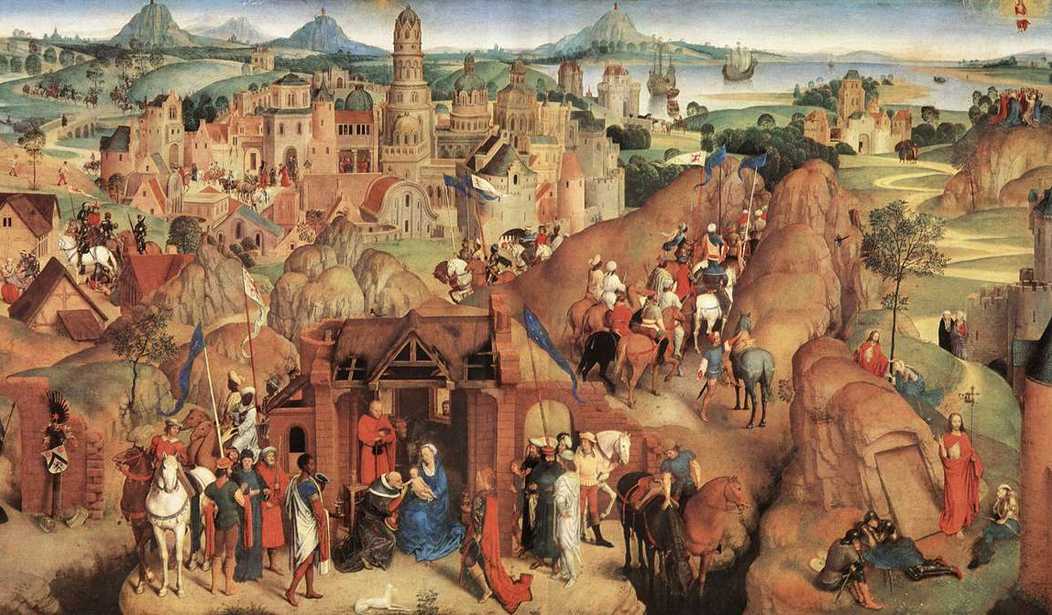
The front page image is "Advent and Triumph of Christ" by Has Memling, 1480. On display in the Alte Pinakothek in Munich, Germany. Via Wikimedia Commons.
“Sunday Reflection” is a regular feature that looks at the specific readings used in today’s Mass in Catholic parishes around the world. The reflection represents only my own point of view, intended to help prepare myself for the Lord’s day and perhaps spark a meaningful discussion. Previous Sunday Reflections can be found here.
Editor's Note: Our Sunday Reflections are free to all readers, but our VIP members help keep this platform going for everyone. Join the effort by using the promo code FIGHT to get 60% off new memberships and upgrades to VIP Gold and VIP Platinum!



Join the Conversation
VIP members get the ability to comment on articles.