As childhoods go, mine wasn’t bad. In fact, I’ve described my childhood as being straight out of Leave it to Beaver. I was lucky and blessed.
But there was one shadow looming over my elementary school years, probably the one thing that ever really gave me nightmares as a child; the idea that the world had just too many people, and that fact was going to kill us all sooner or later.
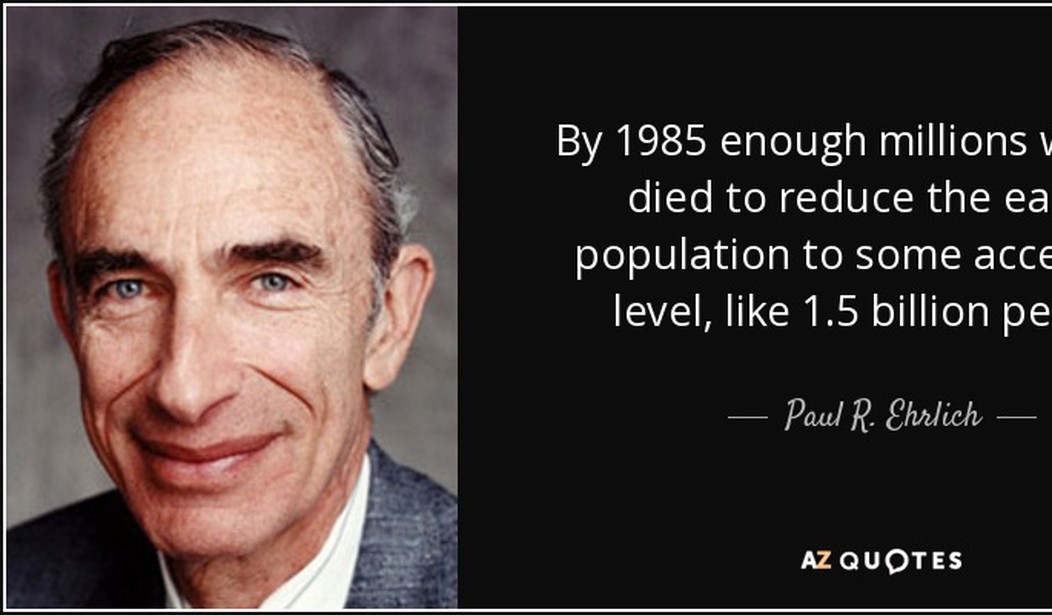
I remember in late elementary school, seeing predictions that Africa and India would both, inevitably, die back to 100 million people each, from famine and the wars and disease that are famine's precursors and consequences; that overpopulation was going to make the world unsustainable; that there would be food riots in the United States by 1985 - and that it was all inevitalble, that there was nothing we could do about any of it without a drastic (and, inevitably, centralized) resonse; it was “settled science”, as it's fashionable to call that sort of thing today.
And the usual suspects leapt into action. The United Nations tried to hijack Halloween - sending a generation of us door to door to collect money for the "UNICEF", the UN Children's Fund, instead of candy.
Other nations took more drastic steps. We'll come back to that.
One of the chief pushers of that wave of anxiety, panic, and policy, Dr. Paul Ehrlich, passed away this past week. He was the author of “The Population Bomb“, a blockbuster bestseller that cemented some of the key myths about overpopulation. My dad had a copy of it on his desk when I was a kid, and reading the dust jacket alone scarred me.
And not only did people - from my grade school teachers to the UN - take Ehrlich and his supporters seriously, but so did nations:
People today forget or simply can’t believe how depraved Ehrlich really was:
— Payton Alexander (@AlexanderPayton) March 16, 2026
Demanded that the FCC require TV shows to depict large families in a negative light, so that parents with multiple children would be shamed and ostracized by society.
Proposed forcibly sterilizing… https://t.co/WkqZaQkYEp
And while the depredations of his policy proposals fell mostly on "people of color", Ehrlich had his eye on America, too:
Proposed forcibly sterilizing millions of Americans by poisoning the water supply to make them infertile. He couldn’t think of a drug to do it “safely,” but wanted to do it anyway.
Supported actual forced sterilization campaigns in India and China, where millions of people
Warned that population growth would lead to starvation, but also proposed cutting off food aid to “overpopulated” countries to reduce their populations… by starvation.
The level of his depravity was hard to measure:
Ehrlich's legacy includes mass sterilization campaigns in India, China, and Peru.
— Crémieux (@cremieuxrecueil) March 16, 2026
India's program was at such a massive scale that, in one year, they sterilized 15 times more than the Nazis did during their entire reign. pic.twitter.com/MoW3PEMcx7
He was wrong, of course. Let the record show that Africa and India are doing famously well, and that not only are we not fighting for food here in America, but for the first time in human history, obesity is a bigger problem than malnutrition.
Even Ehrlich had to admit - very tacitly - that he'd missed some key points. Economist Julian Simon placed a bet with Ehrlich in 1980:
Simon proposed that they bet on what would happen to the price of five metals — copper, chromium, nickel, tin and tungsten — over a decade.
And the logic was that these metals were essential for all kinds of stuff — electronics, cars, buildings. So, if Ehrlich was right, more people on the planet would mean we would start running out of stuff, and the price of these things should go up.
If the price of $1000 worth of those metals in 1980 went up - indicating advancing scarcity - Simon would owe Ehrlich the difference. If they dropped, Ehrlich would pay up.
And in 1990:
...[Simon] was going through the mail at his house. And he found a small envelope from California. Inside was a check from Paul Ehrlich for $576.07. There was no note.
And famine was forestalled by more practical efforts as well:
🧵 1/14: Just days after Paul Ehrlich (the man whose 1968 book “The Population Bomb” predicted billions would starve) passed away, it’s the perfect moment to celebrate the scientist who proved Ehrlich and other doomsayers spectacularly wrong.
— Owen Lewis (@is_OwenLewis) March 18, 2026
Meet Norman Borlaug, the Iowa farm… pic.twitter.com/PU4FjJkuVn
And yet even with his theories shot full of holes, Ehrlich kept beating the drum for the next three decades of his life:
Paul Ehrlich says in 2022 that China’s one-child policy “didn’t go far enough.”
— KanekoaTheGreat (@KanekoaTheGreat) March 16, 2026
"It helped China reduce it's overpopulation or population growth, but still not far enough.
The Chinese are now planning to destroy the world by paving and putting automobiles on it by their… pic.twitter.com/YdWLYfCFnU
Ehrlich was also an early convert to the "climate change" faith and is the intellectual grandfather of the likes of Greta Thunberg.
Although "intellectual" is doing a lot of lifting in that sentence.
I rarely rejoice in a (non-violent) human's death. And I won't for Ehrlich's. But I'm doing a little jig at the end of the movement he spawned.