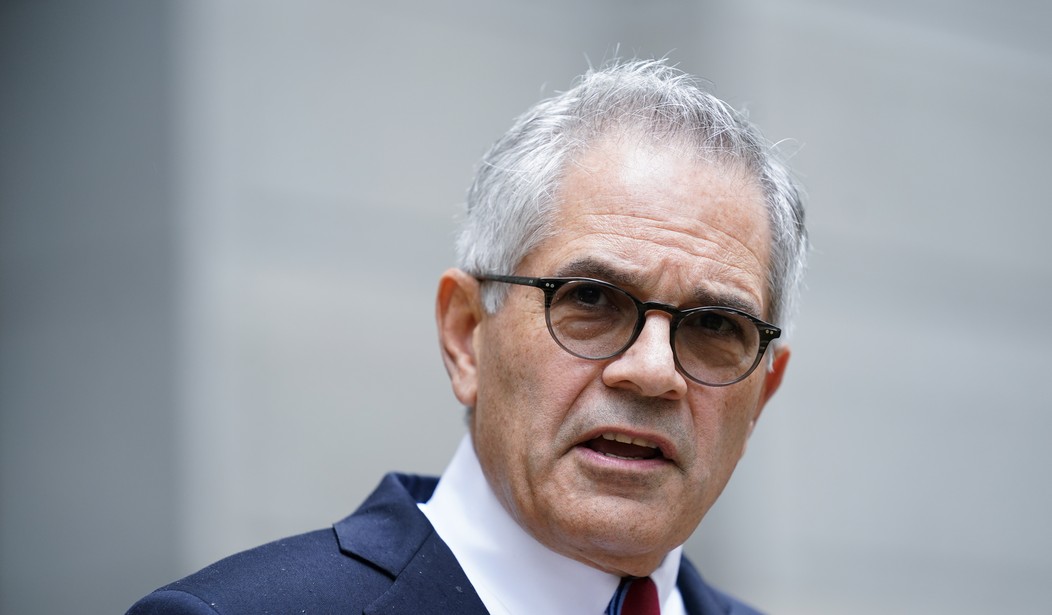
Philly DA Larry Krasner has long made it clear that the only activity he enjoys more than attacking Donald Trump is letting criminals walk free. But did Krasner lie to a federal judge in order to help free a convicted murderer?
Federal Judge Paul Diamond, a Bush appointee, certainly thinks so. In a stunning move, Diamond disqualified Krasner and his top deputy over allegations of potential perjury and obstruction connected to allegations of conflicts of interest in the case of Dennis Johnson, whom Krasner had spent four years trying to spring on a habeas petition. Diamond referred the matter to the Department of Justice for a criminal probe. NBC's Philly affiliate reported the story late yesterday:
The ruling stems from a federal case involving Dennis Johnson, who was convicted in 2009 of killing Kenyatta Smith. In 2022, the District Attorney's Office filed court documents stating that Johnson was entitled to habeas relief based on ineffective assistance of counsel.
Beginning in May, U.S. District Judge Paul Diamond held a series of evidentiary hearings that included testimony about potential conflicts of interest within the District Attorney's Office.
According to court documents, four employees rejected a proposal they viewed as inappropriate and told Krasner that the case should be referred to the Pennsylvania Attorney General's Office because they believed conflicts of interest had developed following the involvement of a supervisor.
Krasner strongly opposed sending the case to the Attorney General's Office, arguing that someone needed to stay involved to "protect the office," and dismissed the suggestion that the Attorney General's Office handle the matter, according to court documents.
The prosecutors responded that protecting the office was itself the conflict because prosecutors should be focused on the merits of the case, not the office's interests.
First off, let's take a look at the initiating event. Why would the DA's office just concede on an appeal on behalf of a convicted murderer based on ineffectiveness of counsel? Normally, prosecutors would challenge that motion and allow a judge to decide it. Instead, Krasner's lieutenant ordered the DA's office to file a concession, which touched off a four-year saga.
There may be precedent for a DA taking up this cause, but it seems unusual. If the DA felt that prosecutors convicted the wrong man, Krasner could have petitioned the state court to vacate the conviction based on new evidence. It appears from the pushback within his office that prosecutors thought it was pretty strange too, and took it to the judge in June with a petition claiming the original filing contained material misstatements of fact from Krasner's office.
Diamond discusses this in the memorandum accompanying the order, which we will get to shortly:
On June 5, 2026, the District Attorney’s Office moved to withdraw its November 2022 Concession because it contained “material misstatements.” (Doc. No. 118 at 3–4.) Unusually, four ADAs—Katherine Ernst, Steven Wildberger, David Napiorski, and Peter Andrews (“the Four”)—signed the Motion. (Id. at 8.) They explained that under the supervision of ADA Matthew Stiegler, Mason had prepared the Concession. (Id. at 3 n.1.) The Four further stated without explanation that Mason had resigned from the DAO on June 2, 2026. (Id.)
On June 11, 2026, the OAG [Office of the Attorney General - Ed] urged that the DAO’s Withdrawal Motion did not capture all the 2022 Concession’s deficiencies: that the Concession Brief “presented this Court with serious allegations that other attorneys did not fulfill their duty of candor to the tribunal and that the Magistrate Judge relied on those misstatements.” (Doc. No. 119 at 2, 5.) The OAG further charged that the Four had failed to point out “factual and legal errors and omissions” that “had a significant impact” on Judge Sitarski’s analysis. (Id. at 2.)
On June 24, 2026, in a filing authored by newly assigned ADA Thomas Gaeta, the DAO responded that no hearing was required “to resolve its motion to withdraw its prior, erroneous Response.” (Doc. No. 122 at 3.) Oddly, the DAO did not respond to the accusations the OAG had made against the Four. Rather, Gaeta noted in a footnote that “since the filing of its motion to withdraw, [the Office] has recognized that some of the assistant district attorneys involved in the case may now have an actual or apparent conflict of interest, and the matter is in the process of being assigned or referred to non-conflicted counsel.” (Id. at 2.) On June 25 and 26, 2026, the Four withdrew their appearances. (See Doc. Nos. 123–26.) The Withdrawal of Appearance Form jointly submitted by Ernst and Wildberger stated that they “believe, based on their best professional judgment, that the Philadelphia District Attorney’s Office may have a conflict of interest in this case.” (Doc. No. 123.)
The situation escalated with Diamond not long after that:
On July 20, 2026, ADAs Ernst and Wildberger filed a Notice of Conflict, stating that the entire DAO had a conflict of interest in Johnson because the District Attorney received litigation advice from Stiegler, who—because he was more concerned with his professional reputation than Johnson’s merits—had a clear conflict of interest. (Doc. No. 135 at 2.) Ernst and Wildberger further explained that Stiegler’s advice to Mr. Krasner “suggested conduct they view[ed] as inappropriate for the person litigating the merits of this habeas case.” (Id. at 2 n.1.) Ernst and Wildberger further urged that the DAO was conflicted because Mr. Krasner had ordered Ernst and Wildberger to “litigate the case in a manner to ‘protect the office,’” and that this was “incompatible with their ethical obligations and the interests of the Commonwealth.” (Id. at 2.) On July 23, 2026, in a filing authored by Gaeta and Mr. Krasner, the DAO urged that the Four were conflicted because they would become fact witnesses once the July 17 hearing resumed. (Doc. Nos. 138, 169 at 30.) The July 23 filing also stated that any conflict with which the Four were burdened had been eliminated by Mr. Krasner’s hiring of Missouri attorney Jean Peters-Baker whom he had specifically hired as an ADA and assigned to Johnson. (Doc. No. 138 at 9 n.16.)
In other words, Krasner tried to get around the conflicts of interest and politicization of the Johnson case by hiring an outside attorney for the case. That point matters when reviewing the order, but in the meantime, Diamond held several sessions of inquiry with everyone involved, while Krasner never participated or even disputed the claims:
Although Mr. Krasner chose not to testify at the three hearing sessions (July 17, August 27, or September 1), or even to submit an affidavit after the hearing, he apparently does not dispute—or does not address—much of the testimony presented. (See Doc. No. 169.)
The testimony laid out the politicization in gritty detail. Read it all, but I will just recap. Krasner lieutenant Matthew Stiegler got lobbied by the progressive Innocence Project to take action in the Johnson case, and Stiegler ordered Mason to file the concession to Johnson's challenge. At this point, no one in the DAO had bothered to re-interview witnesses or consider whether the habeas petition was even well-founded. Mason complied because Stiegler told her that Johnson's counsel had already performed an "independent investigation," and that she did not need to perform any due diligence as a result. Stiegler claimed in the hearing that he expected Mason to do an independent review, and Diamond writes:
I do not credit Stiegler’s hearing testimony that he believed Mason would conduct a full investigation of Johnson. (Id. at 70:6–21 (Stiegler).) Indeed, contrary to the Defender’s advice, he assigned an inexperienced ADA to Johnson, making it more likely that she would not question his actions or orders. (Id. at 14:14–19, 21:20–22:10 (Mason), 65:3–18 (Stiegler).)
That may be one of the perjury allegations in Diamond's referral. The obstruction issues may relate to collusion between the two parties to manipulate the federal court on the habeas petition:
In reopening Johnson’s Section 2254 Petition, the DAO and the Defender entered into a joint briefing schedule. (Doc. No. 73.) As the filing deadline approached, Mason and Stiegler met with Defender and Innocence Project lawyers “many, many times.” (Doc. No. 141 at 24:1–11 (Mason).) The participants discussed “which claim would be the best claim to concede on.” (Id. at 29:11–16 (Mason).) Mason’s September 15, 2022 notes of one such meeting (which Stiegler falsely described as Mason’s “report . . . of her review of the case”) confirm this. (Id. at 79:8–12, 88:11–16 (Stiegler).) She summarized the arguments defense counsel made: “Strategy for response: Concede that Johnson is entitled to complete relief on the Brady claims rendering other claims moot.” (Exs. R-1, R-2; Doc. No. 141 at 80:25–81:1, 82:18–20, 83:10–12 (Stiegler).) When legal difficulties arose, the thinking then “shifted” to conceding Johnson’s ineffectiveness claim, which had been exhausted. (Doc. No. 141 at 30:3–10 (Mason).)
That certainly looks like a huge conflict of interest. Why would Krasner's chief deputy collude with his nominal adversary to strategize over the approach to a federal court?
The effluvium really hit the fan when Mason and others in the DAO began to dig into the concession that Stiegler had ordered Mason to sign and submit. They determined that it was largely nonsense and that the filing had contained several material and misleading misstatements. Mason, who figured out belatedly that Krasner and Stiegler set her up to be the patsy, resigned from the DAO. Diamond concludes that Stiegler went on to try to blame it all on Mason, just as she suspected:
At this time, Stiegler “lobbied” Ernst and Napiorski. (Id. at 50:5–18, 53:9–15 (Ernst), 166:14–22 (Napiorski).) Early on June 5, Stiegler told Ernst that Mason “had purposefully inserted the false facts into the response,” and that “this was one hundred percent her fault, zero percent his fault.” (Id. at 45:3–16 (Ernst).) Stiegler suggested that the DAO “file something with the Court preemptively before the hearing explaining that we had gone through Ms. Mason’s cases, that we found mistakes in other cases too, and that, therefore, this was all her fault.” (Id. at 45:16–20 (Ernst).) Ernst responded that if there were errors in Mason’s other cases, this would only show a pattern of poor supervision by Stiegler. (Id. at 45:21–46:3 (Ernst).) He nonetheless persisted:
[W]e have to get out ahead of this. Because if we get out ahead of it, then the Judge will view this as one rogue ADA—well, an ADA who went rogue basically. And whereas if we don’t, then he will think of this as this was all Matthew Stiegler’s fault.
(Id. at 46:6–10 (Ernst).) Stiegler made the same suggestion to Napiorski: “to look through old filings or old documents that Ms. Mason prepared and find more mistakes and to kind of paint her as a rogue actor.” (Id. at 163:13–25 (Napiorski).) Yet, Stiegler testified before me that Mason was an “experienced” ADA, “one of our strongest ADAs in the [U]nit.” (Doc. No. 141 at 92:25–93:5, 104:23–105:7 (Stiegler).) In urging Ernst and Napiorski to say just the opposite, Stiegler was urging them to misrepresent to the Court. See infra Section II.
Holy crap. That's going into 'conspiracy to obstruct justice' territory. And guess who else was in on the conspiracy?
Andrews handed Mr. Krasner a printed draft of the Motion to Withdraw. (Doc. No. 160 at 51:15–17 (Ernst); Doc. No. 165 at 30:9–13 (Andrews).) Mr. Krasner’s edits included a change that lessened Stiegler’s apparent involvement in preparing the Concession Brief. (Doc. No. 160 at 51:18–25 (Ernst).) By the end of the meeting, Mr. Krasner approved the filing. (Doc. No. 160 at 52:1–2 (Ernst), 165:10–13 (Napiorski); Doc. No. 165 at 11:15–12:1 (Napiorski), 30:14–16 (Andrews).)
Mr. Krasner then told the Four:
[S]omeone gave me a really good idea. Actually, it was Matt, Mr. Stiegler, that gave me this really good idea. I think that we should go through Ms. Mason’s cases, find mistakes that she made in other cases, say that this was a pattern by her, and then file something with the Court saying that.
(Doc. No. 160 at 52:5–11, 106:17–20 (Ernst), 122:23–123:2 (Wildberger), 165:14–20 (Napiorski); Doc. No. 165 at 36:9–14 (Andrews).) Like Stiegler, Mr. Krasner wanted the DAO to submit a false narrative to the Court. See infra Section II.
Diamond had clearly heard enough at this point. His order disqualified Krasner, Stiegler, and denied Peters-Baker's motion to represent the DA in the case pro hac vice. Diamond also threw out a submission from Peters-Baker on the habeas matter, the entire reason Krasner hired Peters-Baker in the first place.
Krasner and Stiegler are in deep trouble, and the Innocence Project may end up entangled in a criminal probe as well. Diamond, a George W. Bush appointee, lays out a pretty good case for an indictment in this memorandum, based on testimony and documentation already submitted in federal court. The only question will be how enthusiastic the DoJ will be in pursuing a case against a radical TDS-suffering Soros prosecutor, and ... that question answers itself, no?
Editor’s Note: Help us continue to report the truth about corrupt politicians.
Join HotAir VIP and use promo code FIGHT to receive 60% off your membership.








Join the conversation as a VIP Member