






Not being a logically inclined type, yet surrounded by them in my life - not only with a brilliant dad and every last brother, but my husband and our son as well - I have always admired those who have an aptitude for numbers, engineering, and work to develop higher math skills. There were some things that came easily to me in high school math - working with planes in geometry was one of them. I always assumed it was because my brain is so out there that visualizing was easy for me.
But a word problem in algebra would stymie me for days. I would always get the right answer because I'd work it out on the back of the test paper why Mary Sue got to the grocery store before Ellen, even though she left after her. But I would never get credit for it because, oh, that darn formula you were supposed to have in the 'show your work' portion.
Mine was always a drawing.
Hopeless, I know.
But at least I had an idea and good teachers, God bless them, who tried.
Something must have subconsciously stuck because even on standardized testing back then, my SATs and ASVABs were more than presentable.
I believe kids today are up against a number of barriers, some of them self-induced or a household issue, but the vast portion of it is thanks to the shape of the educational system right now.
For one thing, even a few years ago, a frustrated friend had tried to help his daughter with her math homework and, as most parents are, he was a few years past remembering how to do whatever the equations were she was stuck on. In any of our math textbooks, there was always a reference section where you could go, parents included, that gave you examples for any given chapter of 'how things work.'
Only his daughter didn't have a textbook. She had a school-issued computer, no workbook, nothing tangible, and her math program had no 'help' section. Just assignments.
He had never realized that was what was happening.
Do teachers have time to work through these concepts like they used to? I don't know - I don't have kids in school anymore. But the more I see various school districts publicly wondering if they should rethink the 'every child needs a laptop' concept of the past five or 10 years, the more it makes me wonder what damage has been done to a whole generation.
And is this why, under the guise of 'metrics are racist, ' colleges stopped requiring standardized tests like the SAT and ACT to determine not who's the best and the brightest, but as a basic measure of who could handle college-level coursework?
It seems those chickens are now coming home to roost, and not just in community and liberal arts colleges, but in what are supposed to be the finest STEM-oriented universities in our country.
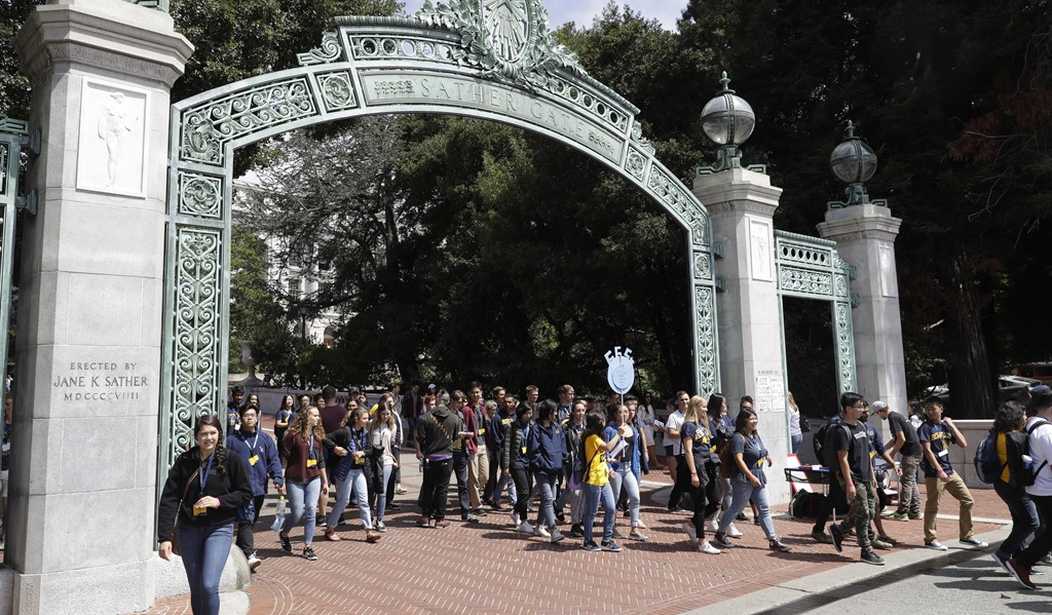
Cal Berkeley is cooked: I teach calculus at Berkeley. Some of my students can’t do middle school math
— Steve Guest (@SteveGuest) August 16, 2026
“Since the University of California abandoned the SAT and ACT, thousands of faculty say it’s admitting students who aren’t prepared for the coursework.”
“I teach mathematics at… pic.twitter.com/jrF0B5TXJW
If they can't do math when they get to Berkeley, what were they doing in high school?
But to be fair, Berkeley, instead of virtue signaling, should have been making sure they could before it ever accepted them.
But then, Berkeley had Janet Napolitano as president in 2020, when this vicious experiment began.
...I teach mathematics at UC Berkeley. Three days a week, I stand in front of lecture halls with 500 to 1,400 students. By the second week of the semester, I already know who is in trouble. Some students are five to eight years behind in mathematics. Office hours that should be spent discussing integrals instead become lessons on fractions and basic algebra you would expect students to learn in middle school.
That is why this spring and summer, thousands of faculty members across all 10 UC campuses — including more than two-thirds of UC’s mathematics faculty — signed open letters(opens in new tab) urging the system to restore the SAT and ACT in admissions. Five Nobel laureates joined us, along with professors from across the university, including Beatriz Manz, Berkeley’s first Latina full professor.
We did so because what an admission letter is supposed to mean — that a student is ready to attend the school — no longer matches what we see in our classrooms.
...In January 2020, a UC task force(opens in new tab) studied standardized testing and recommended keeping it. Then-President Janet Napolitano nevertheless urged the Board of Regents to phase out the SAT and ACT, citing pandemic disruptions and long-standing equity concerns. The regents voted that May to make testing optional, and a court ruling(opens in new tab) later that year, focused on access for students with disabilities, required UC to become completely test-blind through 2025.
Since then, admissions officers have been forbidden from considering the one standardized measure that provided a common academic benchmark across California’s thousands of high schools.
In 2023, I wrote a post about how Caltech, another totally egghead university, had dropped the entrance requirements for chemistry, calculus, and physics, 'if your school didn't offer them,' which is, sadly, another sign of our educational times.
What Caltech did, though, wasn't a complete pass for skipping out on the courses. They called them 'alternatives.' Applicants could either test out on the International Baccalaureate exams or attend something like Khan Academy courses and earn their certification with a 90 percent or better passing grade.
This was really a clever workaround.
...But not having it available in high school isn’t a free pass – a student still has to take course and pass a subject certification exam, or Caltech will also accept a score of 5 on AP exams and a score of 6 or 7 on International Baccalaureate exams So this new program isn’t a gimme, per se. The ability has to be proven prior to being accepted.
…One of Caltech’s alternative paths is taking Khan Academy‘s free, online classes and scoring 90% or higher on a certification test. Sal Khan, academy founder, said Caltech’s action is a “huge deal” for equitable access to college. While Caltech is small — only 2,400 students, about 40% of them undergraduates — Khan said he hoped its prestigious reputation would encourage other institutions to examine their admission barriers and find creative solutions to ease them.
Caltech has also reinstated its SAT/ACT requirement, as have many others like Harvard, Yale, and Stanford, with a big Ivy League push underway to revisit reinstating it there, too.
At Berkeley, the author of the piece, award-winning Professor Zvezdelina Stankova, says they are retrenching in the opposite direction, even as the faculty begs to return to proper screening for the benefit of the students and the university' programs.
As she also points out, blaming COVID or even, now, AI in admissions essays as the villain is no longer applicable to what is happening.
...Both those factors surely contributed. California’s K-12 math program isn’t a success story. In 2025, only 37% of students in the state performed at grade level(opens in new tab).
But neither fully explains what faculty are seeing.
General learning loss would lower the entire distribution. It would not hollow out the middle while piling students up at exactly zero. Something else appears to be compounding the problem. Whatever the mix of causes, the problems at UC accelerated precisely when the system discarded the one standardized baseline it once had. Without standardized tests, admissions officers are flying blind, especially as grade inflation has made transcripts a weaker indicator of readiness, and artificial intelligence has made admissions essays a weaker signal of students’ work.
It’s also worth remembering that students entering in fall 2027 were in fifth grade when the pandemic began. If, seven years later, many cannot reliably solve a basic inequality such as x² > 4 — a four-answer multiple-choice question that fewer than half answered correctly — then “pandemic learning loss” is no longer doing all the explanatory work.
Berkeley administration is going through yet another navel-gazing examination of 'What are we gonna do, George?' that won't be complete before the end of 2027, which means, as the author points out, nothing can change before 2028.
...Faculty have presented years of classroom evidence. Nobel laureates have spoken. School districts have begun passing resolutions. Yet the university’s response remains another study, another committee, and another delay.
The question is no longer whether more evidence is needed.
It’s how many more students we are willing to gamble with before acting.
I don't think the university administration and regents are so much concerned with numbers and outcomes. If they were, it would have changed.
If they had to actually deal with 'students,' perhaps, but not at the big-idea level they operate at.
What Ms. Stankova says holds true for many dedicated but horribly frustrated teachers who want to teach. It's a double-edged sword. They are being disserviced by the experimentation in the grades below theirs, but how many of their peers in the liberal arts and perhaps even in STEM were advocates themselves?
This also doesn't shake out overnight by magically adding SATs/ACTs that high schoolers cannot pass, which is obviously going to be an issue if scores are already below grade level across the state.
There has been so much harm done to these children, and, by extension, the country, by catering to the lowest common denominator.
Editor's Note: The Democrat Party has never been less popular as voters reject its globalist agenda.
Help us continue exposing Democrats' plans to lead America down a dangerous path. Join HotAir VIP and use promo code FIGHT to receive 60% off your membership.



Join the Conversation
VIP members get the ability to comment on articles.