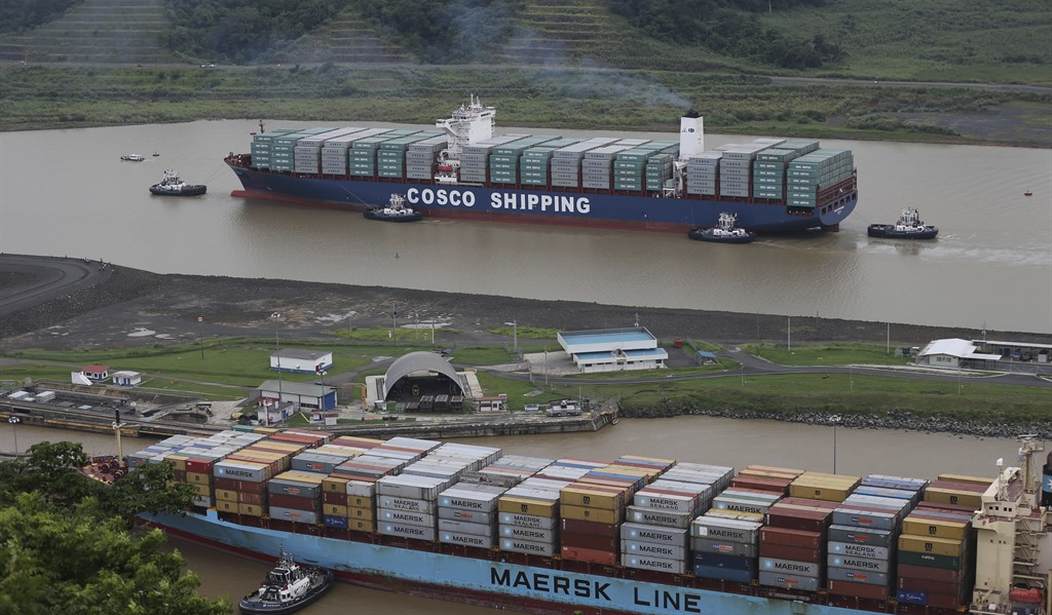
Well, it was a short and much-appreciated respite. After almost two years of an El Niño-induced drought with no random helpful tropical systems blowing through to ease the pain...
The climate hoaxers at World Weather Attribution @WWAttribution pretend to be even handed by arbitrarily deciding that emissions are not to blame for low rainfall at Panama Canal.
— Steve Milloy (@JunkScience) May 1, 2024
Don't be fooled. WWA is just making it up as it goes along so as to advance the climate hoax.… pic.twitter.com/7RS8tPpgIY
...in 2024, the waters of Gatun Lake, which feed the Panama Canal and the freshwater system of locks on both ends, finally started to rise again with the arrival of sweet, blessed rain.
By June that year, projections for increasing passages back to nearly the historical norm of 34-38 ships a day, and increasing the draft allowance so more of the super-sized Panamax ships could make the trip were humming along.
With the Houthis becoming active around that time, and maritime insurance woes just beginning, every last avenue and alternative for international shipping was crucial for keeping freight both moving across the globe and as affordable as possible.
Fast forward to this year. When the United States went after Iran, and the Straits of Hormuz became virtually impassible for months on end, both because of the conflict and Iranian threats and the lack of insurance from spooked brokers, having access to the Panama Canal was an imperative for global commerce and moving what energy supplies could be routed through it.
This is quite a cool video of a liquefied natural gas (LNG) tanker motoring along in the Canal.
As a general safety rule in the Panama Canal, the combined speed when meeting a LNG carrier should not exceed 12 kts. We can't do much about the passage distance.
— Themaritimepilot (@Themaritimepil2) July 22, 2026
Besides the LNG is assigned 2 tugs all the way througout the transit.
Good day! pic.twitter.com/KkrUalfqcZ
This year, in what is good news for the United States, particularly those of us who live in hurricane-prone zones, we are undergoing another one of those natural cyclic changes in the weather - back to an El Niño, and this one is predicted to be one of the strongest on record.
Its effects were already obvious for the past two days, as we watched trees whipping in 40+ mph gusts with a little rain. All thanks to Tropical Storm Bertha rolling along at a snail's pace just offshore, which, had it been a La Niña year, could have possibly roared onshore as a monster.
Bertha is exactly the type of tropical storm we want during this climate-fueled Super El Niño.
— Ryan Maue (@RyanWeather) July 21, 2026
Strong wind shear likely related to the supercharged Pacific Ocean waters is acting like a giant leaf blower = wind shear that is tipping the storm to the south exposing its inner… pic.twitter.com/zEtKdVdExY
...Strong wind shear likely related to the supercharged Pacific Ocean waters is acting like a giant leaf blower = wind shear that is tipping the storm to the south exposing its inner thoughts.
60 mph winds, but in a different year, could have been 160 mph
While we're all feeling a bit more sanguine about the prospects for a less-than-miserable hurricane season, in Panama, any El Niño is treacherous from a less-than-average rainfall perspective. But the 'super' one they are predicting is really going to cause trouble for the levels in the Canal and a global shipping industry that is already constrained by human events now is going to have to deal with a major weather one.
The water levels in the Canal are already declining, and the Canal Authority is being forced to plan accordingly.
🚨Add a 4th chokepoint to the list, and this one has nothing to do with any war.
— Jack Prandelli (@jackprandelli) July 21, 2026
The Panama Canal Authority is suspending part of its booking system, daily auctions for Panamax class locks, starting July 25, because of water levels at Gatun Lake and the risk of a new El Niño.… https://t.co/FnjUxgRsKz pic.twitter.com/0lzyQ5NPvk
...The Panama Canal Authority is suspending part of its booking system, daily auctions for Panamax class locks, starting July 25, because of water levels at Gatun Lake and the risk of a new El Niño.
Hormuz, Bab el-Mandeb, and the Black Sea are jammed by conflict.
Panama is jammed by weather.
Churchill's warning about never depending on 1 route did not specify which kind of disruption.
'Tighter access' means less cargo and higher premiums to be the boat that can transit.
...The tighter access to the Panama conduit comes as other global chokepoints have faced disruptions, slowing trade and boosting costs. In the Middle East, the Iran-US war has brought traffic through the Strait of Hormuz to a near-halt after vessel attacks. Elsewhere, Yemen’s Iran-backed Houthi militant group has threatened shipping via the Bab el-Mandeb Strait in the Red Sea. The Panama Canal Authority didn’t immediately respond to calls and emails seeking comment outside working hours.
Daily auctions in so-called period three for the canal’s Panamax-class locks will be halted from July 25 until further notice given present and projected water levels at Gatun Lake, Norton Lilly said in a notice on its website. As a result, daily booking capacity will be cut from 36 to 34 vessels, it said.
The suspension is being introduced based on current hydrological conditions, as well as the potential development of an El Niño weather pattern, it said, citing the authority. Previous El Niños have dried up freshwater lakes supplying the canal, causing the authority to impose daily transit restrictions.
The Panama suspension would mean fewer opportunities to get slots; more competition for openings in periods one and two; and potentially “greater challenges” for ships without confirmed bookings, Norton Lilly said.
Gatun Lake, which sits above the waterway and feeds the locks below, currently has a depth of 84.6 feet (25.8 meters), tracking just below the five-year July average of 84.7 feet, according to the Panama Canal Authority. Water levels are projected to keep declining in the coming months, falling to 83.8 feet by late September, 1.4 feet below the five-year average.
During the last El Niño of 2023-2024, monthly vessel traffic through the canal plunged from a pre-El Niño peak of 1,523 in December 2022 to a low of 1,054 in February 2024, according to data provided by Weathernews Inc.
In recent months, forecasters have warned that this year’s El Niño may be particularly severe, raising the prospect of significant disruption. Earlier this month, the US Climate Prediction Center said the pattern had continued to build and would likely be one of the strongest in more than 75 years.
The country is running at the low end of its average for the past seven weeks of rain, and El Niños are typically a drier-than-normal event for Central America.
The Canal Authority is in the planning stages for what's predicted to be rainfall amounts in 'the bottom third of historical norms' for the August-November timeframe. They are utilizing lessons learned during the last go-round.
...In June, the Panama Canal Authority said it was stepping up efforts to brace for El Niño-fueled extremes by drafting a plan that avoided limiting the type of vessel restrictions that hampered shipping three years ago.
Plan for the worst, hope for the best is prudent and something they had not done in any great measure previously. It was all reactive.
Should the water levels decline precipitously, this will be another stressor on the world's supply chain, unless the United States can ensure shipping passages through Hormuz, where the number of ships transiting has again 'collapsed' as the situation deteriorates.
...Transit numbers have collapsed as a result. At one point only six ships crossed the Strait in a single day, the lowest figure in five weeks. Hundreds of vessels have been left at anchor beyond the entry points, unwilling or unable to proceed.
The human cost sits alongside the financial one. The International Maritime Organization’s own incident log records seafarers killed and injured through July, including fatalities aboard vessels struck while transiting the waterway. Around 6,000 seafarers remain effectively trapped in the region.
The insurance market has pushed back hard on one persistent claim: that reduced traffic reflects an inability to get cover. The Lloyd’s Market Association has stated publicly that war risk insurance remains available in the London market, and that owners are choosing not to transit on safety grounds rather than being priced out entirely. Liability cover through the P&I Clubs is non-cancellable and remains reinsured in London, the LMA notes. What has moved is the price of hull, cargo and fixed-premium charterers’ cover, some of which was cancelled outright earlier in the crisis before being repriced.
Governments have stepped in to backstop the gap. The US International Development Finance Corporation was directed to provide political risk insurance, partnering with commercial insurers on a reinsurance facility offering up to $40 billion in revolving cover across hull, cargo and liability risk. Chubb was named lead partner on that facility, offering war hull, war P&I and war cargo cover, though the conditions attached have not been fully disclosed.
The major industry bodies have issued their clearest warning yet. BIMCO, the International Chamber of Shipping, INTERTANKO, OCIMF, INTERCARGO and IMCA jointly published a 22-page advisory stating that even a technically open Strait may not be safe to transit. The document warns of kinetic threats, electronic warfare, mines, drones, GPS spoofing and heavy congestion all occurring at once.
On the contractual side, owners are leaning on the standard war risks provisions built into most charterparties. BIMCO’s CONWARTIME and VOYWAR clauses allow an owner to refuse an order to proceed where, in the master’s or owner’s reasonable judgment, the vessel, cargo or crew may be exposed to war risk.
Sanctions add a further layer of complexity. Because the IRGC is a proscribed or sanctioned entity in both the UK and the EU, standard BIMCO sanctions clauses bar charterers from issuing any order that would involve a sanctioned party or activity, including compliance with Iranian demands over Strait passage. Legal advisers are pointing owners toward guidance from the US Treasury’s Office of Foreign Assets Control on exactly this risk.
Should the Canal Zone catch a lucky tropical system or two overhead with moisture enough to replenish some of the water, that would help forestall the worst of the impact.
But it is weather.
It's painful but prudent to plan ahead for when there are no rainy days.
Editor's Note: We now have the room to run outside commentary by some of our favorite and most provocative thinkers on the Right. That only happens because of the support of our readers, who ensure that we have the resources to keep providing an independent platform and independent voices in a sea of Protection Racket Media domination.
Help us maintain that fight! Join HotAir VIP and use promo code FIGHT to get 60% off your membership.











Join the conversation as a VIP Member