This is kind of fun in this day and age, to hear this term being used by serious people in a serious fashion, in concert with the government of the United States.
LETTERS OF MARQUE AND REPRISAL
And I have to clarify for those not up to speed on the nuances of high seas piracy and such things - I'm not really talking about pirates if I'm talking about letters of marque. I'm talking 'privateers.' Privateers are basically private contractors given licenses by the government to do ocean-going seizures of enemy ships and goods for them for a cut of the proceeds. Helps the Navy out, which is usually busy, and keeps their losses to a minimum if things get dicey.
The practice of 'hiring' these contractors or privateers is known as issuing 'letters of marque and reprisal,' which authorize the holder to freely seize designated enemy assets - ship, cargo, and crew - at will.
It's also Constitutional, having been an important part of a young America's military arsenal when we were ship-poor.
It is also expressly a Congressional or federal power. Individual states may not issue letters of marque.
Article I, Section 8, Clause 11 of the Constitution authorizes Congress to "grant letters of Marque and Reprisal[,]" which are instruments that permit private citizens to seize enemy vessels and their cargos and crew. This Sidebar is part of a two-part series that discusses Congress's power over these instruments. This installment provides an overview of letters of marque and reprisal and places them in historical context. Part 2 examines the instruments' role in the drafting of the Constitution, discusses their rise and decline in U.S. practice, and outlines proposals to revive use of the instruments in modern contexts.
Overview of Letters of Marque and Reprisal
Letters of marque and reprisal were once common tools for countries with small naval forces to augment their militaries by drawing upon the strength of their private merchant vessels. As a young country, the United States used the instruments with success in several early conflicts, including the Revolutionary War and the War of 1812. Over the course of the 19th century, however, commissioning private parties to use armed force fell out of favor in domestic and international practice, and Congress has not authorized a President to issue the instruments since the Civil War.
During the era when the United States used letters of marque and reprisal, Congress historically authorized the President to issue the instruments, subject to statutorily defined requirements and conditions, rather than issue instruments directly from the legislative branch. Individual states, by contrast, are prohibited from issuing the instruments under Article I, Section 10 of the Constitution.
The Framers of the Constitution placed the Marque and Reprisal Clause between provisions that authorize Congress to declare war and to "make Rules concerning Captures on Land and Water." These three authorities are interrelated and can function together. For instance, in conjunction with declaring war, Congress might authorize letters of marque and reprisal allowing private ship-owners to assist the war effort by targeting enemy vessels, as it did in the War of 1812. Holders of those letters could then capture enemy vessels and bring them into port to be condemned and sold as prizes of war. Using its authority to "make Rules concerning Captures[,]" Congress could define the legal framework governing how the condemnation proceedings would operate and how the proceeds of the sale would be distributed.
The Supreme Court has mentioned the Marque and Reprisal Clause most frequently when listing Congress's war powers and authorities over foreign affairs. The Court has described the power to issue letters of marque and reprisal as an inherent feature of sovereignty that is national in nature. The Court has further observed that the Constitution expressly grants Congress the power to issue the instruments and that "no restrictions are imposed" upon that authority. Finally, in an opinion for the Court in Barron v. City of Baltimore, Chief Justice John Marshall observed that the Constitution grants power over the instruments to the federal government while denying states the ability to issue them because, "[t]o grant letters of marque and reprisal, would lead directly to war; the power of declaring which is expressly given to congress."
As the piece says, none have been authorized since the Civil War (although there has been some talk for some time about issuing them to private hackers in the cyber wars - assets don't always have to be 'wet'), but the authority to do so is right there in the Constitution.
Back this past February, Representative Tim Burchett of Tennessee introduced something he called 'H.R.1238 - Cartel Marque and Reprisal Authorization Act of 2025.'
What it was intended to do was authorize the president to issue letters of marque and reprisal to privateers to go after cartels, associates, or conspirators.
...To authorize the President of the United States to issue letters of marque and reprisal with respect to acts of aggression against the United States by a member of a cartel, or a member of a cartel-linked organization, or any conspirator associated with a cartel, and for other purposes.
...SEC. 3. Issuance of letters of marque and reprisal.
(a) Authority of President.—The President of the United States is authorized and requested to commission, under officially issued letters of marque and reprisal, so many of privately armed and equipped persons and entities as, in the judgment of the President, the service may require, with suitable instructions to the leaders thereof, to employ all means reasonably necessary to seize outside the geographic boundaries of the United States and its territories the person and property of any individual who the President determines is a member of a cartel, a member of a cartel-linked organization, or a conspirator associated with a cartel or a cartel-linked organization, who is responsible for an act of aggression against the United States.
(b) Security Bonds.—No letter of marque and reprisal shall be issued by the President without requiring the posting of a security bond in such amount as the President shall determine is sufficient to ensure that the letter be executed according to the terms and conditions thereof.
(c) Definition of cartel.—In this section, the term “cartel” means an organization that—
(1) is described in section 1 of the executive order titled “Designating Cartels And Other Organizations As Foreign Terrorist Organizations and Specially Designated Global Terrorists” and dated January 20, 2025; or
(2) is a “transnational criminal organization” under the meaning given that term in section 3003(5) of the Public Law 118–50 (21 U.S.C. 2341(5)).
Intriguing and novel but vintage concept, and it's been sitting in the House Committee on Foreign Affairs ever since.
Senator Mike Lee might get Burchett's bill moving out of committee, as he introduced the sister legislation in the Senate yesterday.
Would you like to seize cartel assets as a privateer?
— Mike Lee (@SenMikeLee) December 18, 2025
My bill would allow the president to issue you a letter of marque.
Time to take these pirates down. 🏴☠️ https://t.co/Gea6Y0MVyl
As these are drug cartels and drug-running operations for the most part, there are a few issues to be resolved about inventory disposal and such. There's a...um...spirited discussion on that point in the comments.
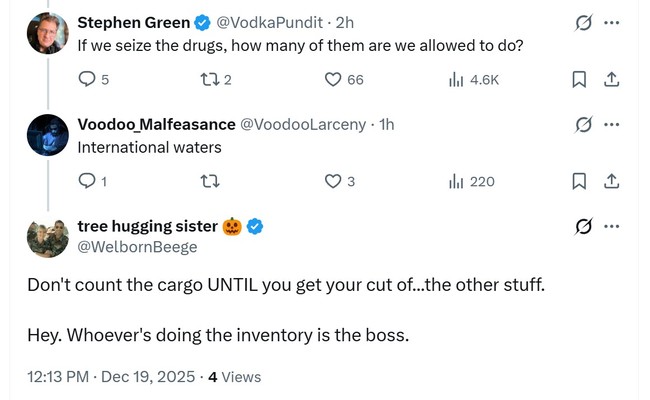
And as with any modern business, there are liability issues to iron out and disclaimers to sign before the deal is sealed.
SON? YOU'RE ON YOUR OWN
Bring back the Letter of Marque!!! Just make sure if you accept it, don’t expect the US Navy to rescue you if you get into trouble. You’re on your own. So hoist the mainsail and beat to quarters! @johnkonrad @mercoglianos https://t.co/7Hb7gsJmy9 pic.twitter.com/hCs1R6DlX4
— John Bulkeley (@bulkeley_john) December 19, 2025
Once that's all squared away, though, well, it could turn out to be, as Breitbart put it, a fleet of Patriots of the Caribbean shoving off to sea in pursuit of fortune and glory.
...Lee gave a nod to history in calling for the enabling of private citizens to take the fight against pirates, noting that Article I, Section 8, Clause 11 of the Constitution authorizes Congress to “grant Letters of Marque and Reprisal.”
“The Constitution provides for Letters of Marque and Reprisal as a tool against the enemies of the United States,” Lee said. “Cartels have replaced corsairs in the modern era, but we can still give private American citizens and their businesses a stake in the fight against these murderous foreign criminals. The Cartel Marque and Reprisal Reauthorization act will revive this historic practice to defend our shores and seize cartel assets.”
Burchett zeroed in on the fentanyl epidemic as a justification for the law, pointing out the risk to American national security presented by the cartels.
“They push millions of dollars in fentanyl into our country with no regard for American lives,” he said. “It’s time to get creative about how we face these threats. These cartels present a serious risk to our national security, and this bill would authorize President Trump to commission Americans to help defend our homeland.”
Lee's bill is very much a mirror image of Burchett's, so there shouldn't be too much squabbling to reconcile the two if either passes muster in their respective chamber.
This has also given heart to some analysts who had floated the idea over a year ago. They are tickled.
In August of 2024, Chuck DeVore over at The Federalist wrote about beefing up a scaled-down US Navy with?
Privateers.
That's great! I proposed that last year - great force multiplier. https://t.co/yckwRlZ2eG
— Chuck DeVore (@ChuckDeVore) December 19, 2025
He's feeling pretty smug right now.
To Bolster An Aging U.S. Naval Fleet, It’s Time To Bring Back Privateers
he U.S. Navy isn’t just for fighting overseas or protecting the homeland. It’s also a basic tool of force projection, diplomacy, and protecting and regulating international trade. But today’s Navy is too small to meet the demands placed on it. As a result, traditional Navy tasks, such as enforcing sanctions, are far down the priority list. But this capability gap could be filled if we had the boldness to bring back privateers.
During the long response to the Sept. 11, 2001, attacks and the delusion of the peaceful rise of the People’s Republic of China (PRC), the U.S. Navy was allowed to atrophy. One tangible consequence: Today, America reportedly has no aircraft carriers dedicated to deterring an increasingly bellicose China — they’re all either in the Middle East, headed to the Middle East, or in various stages of training or repair.
Navies aren’t cheap. Modern ships take a long time to build — at least in the West; the PRC seems to be building dozens of warships quite quickly — and the U.S. defense industrial base needs billions to even begin to ramp up production. So our Navy will be too small for at least a decade.
...In February, the U.S. blacklisted 14 Russian tankers operated by Sovcomflot, a state-run shipping company. It doesn’t appear that the blacklisting has had any practical effect, as there is no record of any ship being impounded. But declaring sanctions and then not diligently enforcing them erodes U.S. credibility — and, with it, deterrence.
It was estimated that 196 tankers loaded with crude oil left Russian ports last December alone, with most of the ships flying flags of convenience from Panama, Gabon, and Liberia. As the ships pass near European powers, they’re often escorted by Russian warships, but then they’ll “go dark” — turning off their transponders as they link up with other vessels to transfer the oil or offload it in ports where the adherence to rule of law is a bit spotty.
If the U.S. truly wants to shut down Russia’s ghost fleet, it should consider an old but effective tool: privateers. Bringing back privateers, sanctioned under the U.S. Constitution, to target the Russian ghost fleet can bolster national security while the U.S. fleet is rebuilt. This approach, grounded in historical precedent and legal framework, would enhance U.S. strategic flexibility, especially if paired with a policy that promoted American energy dominance.
Imagine him talking about that 'ghost fleet' a year ago, and here is President Trump taking specific aim at the sanctioned tankers in it just this week with an active blockade.
Timing is everything.
There was an opposing argument raised when Burchett first broached this idea back in January, and Mike Lee followed up on it - that privateering is a violation of international law and supposedly the US has 'agreed' to that. Sen Lee didn't believe that was much of an impediment in light of what they feel is at stake with the cartels.
...The last time Congress exercised the power—which was more than 200 years ago—it was an affordable way for the state to disrupt the economies of its enemies and help fund the U.S. war effort.
Today, privateering is considered a violation of international law and the U.S. has agreed not to do it. But Lee thinks the U.S. should bring it back to tackle the cartels, which he claims are threatening to target U.S. planes deporting undocumented immigrants.
“Congress could issue letters of marque and reprisal authorizing private security firms or specially trained civilians to intercept cartel operations, particularly those involving drug shipments or human trafficking across borders,” he wrote.
The operations would focus on disrupting supply lines, capturing high-value targets, or seizing assets like boats, vehicles, cash and weapons. The benefits would be more flexibility and lower costs for the government, he argued, and could be an “effective alternative to war.”
Lee admitted the idea would draw criticism, but argued that “abstract” principles like international law should take a back seat to the “clear and present threat” posed by the cartels.
I'm a firm believer that a vague, international 'US agreed to it' has never stopped the US from doing something explicitly in the Constitution if it felt it had to.
Consider this your heads up - if you ever had a hankering to be a person of adventure, are handy with a four-stroke or higher motor and engine repairs on the fly, and not prone to barfing your guts out in a rowboat, less mind rockin' open water, there might be a privateering spot for you somewhere in the Caribbean.
You might turn out to be the best privateer we've ever seen, savvy?