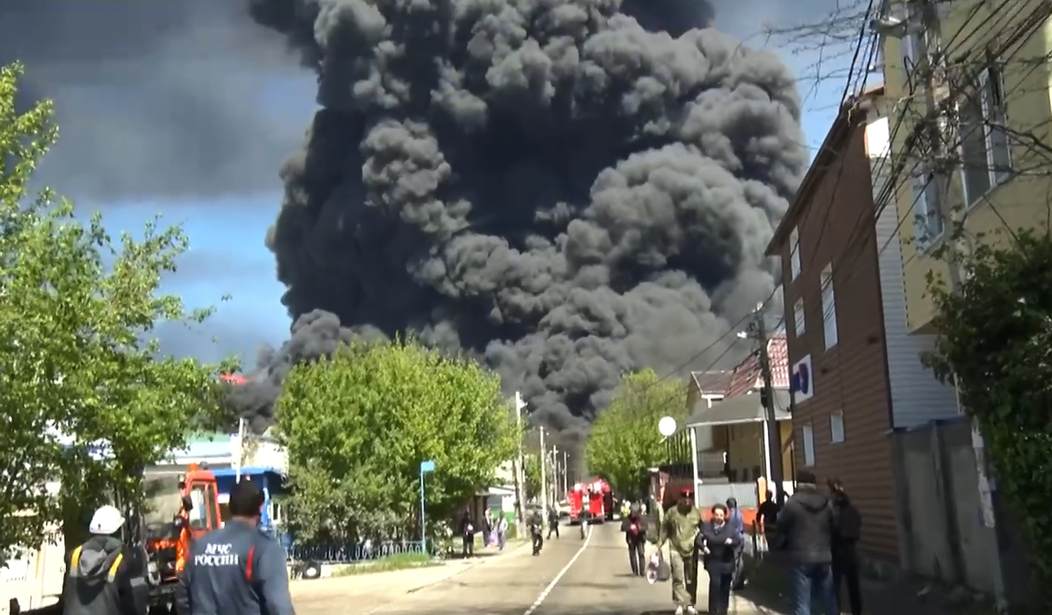
The price of diesel fuel is around $6.25 a gallon at the moment nationwide. That's an average of course. Things are much worse here in California where the price is over $8 per gallon. Diesel fuel is important because it powers most trucks on the road. A big increase in diesel prices can quickly turn into a surge in transportation costs for everything which then has to be passed on to consumers.
President Trump has been very understandably concerned about how fuel prices could impact the midterms. Democrats freaked out last week when he inartfully argued that the increased price at the pump was worth it for ensuring Iran would never have a nuclear weapon.
But when it comes to diesel prices, Trump has argued that those are being driven less by the war with Iran and more directly by events in Russia, specifically Ukraine's bombing of Russian refineries.
Last Friday, as European officials were meeting with Trump's peace envoys in Miami, the administration announced a new deal to buy more Russian diesel.
With the front lines largely frozen, Russia and Ukraine have turned the war into a contest of economic endurance. Kyiv has gone after Russia’s oil refineries. Moscow has hit Ukraine’s ports and heavy industries.
On Friday, President Trump sided with Russia in this all-important battle.
The American leader announced a deal to buy Russian diesel fuel and stepped up pressure on Ukraine to stop striking Russian refineries. The diesel agreement, if it goes ahead, could send some $4 billion of American money into the Russian economy, energy experts said. A halt to refinery strikes, if Ukraine accedes to one, could be much more valuable to the Kremlin.
This strikes me as a terrible bargain for two reasons. First, as mentioned above, it will help Putin when his economy is arguably more on the ropes than it has ever been. Putin had to end the export of gasoline and diesel months ago because he needed what he had for domestic consumption. He was then forced to import gasoline from neighboring countries to fill in the remaining gap. All of that costs him substantial money at a time when he can't afford it.
The U.S. is already, unintentionally, helping Putin by raising the price of oil thanks to the war with Iran. Putin was limited to selling his oil at a big discount but with prices now reaching $100 per barrel, he's getting a lot more than he was previously for the oil he sells through his shadow fleet of tankers (used to evade US sanctions). Now this deal would reward him directly for selling diesel.
Second, despite what Trump has said about it, it's unlikely this deal will make much difference at the pump for U.S. consumers.
"Adding hundreds of thousands of tons of diesel fuel to the global markets will lower prices," a White House official told Newsweek on Monday...
But the analysts who spoke with Newsweek said the additional supply is too small to significantly change diesel-market fundamentals before Election Day...
Patrick De Haan, head of petroleum analysis at GasBuddy, said the promised volumes appear too small to substantially change market conditions. He told Newsweek that he does not expect the agreement to "meaningfully" affect U.S. diesel prices.
"Perhaps slight decreases, but that's only if the deal actually happens," De Haan said. "Russia may not actually have enough diesel as this deal represents."...
De Haan also questioned the scale of the announcement, noting that the initial 300,000-ton shipment cited by Trump represents only about a day and a half of typical U.S. diesel supply.
"The amounts aren't exactly sizable," he said. "The 300,000 tonnes is about 1.5 days of typical U.S. supply."
Could the experts be wrong? Sure. Is there any reason to think this will be a major game changer? Not that I can see. There are also reports that this deal for diesel came along with a not-so-subtle request that Ukraine stop bombing the crap out of Russian refineries.
Senior Ukrainian and European officials had traveled to the club, Shell Bay, for talks with Mr. Trump’s peace envoys, Mr. Witkoff and Jared Kushner. They had planned to discuss updated proposals to end the war in Ukraine ahead of another trip to Russia by Mr. Witkoff and Mr. Kushner.
But Mr. Witkoff and Mr. Kushner soon made an announcement that stunned the visitors and much of the world when the news became public shortly thereafter. The United States, the Americans said, would suspend sanctions on Russian diesel fuel. The Americans added a firm request from Mr. Trump: that Ukraine stop attacking Russian oil refineries.
One of the Ukrainians asked what they would get in return.
The Americans responded that the United States was doing a lot for Ukraine already, according to three people familiar with the meeting, and should not have to make a trade for Ukraine to stop its refinery attacks. The Americans then mentioned U.S. intelligence assistance, considered vital to the Ukrainian war effort.
All of this must have been greeted like Christmas morning at the Kremlin. Trump is simultaneously boosting the Russian bottom line and asking Ukraine to stop hitting Russia's economy for nothing in return.
Meanwhile, the war on the front lines has basically become a stalemate.
A monthslong Ukrainian counteroffensive in the northern part of the Donbas has thwarted Russian efforts to encircle the remaining Ukrainian-controlled cities in the region. Russia, Western analysts say, has lost dozens of square miles of territory during the Ukrainian campaign, which Kyiv is calling Operation Vivaldi.
In the southern Donbas, Russia continues to mount furious assaults to break through Ukrainian lines. But Kyiv has reorganized its defense there and has so far kept the Russian military from pressing farther in its efforts to surround the major Donbas cities.
More broadly, Russian gains across Ukraine have slowed markedly in 2026 from their already glacial pace of last year. September was the worst month in net territorial gains for Russia inside Ukraine since June 2023, according to the Finland-based research firm Black Bird Group.
While Western researchers who track the battlefield report varying numbers, they generally agree that Russia has gained only slightly more land than it has lost this year.
That contrasts sharply with the narrative put forward by the Russian Ministry of Defense, which said on Sept. 19 that Russia had captured more than 2,000 square miles. Even ultranationalist Russian military bloggers have pushed back, voicing concern that Russia’s push to envelop the so-called fortress cities of the Donbas is failing.
Both sides in this war seem unable to advance which means it has now become a war of economic depletion. No one is seizing territory, the question now is whose economy will go broke first. On the count, both Ukraine and Russia are in trouble, but this deal represents a big boost for Russia's survival.
Trump's argument for the war in Iran makes sense to me. We're taking a short term hit in terms of gasoline prices for a long term strategic gain: Settling of scores with Iran and making sure they never have a nuclear weapon. That's all good.
But when it comes to Russia he's saying the opposite. Instead of taking a short term hit to drive the war in Ukraine to a conclusion (by forcing Putin to the table), we're instead announcing a deal that will help fund Putin's regional war in exchange for cheaper diesel at home.
Editor’s Note: Thanks to President Trump’s leadership and bold policies, America’s economy is back on track.
Help us continue to report on the president’s successes and combat the Democrats' lies about America's economic revival. Join HotAir VIP and use promo code FIGHT to receive 60% off your membership.









Join the conversation as a VIP Member