








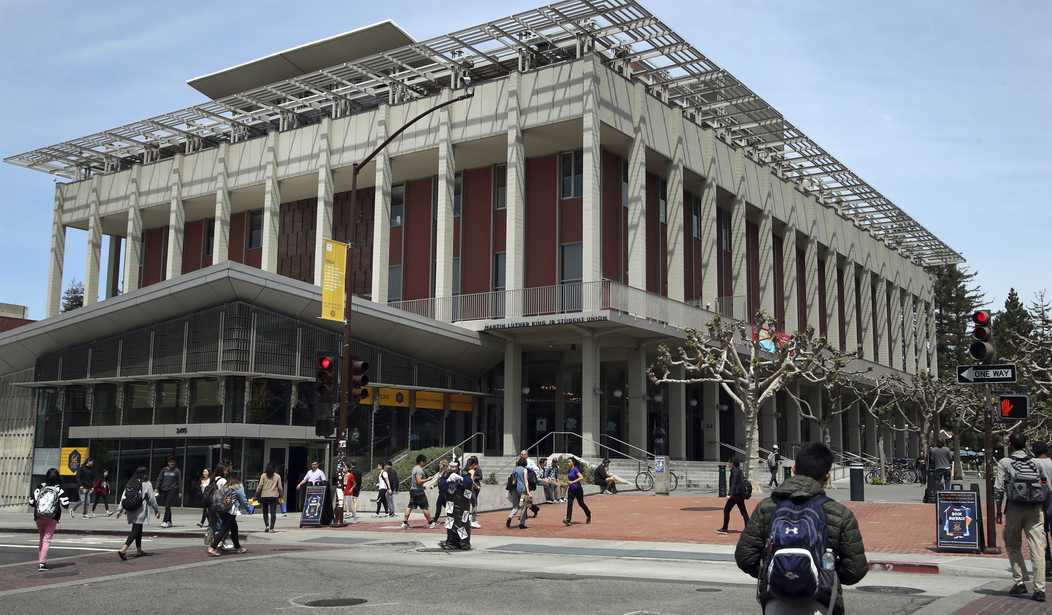
Last weekend a Berkeley math professor named Zvezdelina Stankova wrote an opinion piece for the SF Standard in which she argued at length that California's decision to abandon the SAT was effectively resulting in unfair admissions decisions. She used as an example two actual students whose names she changed to protect their identities.
One student — I’ll call him Elias — was admitted to a top University of California engineering program. His family was thrilled though surprised. Math had been his weakest subject in high school, but they assumed the university had seen something they hadn’t.
Another student — Nadia — watched rejection after rejection arrive from UC campuses. One turned her down even though she had earned A’s there in Calculus II and other college-level STEM courses through concurrent enrollment.
I've experienced this first-hand. My son also applied to colleges this year and after being wait-listed at Berkeley, he was turned down. He had graduated in the top 10 of his class and his best subject was math. In fact he'd taken extra math courses at a local community college while taking all advanced math the school offered.
But the real kicker was his SAT scores. He took the test several times. His best score (without super-scoring) was a near-perfect score which put him in the top 0.5-1 percent of all students nationwide (His lowest score put him in the top 3 percent of all test takers.)
But of course Berkeley never saw any of that because Berkeley and the rest of the UC system refuse to look at SAT results.
To learn that people like "Elias" got into top schools this year with no real math skills is upsetting. I told my son repeatedly that I didn't want him to go to Berkeley, but he should have had the chance to reject them because he was more than qualified. Fortunately, he got into another top UC engineering school.
Anyway, this is what is really happening now. A huge percentage of admitted students to one of California's top STEM schools can't do math. Not just a handful of them, but maybe a full third of the student body at this point.
I teach mathematics at UC Berkeley. Three days a week, I stand in front of lecture halls with 500 to 1,400 students. By the second week of the semester, I already know who is in trouble. Some students are five to eight years behind in mathematics. Office hours that should be spent discussing integrals instead become lessons on fractions and basic algebra you would expect students to learn in middle school...
Before 2020, Berkeley administered a diagnostic exam to incoming Calculus I students. Between 2018 and 2020, 71% of roughly 2,200 students tested as ready or nearly ready for calculus. At the bottom of the distribution there was almost nobody. Just 0.14% tested below basic algebra.
After UC adopted test-blind admissions, the picture changed dramatically.
Among approximately 2,800 Calculus I students tested between 2021 and 2023 with a different diagnostic that measured proficiency in eight mathematical topics, the share who were ready or nearly ready for calculus (meaning, they had proficiency in five to eight subjects) fell to 51%, dropping to 44% by 2023. Most troubling, the bottom of the distribution exploded. Seventeen percent of students answered none of the eight diagnostic topics correctly. By 2022-23, more than one-third had severe math deficits, and the single most common score on the exam was zero.
There's also a side story here about misleading reporting from the San Francisco Chronicle.
An Aug. 12 article(opens in new tab) in the San Francisco Chronicle said that in the pre-2020 readiness assessment, 48% of students who took the exam were prepared for Calculus I. The article said the faculty reported higher readiness for students admitted under the test-blind policy. But that is incorrect. Our analysis(opens in new tab) defined calculus-readiness as students passing seven or eight out of eight topics on the diagnostic exam. By 2023, that figure had fallen to 26%. More important than any percentage is the distribution itself. The crisis isn’t simply that readiness declined; it’s that the middle collapsed while the bottom became the largest group in the room. The Chronicle didn’t mention that.
At the end of the article she returns to what is happening with admissions at Berkeley:
At Dougherty Valley High School (opens in new tab) in San Ramon, 432 of 756 juniors exceeded California’s math standard in 2024, as measured by SBAC. Of the school’s 542 Berkeley applicants that fall, 44 were admitted (opens in new tab) — an acceptance rate of 8%.
At Mission High School (opens in new tab) in San Francisco, 193 of 202 juniors did not meet the state math standard. Yet Berkeley admitted 34 of the school’s 76 applicants — a 45% acceptance rate.
The author doesn't speculate why Berkeley is doing this but I've written previously about the motives. I suspect California will eventually claw back this unjustifiable decision but that could take several more years.
Editor's Note: President Trump is fighting to ensure America's kids get the education they deserve.
Help us fight back against Big Government waste and restore power to the states. Join HotAir VIP and use promo code FIGHT to receive 60% off your membership.


Join the Conversation
VIP members get the ability to comment on articles.