





Do you remember a few years ago when the city of San Francisco decided to add a couple of toilets to an outdoor area at a cost of $1.7 million dollars? That figure was so high that is shocked people across the country. But why did it cost so much? As I pointed out at the time, there were lots of factors but the biggest one seemed to be the maze of bureaucracy involved in building anything in San Francisco.
An architect will draw plans for the bathroom that the city will share with the community for feedback. It will also head to the Arts Commission’s Civic Design Review committee comprised of two architects, a landscape architect and two other design professionals who, under city charter, “conduct a multi-phase review” of all city projects on public land — ranging from buildings to bathrooms to historic plaques, fences and lamps.
After all that there was still the Rec and Park Commission and the Board of Supervisors. Bottom line: It cost $1.7 million and would take three years.
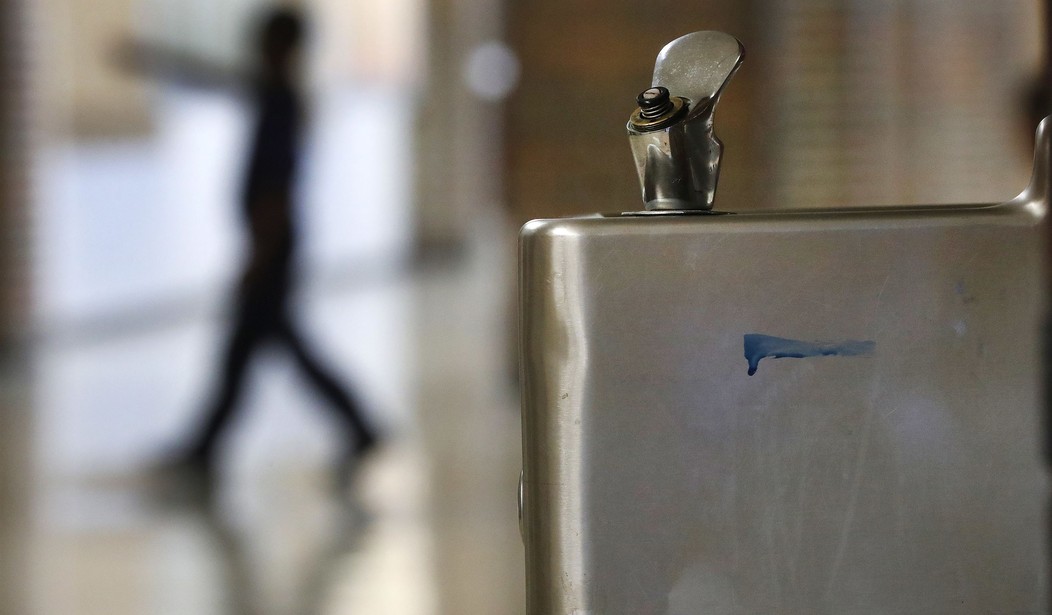
Today, there's a kind of companion piece to that story which takes place on the East Coast, specifically the island of Manhattan. There the plan was to add two drinking fountains to a park. The anticipated cost was $375,000.
Last year I was appointed to Manhattan Community Board 7, which serves the city’s Upper West Side. At a parks and environment committee meeting in October, a project manager from the parks department presented 23 slides about plans to replace two drinking fountains in Riverside Park. The presentation covered flood zones, tree roots, backflow prevention and a new water line. The budget? $375,000.
I sat there wondering how two water fountains could cost more than a four-bedroom house in a Kansas City suburb...
Each requirement for the drinking fountain project has its own logic. Backflow prevention protects the water supply. Parks directives require replacing older water service pipes when making new connections. Since the parks department chose to rebuild one of the fountains exactly where an old one stood and has no records of where the original line ran, the city will need to dig a new trench. Digging the trench means doing a tree root survey. Procurement rules are intended to prevent corruption. The project manager presenting the slides was professional and thorough, checking every box. All of this led to the nearly $400,000 price tag...
This is why a mile of new subway in New York City costs $2.5 billion, roughly 8 to 12 times what comparable projects cost in Spain and Italy.
Let me suggest that cities in which it costs $375,000 to install to drinking fountains or $1.7 million for a couple of toilets are not places where "affordable housing" can exist. So if the plan for reducing homelessness is to build more low-income housing in these place, you might as well give up now, because it can't be done.
Zohran Mamdani campaigned on spending $100 billion over 10 years to build 200,000 “publicly subsidized, permanently affordable, union-built, rent-stabilized homes” — about $500,000, or nearly three drinking fountains, per home.
The point of the Washington Post opinion piece wasn't to highlight this one outrageous project, it was to highlight the larger problem behind it, something the author calls "the machine."
Here’s how I’d explain it: The thing breaking America isn’t a person, a party or a conspiracy. It’s a self-perpetuating system, built over decades by well-meaning people making individually rational decisions that added up to something no one would build on purpose. Call it the Machine. People may run its individual components, but no one operates or entirely understands its full scope.
The Machine narrative dovetails with “Abundance,” the idea Derek Thompson and Ezra Klein popularized last year with their best-selling book. Abundance names the goal: more housing, more energy, more state capacity, more of the things that make life affordable and government functional. The Machine names the adversary standing between the public and the goal.
The machine is a fine name I guess, but it seems to me he's really just talking about regulation and bureaucracy. The first is the endless number of rules put in place to control everything and the second is the system government uses to make sure everyone abides by those rules.
According to Wikipedia, the origin of the word bureaucracy comes from a French economist.
The term bureaucracy originated in the French language: it combines the French word bureau – 'desk' or 'office' – with the Greek word κράτος (kratos) – 'rule' or 'political power'.[7] The French economist Jacques Claude Marie Vincent de Gournay coined the word in the mid-18th century.[8] Gournay never wrote the term down but a letter from a contemporary later quoted him:
The late M. de Gournay ... sometimes used to say: "We have an illness in France which bids fair to play havoc with us; this illness is called bureaumania." Sometimes he used to invent a fourth or fifth form of government under the heading of "bureaucracy."
— Baron von Grimm (1723–1807)
So it sounds like bureaucracy was already irritating people 300 years ago, well before America was a country. But here we are hundreds of years later and it seems to have completely taken over in some places, especially deep blue places like Manhattan and San Francisco. The places that are the most progressive politically are the most conservative, in some sense, when it comes to making sure not a single root is disturbed for a new water fountain, not a single community color palette is upset by a new public toilet.
Scapegoating and arguing about who’s to blame is not a path to problem-solving. Organizing against the Machine is more a matter of function versus dysfunction and doers versus blockers than it is about left versus right or pitting one group or class against another. This would mean asking uncomfortable questions of institutions you might normally support — unions, public agencies, advocacy groups — and judging them by what they deliver rather than what they stand for.
The author is doing his best to both-sides this problem but the groups he lists seem likely to be partisan left holdouts for the most part: Unions, public agencies, advocacy groups. On the other hand, the developers trying to make a living by building things within this system, those are the people who seem more likely to be conservative leaning folks. There would be exceptions on both sides of course, but generally speaking this rings true as a blue state (and city) problem.
...community board members like me and everyone else who cares about making things work — need to start asking the question the Machine has trained us not to bother with: Are we getting what we’re paying for?
Republicans have been begging blue state populations to ask these questions for many years in some places. And always the response is your input is not needed in this blue state demi-paradise. We can build a bullet train without you. We can run a city without you. No one asked for your advice on dealing with the homeless or drug addicts or violent crime, etc., etc.
The whole piece is like a request that progressive start thinking and acting a bit more like conservatives in places like Manhattan. And I can guarantee you the moment they do, they will be hated and canceled by the progressives who will accuse them of ignorance, racism and other sins and demand they back off. The reason we can't get things done in a reasonable way isn't because there are no reasonable people left, it's because they get shouted down and told to shut up by the unreasonable mobs that really run those places. To fix those places you need to fix that problem first.
Editor's Note: Do you enjoy HotAir's conservative reporting that takes on the radical Left and woke media? Support our work so that we can continue to bring you the truth.
Join HotAir VIP and use promo code FIGHT to receive 60% off your membership.
Join the Conversation
VIP members get the ability to comment on articles.