







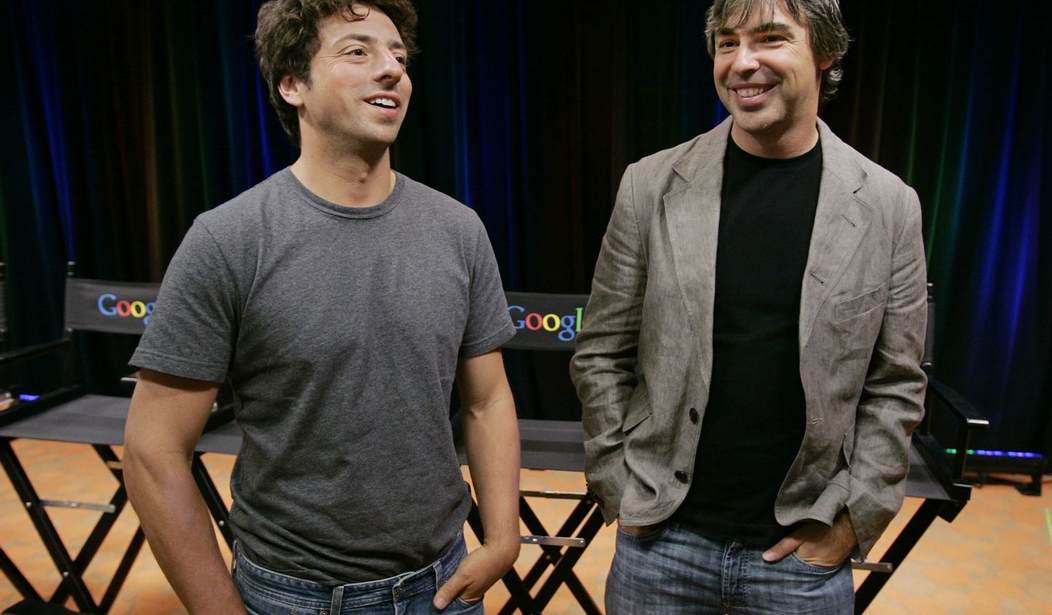

Two of the economists behind the California wealth tax proposal, Emmanuel Saez and Gabriel Zucman, have a new opinion piece in today's New York Times arguing on behalf of their plan. Despite the Times pulling out all the stops to illustrate the article with graphics, what really comes across is how spectacularly dishonest this piece is.
A large labor union representing health care workers and advised by academic experts — including the two of us — got the 2026 Billionaire Tax Act on this November’s ballot. The proposed tax would be a one-time levy of 5 percent on billionaire wealth, spread over five years. If the measure passes, it would be the first tax targeted at the combined personal and business wealth of billionaires enacted anywhere in the world.
California is an ideal place to test this idea. The state needs money to fill a budget hole that the Trump administration created when it cut, among other things, Medicaid, a state-federal partnership that provides health coverage to low-income people. Without more state tax revenue to fill the loss in federal funding, the fraction of uninsured Californians will increase substantially, reversing part of the progress made since Obamacare.
Here what the authors don't mention is that a huge part of the California's struggle to balance the budget was the expansion of Medi-Cal (California's Medicaid) to illegal immigrants. That decision, which was put in place by Gov. Newsom last year, put a $10 billion hole in the state budget because the federal government will not cover those expenses for non-citizens of the U.S.
They also don't say that, thanks to the booming stock market, California was able to close the budget deficit this year, meaning there is no shortfall to close in the coming year. In other words, the state literally does not need the money in the next year and if it did it could reduce spending by $10 billion per year by cutting Medi-Cal for migrants.
A California ballot initiative that will be put to voters in November would tax just 5 percent of billionaires' fortunes over five years. This trailblazing wealth tax would be a small (for the ultrawealthy) but important (for everyone else) step toward raising needed tax revenue and curbing the state's runaway inequality.
This is accompanied by a graphic which shows the wealth of California's ten richest people over several years. If you watch closely, you'll notice that back in 2020 Elon Mus was the 3rd richest person in California but in subsequent years he is gone from the list. What happened? In 2020 Elon moved to Texas and in 2021 he moved the corporate headquarters of Tesla there as well. The corporate HQ of Space X also left California in 2024. This is significant because it points to an obvious flaw with the plan: Billionaires can leave.
Here's how the graphic looks for this year:
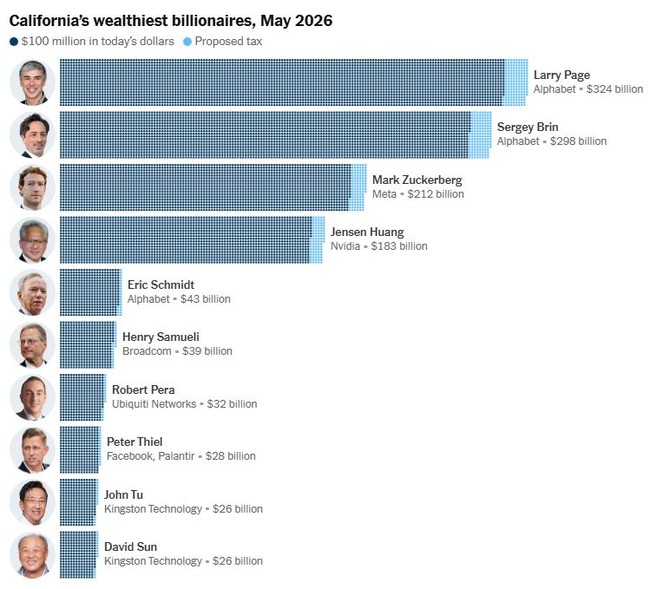 The light blue dots represent the 5% the tax would collect. Except, as we just discussed, you can't apply that tax to people who are no longer in the state. Larry Page and Sergey Brin are already gone. And critically, they appear to have beat the January 1 2026 retroactive deadline created by the new tax to trap billionaires who might want to leave. They got out in time.
Now, Mr. Brin and Mr. Page are cutting some ties with the state where they made their fortunes.
In the 10 days before Christmas, an entity connected to Mr. Brin, 52, terminated or moved 15 California limited liability companies that oversee some of his business interests and investments out of the state, according to documents seen by The New York Times. Seven of the companies — including those that appear to manage one of Mr. Brin’s superyachts and his interest in a private air terminal at San Jose’s international airport — were converted into Nevada entities.
Mr. Brin is joining Mr. Page, 52, in reducing his California presence. More than 45 California limited liability companies associated with Mr. Page filed documents last month to either become inactive or move out of the state, according to state records. A trust with ties to Mr. Page also purchased a $71.9 million mansion in Miami’s Coconut Grove neighborhood this week, according to a deed seen by The Times.
Another entity jointly managed by Mr. Brin and Mr. Page moved out of California and to Nevada on Christmas Eve, according to a filing seen by The Times.
Peter Thiel, who is #8 on the list, is also gone. Mark Zuckerberg, #3 on the list, hasn't left California but he did buy property in Florida recently. So he may be waiting to see what happens. Eric Schmidt (#5) has also reduced his profile in California.
The point is that this tax was aimed at $2 trillion in wealth held by 200 billionaires in the state. But that money was not even distributed. With just Brin and Page leaving, you've lost about 1/3 of the wealth you were intending to tax. So the chance that this will ever raise the $100 billion it was intended to is a fantasy. But of course the authors don't tell you that. Instead they get into this spectacularly dishonest passage conflating income tax (which exists) with a wealth tax (which does not).
From 2019 to 2025, California billionaires’ wealth grew an average of over 15 percent per year, while they paid, on average, just 0.26 percent of their wealth annually in state income taxes. Their income tax payments accounted for only 2.4 percent of California’s income tax revenue.
Their wealth, meaning the value of stock in companies they own, went up 15% but they paid just 0.26% of their wealth in taxes. Well, that's because we don't tax wealth in CA or anywhere else. They paid based on their income like everyone else, including sales of stock. In other words, the authors are using everything a billionaire owns as the denominator to calculate this percentage and then comparing that to what regular people pay in income taxes. This is apples to oranges at best.
Then they tell us that billionaires actual income taxes paid 2.4% of California's income tax revenue, which seems like a lot for 0.0005% of the population to pay.
For the very richest individuals, the effective burden was even lower. The four wealthiest Californians — Mr. Brin, Mr. Huang, Mr. Page and Mr. Zuckerberg — paid an average of just 0.07 percent of their wealth annually in California income tax over that period, according to our analysis of Securities and Exchange Commission records on stock sales and executive compensation from their companies.
Again, this is cheating. No one's taxes are calculated using their entire wealth as a denominator. We tax a percentage of people's income. They do get around to admitting this is how it works but only after presenting the misleading percentages.
The problem is that billionaires’ fortunes are largely held in assets (mainly stocks) that rise in value over time. This rise in value is not taxed unless the assets are sold. Under current law, when billionaires don’t sell their stock, wealth accumulates while taxes on their gains are deferred indefinitely and sometimes avoided entirely.
At this point, there are more graphics describing billionaires wealth as an iceberg and using Mark Zuckerberg as an example.
From 2019 to 2025, Mr. Zuckerberg reported more than $7.1 billion in income from Meta: $181 million in compensation, $1.4 billion in dividends and $5.6 billion in gains from selling stock.
Despite making so much money, Mr. Zuckerberg was taxed a combined state and federal rate of just 27 percent on that income. That’s not much higher than the average California household’s effective tax rate of about 20 percent.
Mr. Zuckerberg’s tax rate was relatively low in large part because most of his income was in the form of capital gains — what he made from selling stock that had risen in value. Capital gains are taxed federally at a lower rate than ordinary income.
But a vast majority of Mr. Zuckerberg’s wealth is hidden from income taxes.
Having briefly left behind the fantasy percentages in the previous passage the authors now look at actual taxes on income and find that Zuckerberg pays about 27%. Why? Because nearly all of that is stock sales which are taxed at a top rate of 23.8%. Even so, the authors admit he is paying more on his actual income than the CA average of 20%.
The final line is the kicker: "But a vast majority of Mr. Zuckerberg’s wealth is hidden from income taxes." Yes, that's true because it's not income until he sells the stock for cash. This is the same for anyone who owns a home. The value of the home may go up 50% in just a few years if the housing market is tight but that money is not counted or taxed as income until you sell the home. The authors eventually admit this is how it works.
Unless Mr. Zuckerberg sells his shares, all of this growth remains untaxed. But he can put his gains to use without selling them, borrowing tax-free against his holdings at low interest rates, as he did in 2023, when he pledged $3.1 billion worth of his Meta shares as collateral for a loan.
But once again, they aren't telling the whole story. Billionaires can indeed take out loans which are not taxed because loans are a debt, not income. What they dont' tell you is that those loans have to be paid back. Billionaires eventually have to sell off their stock and realize gains which are then taxed in order to pay off those loans. So the $5.6 billion Zuckerberg sold in stock between 2019 and 2025 were likely sold to pay off loans. The gains were taxed as described above. They aren't avoiding the tax man. Zuckerberg paid 27% on his income before he used the remaining money to pay back loans.
Eventually the authors do mention that the top 2 wealthiest people in the state are leaving, but they don't admit this means about 1/3 of the wealth the tax was aiming to raid is now gone.
Google’s founders, Mr. Brin and Mr. Page, are the state’s richest individuals, with more than $600 billion in wealth between the two of them — up from $345 billion last September. They have come out against the wealth tax initiative while making moves to leave the state. They benefit from the status quo...
We don’t imagine that a one-time 5 percent tax on the wealth of California billionaires, as proposed in the 2026 Billionaire Tax Act, would fix all these problems. But it could raise nearly $100 billion in revenue for California.
Again, the formula here was 5% of $2 trillion equals $100 billion. But if a third of that $2T has left the state, you won't be getting that money. The authors seem to be counting on some judge somewhere to rule that CA can tax the billionaires anyway, even if they leave the state.
It is too late for superrich Californians to flee the state to avoid the tax. If approved in November, the tax would apply to billionaires who were residents of California as of Jan. 1, 2026. Some affected taxpayers might have left between the ballot initiative’s introduction, in late October 2025, and the end of the year. But it is improbable that any significant number of billionaires fully cut ties with California in that short period.
Billionaires have all the money they need to fight this tax. It's just as likely that a court will eventually decide the whole premise of the retroactive tax is unconstitutional. We'll have to wait and see but the chances that this tax raises $100B are next to nil at this moment. The authors know that but they don't want readers to know it.