







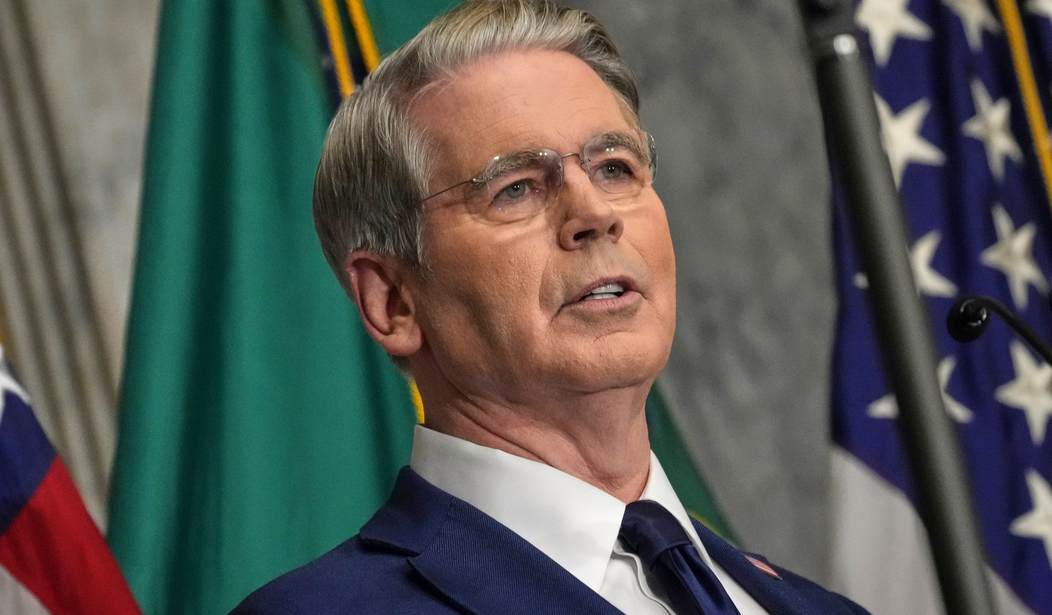
The quiet diplomacy of Operation Economic Outcast is being delivered all over the world this week by the Trump administration, and it will be very interesting indeed to see how countries like China, Russia, Turkey, Pakistan, and the United Arab Emirates react to the tightening of the global economic tourniquet on the dying regime.
Each country in question has a reason, or several, to reject the demands of President Trump and Treasury Secretary Scott Bessent, but the bottom line is the Americans aren't going all-in on this poker hand without an advantage. The dollar remains the world's reserve precisely because no one in the free world wants to see the yuan, the currency of the Communist Chinese Party in Beijing, take over the global markets.
Axios reported yesterday that the Trump administration's plan is to fully implement Economic Outcast over the next few weeks and months, and keep the blockade of Iran in the Strait of Hormuz in place until after the midterms before reassessing whether a return to kinetic action is warranted.
Rich Goldberg of the Foundation for Defense of Democracies has a great piece in the New York Post about what this extra layer of sanctions could resemble soon.
That’s very bad news for the IRGC. Every escape hatch from the naval blockade is about to close. From its immediate neighbors to its sanctions evasion hubs across the Gulf, Europe and China, to its one-off schemes in Africa and the Western Hemisphere, the Treasury Department has mapped out every source of remaining oxygen breathing financial life into the regime in Tehran.
American diplomats and Treasury attaches abroad are meeting with their counterparts this week to tell them what steps are necessary — and put them on the clock to either asphyxiate the IRGC or face asphyxiation from U.S. sanctions.
Secretary Bessent gave us some hints of where Treasury will focus its enforcement efforts: Iranian bank branches still operating abroad, digital assets, technology, gold, aviation and shipping.
But the broader the financial message was clear: If it looks like Iran, if it smells like Iran, or if it talks like Iran, shut it down now, or Treasury will shut you down by the end of the week.
While we wait for the full effect of economic isolation to materialize, it does not take too much research into life inside Iran today compared to even a few weeks ago to realize that all the signs of impending regime collapse are present.
The only leverage the regime has had over the region and the world for the last few months is rhetorical control over the Strait of Hormuz, backed by occasional attacks on tankers and cargo ships by drones or machine guns tied to speedboats. The queasiness of shipping companies to accept risk to traverse the Strait kept ships parked more than anything the Iranians were actually doing to police the region's oil chokepoint.
Over the last seven days, business has picked up again, culminating with Monday's announcement that the United States Navy had completely swept the Strait of any remaining Iranian mines, meaning there is now a second lane of passage available.
The US Navy has cleared mines from the main shipping lane of the Strait of Hormuz, Axios reported Tuesday, citing two US officials with direct knowledge of the operation.
— Iran International English (@IranIntl_En) August 25, 2026
The officials said the Navy had cleared the Traffic Separation Scheme, the central shipping lane between… pic.twitter.com/edqpwT4ATf
As part of Operation Economic Outcast, the United States has effectively ordered all commercial traffic to cut off all communication with the regime.
Mariners and shipping companies risk US sanctions or penalties if they respond to information requests from Iranian organizations related to the Strait of Hormuz, the Treasury Department warned on Monday.
— Iran International English (@IranIntl_En) August 25, 2026
The Office of Foreign Assets Control said the risk applied even when no… pic.twitter.com/hTJZoTZOIY
The policy used to be that there would be no tolls for passage, and anyone paying a toll would be sanctioned by the United States. Now, ships are not allowed to talk to the Iranians. No radio traffic at all. This would largely prevent Iran from gathering any intelligence on the location of other ships sailing through the Strait, albeit with transponders turned off.
So without a navy to patrol the Strait, with drones increasingly becoming ineffective (more on that in a bit), and no actionable intel from ships finking on other vessels in the area, Iran is virtually helpless as millions of barrels of oil pass them by with increasing frequency. What kind of increase are we talking about? More than pre-war frequency.
A busy day in the Gulf of Oman, where there are at least fifteen sets of STS transfer sessions taking place. We count 25 million barrels of crude oil; plus some refined products. The oil originates from almost every country in the region, minus Iran.#OOTT #IranWar #Tankers pic.twitter.com/TAba26mJiW
— TankerTrackers.com, Inc. (@TankerTrackers) August 25, 2026
What we have here is tankers, presumably carrying around 2 million barrels or so each, going through the Strait. They've figured it out and are the runners, or ferries of crude and refined products as well, out of the troubled waterway. Once in the Gulf of Oman, they're offloading to another tanker safely out of harm's way of Iran, and going to their final destination while the runner scurries back for another load. Fifteen sets of transfers took place Tuesday alone. That's how you get upwards of 25 million barrels worth.
That number is staggering, since in early February before the United States and Israel launched Operation Epic Fury, 20 million barrels through the Strait per day was a normal number. Tuesday exceeded that by 25 percent, and that doesn't include the seven million barrels of crude bypassing the Strait entirely through pipelines. Tuesday's total output into the international market was somewhere north of a 32 million barrel day. You add that to increased exporting capacity of Venezuela and the United States, and suddenly, it's not a big deal any more that Ukraine picks off another Russian refinery or oil depot. The world is adapting in real time, and the price of oil, in the mid-$90's a little over a week ago, is about to cross below $80 again. All of this oil is leaving GCC states, with Iran being totally shut out of the process.
Now that the non-Iranian actors in the Middle East have figured out a viable, enforceable workaround for the Strait, it really means it's game over for the regime. No revenue, no resources to import, no leverage, and nothing militarily left in their control to change the dynamics of the situation.
What they do have is the ability to totally miss the memo.
Iran's Deputy Foreign Minister Gharibabadi says the Strait of Hormuz will reopen only in exchange for an end to the war on all fronts, a lifting of the siege, and a resolution on Yemen.
— Open Source Intel (@Osint613) August 25, 2026
More oil went through Tuesday than at any time before the war began and the Iranians "closed" Hormuz, and this yahoo is promising to open what is already floodgates as wide as you can get, but only if the United States gives up, goes home, and lifts all the sanctions. Oh, he also mentions Yemen, too. We'll get there shortly.
Iranian Foreign Minister Abbas Araghchi, along with his Oman counterpart, announced they were ready to sign a joint agreement to open the Strait, remove mines, and open up a second lane of tanker traffic.
Oman and Iran discussed establishing a temporary joint shipping corridor through the Strait of Hormuz and a joint mine-clearing project as part of efforts to restore safe navigation, Oman’s state news agency ONA reported Tuesday.
— Iran International English (@IranIntl_En) August 25, 2026
he talks took place during a visit to Iran by… pic.twitter.com/FqwuI1DlLG
Never mind the fact Iran laid the mines in the first place and slowed traffic to a crawl. But it takes a special kind of false bravado to boldly claim you're in agreement to do...exactly what the United States just accomplished. It's the equivalent of offering to build a freeway when the freeway not only exists, but now features an HOV lane. Now the Iranians are offering to help? Sorry, that proverbial ship has sailed.
I mentioned the Iranians having been degraded largely to a drone-wielding, regional nuisance. One of the mistakes the U.S. made in the early days of the war was not fully anticipating that Iran would adapt what Ukraine excelled at in their war with Russia — drone strikes. Splashing drones that cost a couple grand with high-tech weaponry costing millions was simply not viable. Fortunately, with the help of some of our friends in the burgeoning Defense industrial base, that problem is being solved.
The United Arab Emirates, once an ally and enabler of Iran's illicit oil trade, has had enough of Iranian drones striking their infrastructure. They've spent the last four months caging soft targets like storage tanks. It's like mosquito netting for UAV's.
🚨 To protect against Iranian drone attacks, the UAE has completed giant metal frames around fuel storage tanks in Abu Dhabi.
— The Iran Watcher (@TheIranWatcher) August 22, 2026
The project took roughly four months to complete and shows the extraordinary lengths countries are being forced to take against the terror, conflict and… https://t.co/NjhXifAuPv pic.twitter.com/Egx1gtT2dn
That's not all. Powerus, a U.S.-based Defense contractor, has been working with the Emirates to start up a facility locally to produce Guardian interceptors. The factory is already building 30 units per day, with plans soon to rachet output up to a hundred. The cost? About $5,000 per drone. That's a lot cheaper than a $3 million Patriot missile, and it's a lot less than the incoming Iranian Shahed, which runs around $20,000-50,000 each. That program will ramp up across the Middle East, and will greatly reduce or neutralize the Iranian drone threat for the foreseeable future.
I also mentioned I'd get back to the Iranian regime no longer tying Southern Lebanon and Hezbollah to their list of demands. They appear to have given up on that particular proxy group, replacing it with the poor Houthis, who are having quite a time of it of late. They've had to hold funerals for 16 of their commanders in the last seven days.
🚨 The Houthis continue to get pummeled, with their trenches and fortified positions being targeted from above.
— The Iran Watcher (@TheIranWatcher) August 24, 2026
Yemeni government drones are dropping bombs directly into Houthi trenches as fighters gather inside them, striking positions designed to protect personnel and… https://t.co/1QJBEjTiTj
Just like the Lebanese Army, working in conjunction with the Israel Defense Forces to expel Hezbollah from their midst, the Yemeni government has seen the writing on the wall, and it no longer indicates Iran will be the region's hegemon, so they're going after the terrorists in their midst, the Houthis, with a vengeance. And other GCC countries including Saudi Arabia are providing an assist here and there. Israel continues to reduce Hamas' population on a daily basis, making 2026 a very, very bad year for Iranian proxies everywhere.
Now that we've looked outside of Iran and how much their malign influence is contracting, it's time for a peek at what is occurring inside the country.
Gasoline rations of four gallons per day were an annoyance a few weeks ago, with reports of four-plus hour lines in brutal 120-degree heat. But as of a few weeks ago, Iran still had gas. Not anymore.
🇮🇷 Recent footage shows queues in Tehran, Mashhad and Kerman. One Tehran rider reportedly visited nine stations without finding one operating.
— Eye OSINT (@AlexiaNoel94927) August 24, 2026
Iran consumes 135 million litres daily but produces 121 million. The government says quota cuts are certain, yet has not explained the… pic.twitter.com/9Hq2x67xX6
Vehicles lined up outside a closed gas station in Gohardasht, Karaj, about 40 km west of Tehran, with its lights turned off, as drivers waited in hopes of getting fuel, videos sent to Iran International show. pic.twitter.com/cDfChF5wD0
— Iran International English (@IranIntl_En) August 25, 2026
🔴 Tehran, Iran | Early Tuesday morning. Aug 25, 2026
— Savakzadeh (@Savakzadeh) August 25, 2026
Shariati street in Tehran is packed with cars waiting to get some gas, as several gas stations throughout the city has closed down. pic.twitter.com/jZhjq8z9kI
🚨 Iran’s fuel crisis is hitting a boiling point. Kilometers-long petrol lines have paralyzed parts of Tehran, while stations run dry in a nation sitting on massive oil reserves.
— E.Bhaskar Rao (@NiftyBhaskar) August 25, 2026
Ordinary citizens are stranded and furious while reports point to regime stockpiling. This is… pic.twitter.com/9i0Z1GQOOZ
🇮🇷 Fuel shortages are becoming increasingly visible across Tehran.
— The Tectonic (@thetect0nic) August 25, 2026
Several petrol stations are reportedly out of service tonight, including locations in Pasdaran, Mirdamad, Shariati, Damavand, Mirza-ye Shirazi and Dolat.
The individual stations have not all been independently… pic.twitter.com/RzG8IlMFXN
And it's not just a wait for gasoline, either. Diesel is also hard to come by.
🚨 Will Mojtaba Raise Gas Prices?
— Ehsan Eghbal Eslami (@Ehsaneghbale) August 24, 2026
Long gasoline lines continue across Iran (video: trucks on the Haraz road).
Today the National Security Commission of Parliament discussed the crisis.
First Vice President Aref said any decision must have public satisfaction.
The regime still… https://t.co/gT6Oi9edLL pic.twitter.com/iVankxVEYE
Remember last week when the regime said no cargo ships can get to Iran around the blockade? 'No problem,' they replied, 'we'll just use the land route'? I wrote over a week ago that it would take 2,500 trucks to move one cargo ship's load of containers. Looks like we found a lot of those trucks in line to get diesel. That means they're not moving freight, and that's just one of several such lines all over Iran.
The doom loop for the regime is they cannot refine enough gasoline and diesel to meet demand, they cannot import a drop of either, and decades of providing subsidies to Iranians in order to keep the peace are no longer sustainable. Market forces, along with triple digit inflation, are about to hit where it hurts — energy.
Iran would reduce subsidized gasoline quotas and charge a higher price for fuel purchased beyond those limits, presidential Chief of Staff Mohsen Hajimirzaei said on Monday.
— Iran International English (@IranIntl_En) August 24, 2026
He said the new price had not yet been determined but insisted that government intervention in the…
Iran is already a powder keg. Previous color revolutions, many of them featuring students, took to the streets demanding real democracy, real reform, and a return to an Iran that afforded its population a freer, better life. That is not what is taking shape all over Iran. People are getting angrier and more desperate by the day.
🚨 IRAN: The protest picture is expanding.
— daniel hanuka📟 🇮🇱 (@LionsOfZion_ORG) August 24, 2026
HRANA documented at least 15 protest gatherings across Iran in the past 48 hours, involving several different sectors.
Today, telecom retirees protested in Tehran, Ahvaz, Kermanshah, Sanandaj, Shiraz, Hamedan, Bandar Abbas and Bijar.…
Protests used to be about freedom, or what they believe their version of it could look like without the regime in place. Now, it's people fed up with the country falling apart at the seams around them and at those in the regime that brought about their ruination.
Farda Motors is an Iranian car manufacturer with assembly plants outside the country before importing finished cars back to Tehran. At least before the blockade stopped all that.
🚨 Economic rage is boiling across Iran, with furious citizens now physically attacking company executives and regime-linked figures who they blame for corruption, broken promises and financial ruin.
— The Iran Watcher (@TheIranWatcher) August 25, 2026
In the latest incident, angry customers physically attacked a Farda Motors… https://t.co/aio5viapIX pic.twitter.com/RFrRhqQYhl
Imagine dropping down rials on a car promised to arrive in a week or two, only to have two years go by with no estimated time of delivery, no chance of getting your money back, and being told the cost of the car is now about ten times higher because of inflation. You'd come unglued, too.
🔴 Tehran, Iran TODAY
— Savakzadeh (@Savakzadeh) August 24, 2026
Protests erupt as telecommunications retirees take to the streets in Tehran, chanting:
“Such injustice. No nation has ever seen this much.”
They barely received any retirement pay from the Islamic Republic before. Now it's NOTHING.pic.twitter.com/ABVyd9a7Nc
Seniors who retired from Iran's telecommunications industry, owned and operated by the IRGC, were promised pensions once they retired. They never did get the full amount of what they were promised, but before the sanctions started biting, they got at least a portion. Now? Nothing, and they're not happy about it.
You don't have to be elderly to feel the economic pain.
Another cry from Iran as the economic crisis deepens. 📉 A shop owner says: “You go to sleep, wake up, and the dollar is up another 10,000 toman. Fuel lines stretch 2–3 km, and electricity at the shop goes out for two or three hours.” He attacks the authorities: “If we protest,… pic.twitter.com/KBK8mwLshI
— DDF NEWS (@ddfmarketing1) August 25, 2026
It's not just civilians paying the price. Soldiers in the IRGC, Basij, and Artesh are not getting paid.
🚨 The Islamic Republic cannot pay its own soldiers or the proxy fighters it relies on to keep its regional war machine alive.
— The Iran Watcher (@TheIranWatcher) August 25, 2026
The financial crisis is now reaching the people carrying the guns. U.S. Treasury Secretary Scott Bessent has repeatedly said the regime is unable to pay… pic.twitter.com/9lLgaXryLy
The most ironic tweet in this column shows how bleak things are for the Iranian regime. Because of the extreme fuel shortage, power generating plants cannot stay in operation 24 hours a day throughout much of Iran. Blackouts are now ubiquitous in Iranian life.
A few days ago, members of Iran's Parliament assigned to their Energy Commission met with electricity officials running some of these facilities to discuss the deepening power crisis. You'll never guess what happened during the meeting. Okay, you guessed.
🚨 Iran’s parliament held a meeting about the blackouts, and the power went out.
— The Iran Watcher (@TheIranWatcher) August 24, 2026
The parliamentary Energy Commission was meeting with electricity officials to discuss the nationwide power crisis when the room itself went dark, forcing the meeting to continue with minimal… pic.twitter.com/H83bGYLwC2
IRGC checkpoints are coming under increasing fire from the populace.
❌ An IRGC member has been killed after gunmen attacked a checkpoint near Tehran, amid reports of growing attacks on the Islamic Republic’s security checkpoints.
— The Iran Watcher (@TheIranWatcher) August 25, 2026
Amin Azizi, a member of the IRGC’s Seyyed al-Shohada Corps, was seriously wounded during the August 20 attack on a… https://t.co/wJ3Zopc2KE pic.twitter.com/vB45aB1LB5
How bad are the economics inside Iran? Here's what the regime is willing to admit.
The Iran Chamber of Commerce Research Center admits the staggering scale of Iran’s economic devastation, with millions of livelihoods crushed and the real numbers likely far worse.
▪️770,000 fewer people employed by winter compared with spring.
▪️1.35 million people left the labor force entirely, no longer working or even looking for work. ▪️611,000 fewer workers covered by Social Security.
▪️Underemployment jumped from 6.6% to 8.2%.
▪️Businesses employing 6–10 workers collapsed by 22.3%, while 11–50 worker firms fell 14.2%.
Now imagine the carnage a month or two from now when the remnants of the regime are in the same boat as those retirees protesting in the street, getting thinner by the day. How motivated are those soldiers going to be to quell an uprising when they're just as ticked off at the regime for starving them and their families?
The next time someone on your social media feed pops up with a hot take that Donald Trump is fumbling his way through this conflict with Iran, that Pete Hegseth has no idea what he's doing at the Pentagon, that the war has been badly mismanaged, or that the United States has for all intents and purposes lost to Iran with Trump stuck and looking for an off-ramp, understand that there is a cottage industry on both the left and far right of doomers invested in American foreign policy failure.
And they are as out of gas as Iran is.
Editor's Note: For decades, former presidents have been all talk and no action. Now, Donald Trump is eliminating the threat from Iran once and for all.
Help us report the truth about the Trump administration’s decisive actions to keep Americans safe and bring peace to the world. Join Hot Air VIP and use promo code FIGHT to get 60% off your membership!


Join the Conversation
VIP members get the ability to comment on articles.