








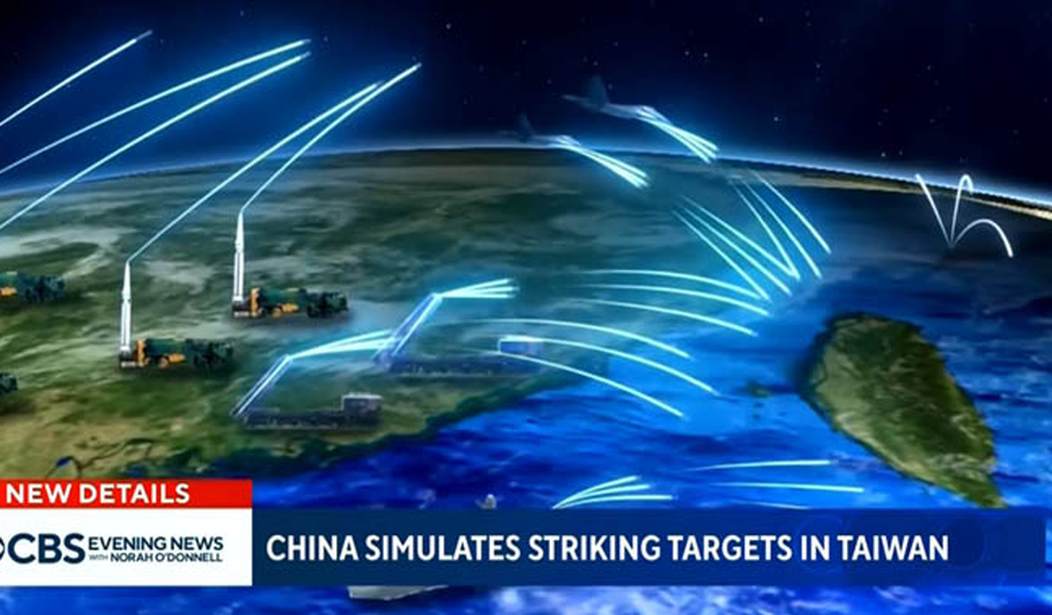
There has been a lot of quite legitimate worry that China has been planning to invade Taiwan in the next year or two, but according to recent intelligence assessments, the likelihood of that happening is diminishing.
Good.
First, it's important to recognize facts that often get blurred: Beijing has pursued a policy of developing capabilities on a timeline that would make an invasion in 2027 a realistic choice, but that never meant it planned to do so in 2027. It never established a timeline for invasion, but one for readiness.
Look at Russia Ukraine. They cant even get food to the front lines. How is China going to move a ship through a mix of antiship missiles and 10K drones that are guided. I doubt any ship can make it across that sea being opposed by drones etc. Even the ships would never be able to…
— Dublin Marley (@DublinMarley) October 1, 2026
U.S. officials now see a Chinese invasion of Taiwan before 2028 as unlikely, Reuters reports, even though Xi Jinping has ordered the PLA to be capable of seizing the island by force by 2027. Officials point to readiness delays tied in part to Xi's anti-corruption purge, and to Beijing's interest in waiting out Taiwan's 2028 election.
U.S. officials also believe Beijing has drawn lessons from Ukraine and Iran: any attack would have to be fast and avoid turning into a prolonged war.
That policy stands somewhere between standard military planning for contingencies, such as the Pentagon having a plan to invade Canada gathering dust on a shelf, and preparations for an expected conflict, such as the U.S. developing massive bunker-buster bombs designed to destroy Iran's nuclear facilities. One is normal planning; the other is preparation for an expected conflict (and one that did come).
China's preparation was more toward the latter than the former, but it also created a politically useful strategic ambiguity to shape the current political battlefield, creating dilemmas for Washington and influencing Taipei's politics, with the goal of making it more pliable.
Hence, the capability serves multiple purposes.
The report comes from Reuters, which listed several reasons for the reduced likelihood of a hot war in 2027 (and, in my judgment, beyond, into 2028-2030).
The main reasons include delays in military readiness amid the Chinese Communist Party's anti-corruption campaign as well as Beijing's eagerness to see the results of Taiwan's 2028 election, which some Chinese officials hope could usher in a government more amenable to bringing the island under Chinese control, according to two current US officials, one former US official and a person familiar with the matter.
I also think that the lessons of the Ukraine War must be factored in, since small drones favor the defense, and that would be especially true given that crossing the Taiwan Strait would leave ships exposed and vulnerable for quite a stretch. What would be extremely costly under normal circumstances could be catastrophically difficult in the current environment.
Beijing may increasingly look to use force in 2028 and beyond if Taiwan's election sees the Democratic Progressive Party win a fourth consecutive term, and in particular if current President Lai Ching-te wins reelection, the people added.
"If that happens, I think 2028 becomes pretty sporty," said one of the US officials, who like the other sources spoke on condition of anonymity.
Lai, who took office two years ago, and his ruling DPP, champion Taiwan's separate identity from China, a position that frequently angers Beijing, which views the island as an inviolable part of Chinese territory. Taiwan strongly objects to China's claims and says only its people can decide their future.
Xi Jinping has been doing a Stalin and gutting his senior military staff, although the reasons are likely more than political, given how corrupt the military is known to be. Whatever the reason, restructuring imposes hard-to-manage costs, and concerns remain that some capabilities are overstated because of hidden problems tied to corruption.
Today's Chinese military also has almost no experience fighting a war, and quite literally no experience fighting a technology-driven war. If the U.S. is involved, we are quite good at killing people and breaking things and have embedded knowledge that only comes with experience. We may have a hard time winning the peace, but we are exceptional at the kinetics.
A countervailing pressure, though, is that China, while still quite populated, is seeing its population age and shrink, which reduces one of its main advantages: its enormous population. This fact is true of most Asian countries, of course, but China faces the prospect of getting old before getting rich.
Another variable, of course, is that Xi faces the prospect of US technological advances coming online in the next five to seven years. He has reason to believe his own current-generation weapons are closing the gap with the US, but we are at the beginning of a furious upgrade cycle that he likely would want to avoid fighting if he waits too long.
Of course, the desire to retake Taiwan is purely political; Taiwan is no military threat or even competitor for power. It is an adversary purely because of Chinese colonial desires. Calling it a "breakaway province" is a bit of a stretch, really, and a political choice. The PRC has never ruled it, while the Republic of China did both prior to its loss in the civil war and ever since.
Xi is committed to the path of reunification, but if his power slips or he is replaced for some health reason, priorities might shift.
Taiwan may be more naturally Chinese territory than Diego Garcia or the Falklands are British, but they are far less Chinese than if California or New York seceded. It is a gray zone matter of definition and choice.
Its hard to say whether the intelligence assessment really is a report that China's intentions have changed much, or a recognition that invading was never the plan in the next year or two. The assessment that a conservative government elected in 2028 that would follow current policies might lead to things getting "sporty" suggests that some in the intelligence community think the desire to invade is very real and a near-term, if delayed, threat.
No doubt that is true, at least in the sense that Xi wants the reunification to be complete before he leaves power. Whether circumstances would ever make doing so anything but disastrous for China is another matter.
Editor's Note: Thanks to President Trump and War Secretary Pete Hegseth's leadership, the warrior ethos is coming back to America's military.
Help us continue to report on Trump and Hegseth's successes as they make our military great again. Join HotAir VIP and use promo code FIGHT to receive 60% off your membership.



Join the Conversation
VIP members get the ability to comment on articles.