We have a new addition to the "now it can be told" file, now that the COVID pandemic is in the rearview mirror (except for socialists, who still wear masks).
The British Medical Journal, as much at fault as any establishment organization, has published a (not-so) shocking report that the CDC and FDA knew their system for finding harmful side effects of the COVID vaccine was fatally flawed and would miss problems.
They chose to keep it that way, despite internal warnings and the availability of alternatives that would work.
Must-read investigative article in The BMJ.
— Adam Urato, MD (@AdamUrato1) September 17, 2026
Clear safety signals of Covid vaccine harms (in red below) were missed by FDA & CDC by using a flawed method where the harms went undetected.
"The agency’s PRR analyses—examined by The BMJ—show that hundreds of types of adverse events… pic.twitter.com/x9oFMWgKzM
Must-read investigative article in The BMJ.
Clear safety signals of Covid vaccine harms (in red below) were missed by FDA & CDC by using a flawed method where the harms went undetected.
"The agency’s PRR analyses—examined by The BMJ—show that hundreds of types of adverse events met the agency’s criteria for a signal" (including myocarditis, pericarditis, Bell’s palsy, and tinnitus.
The FDA doctor who alerted them to the flawed safety system was muzzled. "She was told, with diplomatic flourish, to back off."
https://bmj.com/content/394/bmj-2026-100806
The investigative report is pretty brutal, and kudos to the BMJ for doing its job.
Not too many kudos, though, since the publication is far too little and far too late. It's good that they had the courage to do the deep dive into the problems; it's almost unforgivable that they waited for years to look into a problem that was obvious to many of us, if not in specifics, since the very beginning of the vaccination program.
Here are the basics: early monitoring for potential problems uses statistical analyses from the Vaccine Adverse Events Reporting System (VAERS) database. VAERS is an imperfect system that collects reports of adverse events from the public and medical professionals, and it is filled with noise because no report is the result of a thoroughly investigated adverse event known to be caused by a vaccine. Each is simply a report of something bad that happened that is suspected to be caused by it.
VAERS was absolutely flooded with reports. The ratio of reports for COVID vaccines vs. flu vaccines ranged between 11:1 and 28:1, which in itself was a potential red flag, although the COVID vaccine was under far more scrutiny than other vaccines, so that does not necessarily mean that the actual number of problems caused by them was that much higher.
However, from the statistical analysis, they would never know, because the analysis was so flawed that it never picked up adverse events that we now know for certain WERE caused by the COVID vaccines. And the CDC and FDA knew that, because their own scientists warned the political leaders who ran the agencies that it was so, and when other agencies warned our own that there were adverse events, none of our own methods detected them.
The system was designed to fail.
US officials embraced an algorithm for detecting signals of harm from mRNA covid-19 vaccines that they knew was broken and suppressed efforts to fix it. David Willman reports
Before covid-19 vaccines were rolled out to Americans in December 2020, the US Centers for Disease Control and Prevention (CDC) assured healthcare providers that the agency was on the lookout for any harmful reactions. A key part of the CDC’s strategy was its Vaccine Adverse Event Reporting System (VAERS), which receives such reports after vaccination.
“It is the nation’s frontline system for monitoring vaccine safety and the early warning system for detecting possible vaccine safety problems,” said Tom Shimabukuro, deputy director of CDC’s Immunization Safety Office, on 30 October 2020.
Millions of people were to be vaccinated each week, and the CDC would rely on statistical “data mining” of the VAERS database to quickly identify any safety signals in need of further probing.
Two well recognised, separate algorithms were to be used. The first involved calculating “proportional reporting ratios” (PRRs), which sought to identify types of reactions reported to VAERS disproportionately or more frequently than background rates. The second data mining technique, called “empirical bayesian,” was to be provided by the Food and Drug Administration (FDA), which operated VAERS jointly with the CDC, and the two agencies planned to share and discuss results.1
But in a little noticed September 2022 letter, CDC director Rochelle Walensky said that the agency did not perform PRR analyses for signals until 2022. This was more than a year into the vaccine rollout and was intended, she wrote, “to corroborate” the FDA’s approach. Instead of using the PRR and empirical bayesian methods jointly during the pandemic, Walensky explained that both the CDC and FDA instead “chose to rely” on empirical bayesian, which she characterised as “a more robust technique.”
Scientists at the FDA warned that the method they were using was so flawed that it wouldn't pick up adverse events for a number of reasons, not the least of which is that it used methods that compared adverse events using a method that compared reports between similar vaccines to sort out which AEs were unique to that particular variation.
Only, mRNA vaccines are not like other, normal vaccines, and since they aren't, there are no similar vaccines to compare them to. They chose a system that could not possibly detect problems specific to the new TYPE of vaccine, and hence was incapable of detecting problems specific to the new technology.
The BMJ, however, has found that the FDA’s algorithm was mathematically compromised by the deluge of covid vaccine adverse event reports—resulting in a near total loss of signal detection sensitivity for the new mRNA vaccines made by Pfizer and Moderna. Top FDA officials were warned internally of this problem in early 2021, and the official who headed its pharmacovigilance division for vaccines commented more than two years later to his CDC and FDA colleagues: “We were aware of this [data mining] limitation before and during the pandemic.” Government documents also show that CDC officials were informed during rollout of the vaccines—on multiple occasions.
Yet instead of fixing the safety deficiency—or shutting down the unreliable signal detection system—officials continued to rely on the FDA’s broken algorithm. The officials also cited the absence of signals when assuring clinicians and the public of the vaccines’ safety.
At the FDA, managers went a step further by silencing the career drug safety officer who had repeatedly brought the deficiency to their attention and had offered an updated algorithm intended to fix it. As a result, Americans received unfounded assurances of the safety of the most widely used covid vaccines and were denied prompt warnings of potential harms, The BMJ’s investigation found.
The Israelis were far more vigilant, although arguably not vigilant enough, and they picked up signals early that people were suffering and even dying from adverse events such as myocarditis, and when they brought that to the attention of US officials, our own system couldn't replicate obviously troubling results, even though they were confident that the reports were correct.
Instead, they kept on telling Americans that everything was fine and the vaccines perfectly safe.
By May 2021, VAERS had received hundreds of reports of myocarditis and pericarditis after covid vaccinations, and the CDC began alerting healthcare professionals. While the agency was still unsure of a causal relationship, it decided to alert physicians more broadly through a “clinical considerations” web posting.
But oncologist Peter Marks, who as director of the FDA’s Center for Biologics Evaluation and Research was the agency’s top covid vaccine regulator, objected. He questioned the CDC’s imminent website announcement, emailing Walensky directly, highlighting the lack of any safety signal from the government’s own surveillance: “We still have concerns here [at the FDA] if myocarditis and pericarditis have not actually signaled . . . Can you help me understand why we are doing this when pediatricians and others in the community already seem to be aware?”
Patients experiencing tinnitus had received a similar message from officials at the CDC. Vaccinologist Gregory Poland, who headed vaccine research at the Mayo Clinic and was editor in chief of Vaccine, developed severe ringing in his ears about an hour after his second covid vaccination. He asked the CDC for information about other reported cases, while noting that he had received “a large number of emails regarding others with tinnitus post-mRNA vax.”
The agency told Poland that no signal had been found in VAERS to indicate linkage between the vaccines and tinnitus. Indeed, weekly FDA data mining reports during this period, seen by The BMJ, show that the algorithm never signalled for myocarditis, pericarditis, or tinnitus.3
Still, VAERS reports continued to mount, with myocarditis attracting the greatest attention. In a June 2021 public presentation, the CDC’s Shimabukuro showed that, for young males (age 12-24), VAERS had received between 29 and 347 times more myocarditis and pericarditis reports than the agency expected based on background incidence rates. In a public statement that day, the CDC dubbed myocarditis an “extremely rare side effect.”
Government records show that, the day before his presentation, Shimabukuro had received the FDA’s latest data mining report—and it continued to show no signal. “I’m perplexed that myocarditis isn’t alerting for either of the mRNA vaccines,” Shimabukuro emailed a colleague.
The FDA and CDC were warned that the system wouldn't work, got evidence that it wasn't, and were told by their scientists to ignore the problem. Their goal was to maximize the number of vaccines given, and even mandate them, despite knowing not only that their system was flawed, but that adverse events were occurring at alarming rates.
They chose to advertise to people that there was no statistical indication that anything was wrong, despite knowing that the system was incapable of finding anything wrong.
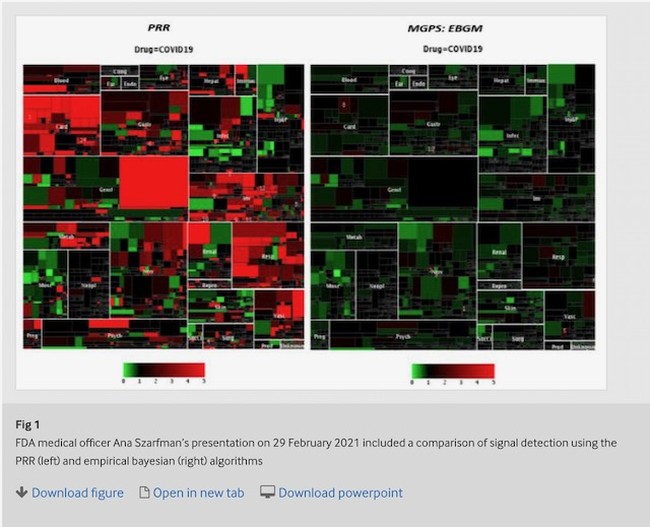 Using the method the CDC claimed it was using but wasn't, the adverse events showed up in glaring colors; using the method they chose to use, nothing showed up. They chose to continue using the failed method, and we all know why. They wanted to deceive people into thinking that the vaccines were perfectly safe.
Marks and his staff, however, declined to alter the FDA’s existing approach—and agency officials did not publicly warn of the deficiency with finding safety signals. When Szarfman continued to press the matter, she was told, with diplomatic flourish, to back off.
That email, sent on 7 May 2021, by Craig Zinderman, associate director for medical policy in FDA’s Office of Biostatistics and Epidemiology, began: “Good Afternoon Ana, Thank you again for talking with us back in March about your work exploring new data mining approaches . . . We are writing to kindly ask you to please hold off on creating and sending data mining reports and analyses using covid-19 vaccine AE [adverse event] data.”
Zinderman told Szarfman that potential problems such as blood clotting and heart attacks were “already under close observation” through other safety systems, such as the CDC’s Vaccine Safety Datalink (VSD). Unlike VAERS, the VSD uses clinical records from participating healthcare organisations to evaluate adverse events.
While Zinderman projected faith in the other approaches, the fallibility of those systems was already evident: VSD analyses, for example, reported finding “no” signal for myocarditis in April 2021, despite intentionally looking for one. (Even in August 2021, two months after US officials had acknowledged a causal relationship between the Pfizer and Moderna mRNA vaccines and myocarditis, VSD did not signal.10)
“We understand that exploring new approaches might improve the methodology and is of interest to you,” Zinderman told Szarfman. “However, from our perspective, the approach employed during a period of intense, high profile surveillance should be standard, predictable, and road tested. Results from adjusting parameters that raise or lower sensitivity of the alerts as the vaccination campaign is underway could lead to confusion and have unintended consequences (eg, regarding vaccine confidence).” His citing of a potential effect on “vaccine confidence” highlighted that the US health agencies were not solely focused on the safety of the covid vaccines.
Zinderman’s email ended by reiterating the FDA’s request to Szarfman: “Please hold off on creating and sending data mining results for covid-19 vaccine AE [adverse event] data.” Zinderman could not be reached for comment.
"Vaccine confidence" in the public was the goal, not informing the public about potential problems, including problems they knew with confidence were clearly evident, despite their own system failing to pick them up. They wanted people to get the vaccine despite known and dangerous flaws, so they chose to sweep the problems under the rug, and people died.
But by July 2021, Szarfman again sounded an alarm over a “strong signal” for “death and sudden death” that she said DuMouchel had identified using the updated algorithm. She shared the findings with a colleague, Richard Forshee, a deputy director for biostatistics and pharmacovigilance, who worked under Peter Marks. Forshee expressed his doubts about the analysis to Szarfman and wrote to Marks: “Ana Szarfman called me . . . She said that she and Bill DuMouchel had found an increased risk of mortality following covid-19 vaccination using data mining methods.
“I am very concerned that whatever association they think they have identified is spurious based on the way the covid-19 vaccination program prioritized individuals and the required and stimulated reporting we are seeing with the covid-19 vaccines. . . . Please let me know how you would like us to proceed.”
Government emails show that Szarfman continued to raise concerns with the FDA’s vaccine regulators. She wrote to agency officials managing the algorithm in September 2021, again urging adoption of the updated technique, which she said was “much, much better at unmasking signals . . . It automatically identifies and corrects for confounders. This is an important function to have, given the pandemic situation.”
On 15 September 2021, Marks wrote to his counterpart in the FDA’s Center for Drug Evaluation and Research (CDER): “One of the CDER statisticians, Ana Szarfman, has decided on her own to do vaccine analyses using VAERS as part of her work at FDA. She is, however, not doing this in collaboration with our [vaccine centre] statisticians, and quite to the contrary, has been asked to cease and desist, because the strategy that she is using could create erroneous conflicts that feed in to anti-vaccination rhetoric. This is creating an issue . . . This issue came up previously during the pandemic and . . . it seemed to go away, but it is now back. Can we catch up about this sometime?”
Less than three weeks later, over Zoom, Marks addressed a group of people who had been experiencing prolonged, severe neurological symptoms after receiving covid vaccines. Marks said that FDA officials would query their databases for “a neurologic signal.” When he met with the same group three months later, he reported that his staff members had “looked for various signals,” but “we have not found a rate . . . that is higher than would be expected in the population.” Marks, who resigned from the FDA last year, did not respond to requests for comment.
This behavior goes beyond negligence. The officials were repeatedly warned that there were problems that were killing people, had evidence that this was obviously true, and because they wanted to force people to get vaccinated, they went after the person most determined to warn them and change the system to one much more reliable.
This would be unforgivable with any vaccine; it is astounding and perhaps criminal with regard to mRNA vaccines, which had never been tried. If this were just another ordinary flu vaccine, at least skepticism would be warranted because the technology was tried and it would be surprising to see lots of new problems; because the vaccine was novel and known to have potential problems, which is why it had not been tried before, this move was negligent homicide or worse.
Many of the people who knowingly pushed vaccines, aware of the dangers, simply lied to the public about their safety system and the safety of the vaccine, using the excuse that they didn't want to confuse the public with pesky facts. They had a vaccine rollout to perform, even if it was killing people who otherwise were at almost no risk from COVID.
That was a consistent theme throughout the pandemic and beyond: telling the public lies in order to get compliance, under the guise of "consistent messaging." Don't confuse the public with the facts. Look into the cameras and lie for the greater good.
You need to break the eggs to make a good omelet, you know.
Bastards.
Editor's Note: The mainstream media continues to gaslight, spin, and lie about President Trump, his administration, and conservatives.
Help us continue to expose their left-wing bias by reading news you can trust. Join HotAir VIP and use promo code FIGHT to receive 60% off your membership.











Join the conversation as a VIP Member