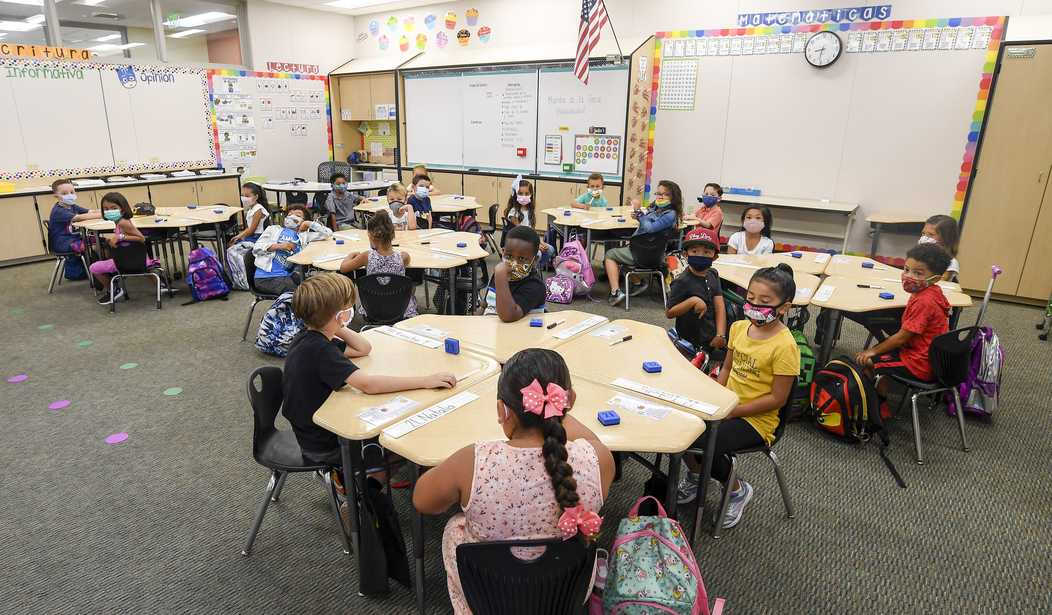
There is a strong, if not quite universal, movement on the left side of the aisle to eliminate gifted-and-talented education.
It is attacked as racist, just as using the ACT or SAT for university admission was claimed to be racist. The movement to do that was so successful that professors at the University of California system are begging for their return because their students can't do middle-school math.
Schools in places like Seattle, Washington, D.C., and New York City have been cutting or eliminating programs for gifted kids, and that's just the tip of the iceberg. The reasoning, of course, is that GATE (Gifted and Talented Education) programs violate equity standards, which require equal outcomes. And since gifted kids are smarter than others, we need to go all Harrison Bergeron and handicap the gifted as a nod to the less so.
The irony of this coming from something called the Intelligencer.
— Dan Gainor (@dangainor) June 12, 2026
Now I have to admit that there has been plenty of pushback from liberals, many of whom come from the highly educated classes and love the idea of equity, but only when the victims of equity logic are other people. While many of them send their own children to tony private schools and bray about inequities in public schools, enough still send their kids to public schools that there is modest pushback.
G&T has a race problem. As of 2022, roughly 60 percent of American students enrolled in a gifted program are white, though recent data shows that white children are only around 40 percent of the total public-school population — a disparity that has been in place for as long as G&T has existed. The gap is apparent in New York. Recent figures on the city’s kindergarten G&T enrollment indicate that white and Asian students are vastly overrepresented relative to their proportion of the city’s student body. The Anderson School, a citywide K–8 gifted institution, barely cracks double digits for Latino students and admits even fewer Black students; the stats for another K–8 citywide gifted school, NEST+M, are no better. The trend continues in high school. Of the 781 students accepted to the highly competitive Stuyvesant High School last year, eight were Black. Among the city’s other eight specialized high schools, 3 percent of offers went to Black students while 6.9 percent went to Latino students. Combined, Black and Latino students make up roughly two-thirds of the city’s public-school population.
But when push comes to shove, it is Asian parents who threaten to lynch school boards when these proposals come up, but that is a different story. Still, God bless them. Most of them berate their children when they get 'B's, so equity is not that appealing to them.
Now, I admit, I was put into GATE programs in school, although I actually didn't think it was any great shakes. I found it as boring as I imagined regular classrooms to be, and certainly didn't feel that special about it. The big advantage was that as a Junior or Senior in High School, you could take classes at the University of Arizona and get credit, and it was free.
However, there was no doubt that the kids around me were smart, and just as little doubt that a lot of kids really aren't, or just weren't academically inclined. Their talents, whatever they were, lay elsewhere.
Since "equity" hasn't been that powerful an argument against parents who want the best for their kids, the fine folks at New York magazine, which is aimed exclusively at the parents of those children, have taken a different tack: your kids really aren't that smart. It's an illusion, so gifted programs are based on a lie.
Some parents I spoke to have already washed their hands of the whole G&T business, refusing to participate in what they view as a corrupt system of segregation. But countless others still place significant stock in the G&T designation and what it offers and are comfortable relying on cognitive testing, should it be required, to determine whether a child qualifies. For decades, people in favor of G&T have promoted the notion that we can put a concrete number to a child’s intelligence, that the smartest children need extra enrichment or acceleration to reach their potential, and that we can measure the beneficial impact of that enhanced learning on the children who receive it.
There is just one problem: Not a single part of this story is true.
Is that really so, though? While it is certainly true that intelligence is not one thing—my father has the kind of spatial intelligence that I could only dream of, and does very complicated math in his head, while I excel at grasping and synthesizing concepts and arguments, and notice connections that many others don't easily—it's pretty clear that the concept of "intelligence" is not based on an illusion.
We all know truly stupid people, and truly smart people. We can simultaneously recognize that most people are gifted in some way or another, but we really aren't all equal in intelligence, just as we aren't all equal in other abilities, such as physical prowess, mechanical ability, social skills, and the like. It's not a question of value as a human being; it's about innate abilities.
According to most definitions proffered by advocacy groups for high-ability children, a child is said to be “gifted” if they perform (or have the potential to perform) at a higher level than other kids their age. Rather than any inherent characteristic, it’s their difference that defines them.
What causes a child to perform at that higher level? A person’s intelligence has been shown to correlate with that of their parents, but researchers view this genetic component as a baseline with which countless life circumstances interact. The number of environmental factors that might impact a child’s intelligence is staggering: their socioeconomic status, and the food, shelter, and stability that it does or does not provide, but also things like level of physical activity or even how much greenery there is in their community. Research suggests that the calibration of nature versus nurture shifts over time, with environmental aspects playing their greatest role when a child is very young. Some theorize that highly gifted children stay in this spongelike developmental window — when factors like enrichment programs, good teachers, and shelves full of books make a big difference — longer than their peers with typical intelligence, which leads to their superior abilities.
But that is just an idea, of course. The bases of high intelligence (and what we even mean when we say “intelligence”) are vast and mysterious, and multiple schools of thought have spent decades battling it out across the landscape of academia. Some educational theorists posit that high intelligence is a single quality that manifests generally in various aspects of thought, while others assert that there are numerous forms of intelligence, such as linguistic, musical, or kinesthetic. Still others say it’s a form of neurodivergence. Research indicates that highly intelligent people are 20 percent percent more likely than their peers to be diagnosed with autism spectrum disorder and 80 percent percent more likely to be diagnosed with ADHD. “I don’t know that there are truly gifted neurotypical children,” says Laura Phillips, a New York pediatric neuropsychologist whose practice includes gifted kids. “One not yet well studied idea about giftedness, and neurodivergent brains in general, is the overexcitability hypothesis, this idea that these kids’ brains are just firing nonstop. They’re so acutely sensitive to information and to stimulation in the environment, and that in and of itself is its own vulnerability.”
Other psychologists reject the notion of a genetic or biological component of intelligence altogether and believe there is no such thing as innate talent or aptitude, that we can all learn anything with the right teacher.
Now stop right there. The point, it seems, is that we can't provide one solid definition of "intelligence," which is trivially true. Intelligence is a complicated concept, but not a meaningless one. To say that there is no one, comprehensive definition that captures something in its entirety is not the same thing as saying that the concept itself is not describing something real.
I recall something Leo Strauss once said when being challenged by a relativist on the concept of inferior and superior cultures and values (I paraphrase): it may be true that because the peaks of a mountain range are shrouded in mist, and therefore we can't quite discern the relative heights of each peak, we can still tell the difference between a mountain and a molehill.
In other words: we may not know the absolutely best, but we sure as hell can tell the difference between good and bad.
The basic argument the author makes is that measuring intelligence is really hard, and we don't do it well enough for a variety of reasons, and for all I know, she has a point. No doubt it is hard, although I think this point is overused, since in the case of GATE, what we are measuring is aptitude for a certain kind of intellectual work, just as a basketball coach looks for aptitude in a specific set of skills that would make a player especially good.
And, as we know, in many cases the aptitude for one sport can translate to others, which is why particularly skilled athletes can excel in many sports, even in ones they pick up quite late.
Of course, as I alluded to before, I think that many GATE programs are overrated, but that is on them. I found my High School experience boring, just as I found my elementary classes so. I finished my mandated 6th grade assignments and completed the curriculum in three months because so little was asked of us in the first place. I can only assume that GATE was better than regular high school, but I doubt that more than a tiny fraction, if that, of students in gifted programs in public schools get 1/3rd as good an education as a kid in a good school in 1890.
Public education sucks. That's the lesson. Not that there aren't smart kids.
The dumbest argument made in this piece stands out like a sore thumb: that GATE students don't actually excel at intellectual pursuits in real life.
When your intelligence is the foundation of your self-perception, failing to achieve feels like soul death. But if the limited amount of information we have about gifted kids long-term is any indication, most lead, at best, ordinary lives of modest accomplishment. A 35-year study of 677 gifted children found that by age 50, only 12.3 percent had reached a level of “eminence,” defined as “full professors … Fortune 500 executives … judges and lawyers, leaders in biomedicine, award-winning journalists and writers.” This means 88 percent never did.
Think about that for a moment: 12.3% reach the pinnacle of their professions. Only? Given that the pinnacle of professions are inhabited by substantially lower than 1% of the population, that's pretty damn impressive. It may be that, as a society, we shouldn't idolize these people so much just for being credentialed, but you can't argue that if that is your measure, having that big a head start is worthless.
I think it's obvious that we should restructure kids' education to help everybody reach their full potential as much as possible, providing a minimum but far better intellectual foundation for all kids, while also focusing on aptitudes beyond academic achievement.
The resentment toward the idea of "gifted" kids is based on what I believe to be an overemphasis on intelligence as a measure of worth by the cultural class, such as the readers of The New York Magazine.
Intelligence is great to have, but highly overrated. A lot of academically talented people stall out because their other skills atrophy from underuse. I like to joke that come the apocalypse, I would be among the first to die because I am utterly worthless at the essential life skills that many people have developed.
GATE programs, in this sense, may be overrated by placing too much emphasis on the prestige of being "smart" and not enough on developing the skills necessary for success beyond a very limited range of activities. I know people who excelled academically, became professionals, and only found happiness by taking up skilled labor jobs like carpentry or electrical work.
The guy who built my deck used to be a lawyer. Getting out was the best thing he ever did.
Editor's Note: The mainstream media continues to deflect, gaslight, spin, and lie about President Trump, his administration, and conservatives.
Help us continue to expose their left-wing bias by reading news you can trust. Join HotAir VIP and use promo code FIGHT to receive 60% off your membership.












Join the conversation as a VIP Member