






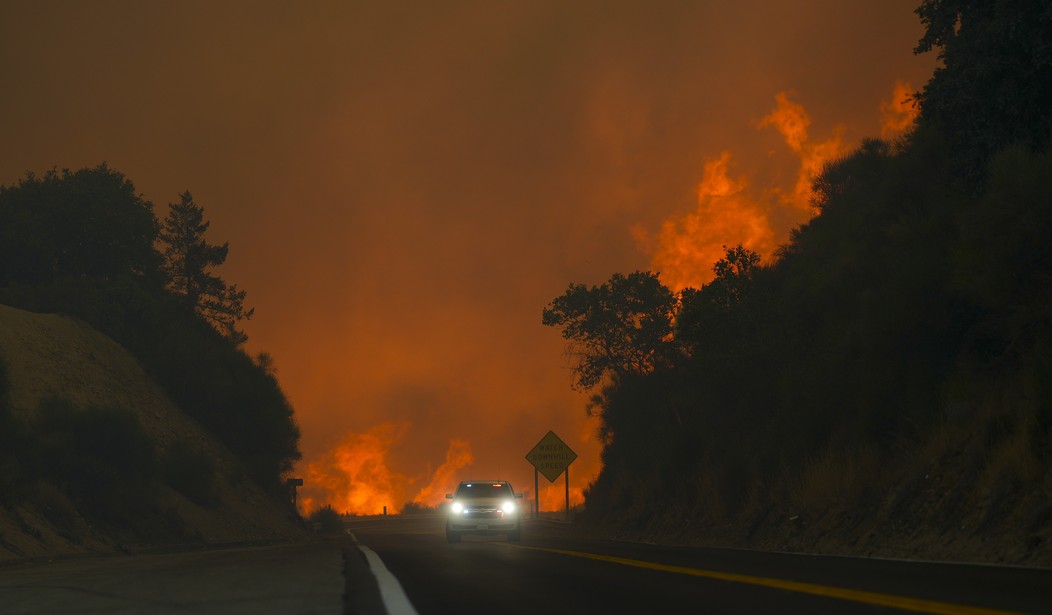
They are having a time in Europe this summer.
First it was hot, hot, HAWT.
And now their own fire season has started under some challenging conditions, including a combination of stronger-than-average heatwaves and, in many areas, a drought that's now nearly a year long.
I have to admit, it has made for some spectacular and scary video. You can tell, if you look closely, that the ground cover the firefighters are charging through with their hoses is just as dry as a bone.
WATCH: Dramatic firefighter bodycam footage captures crews battling raging wildfires in France’s Gironde region, where an estimated 240 buildings have been destroyed. pic.twitter.com/GXvK2QOVKp
— Breaking911 (@Breaking911) July 28, 2026
The countryside across much of Europe is a tinderbox.
This is pretty amazing footage of Canadian-built water bombers scooping water out of a lake to continue the assault on a French fire. And yes, these are the planes the Canadians cannot afford to buy for themselves.
Impressive footage of 5 @SecCivileFrance Canadair CL-415 water bombers taking turns scooping water from Lake Sainte-Croix 🇫🇷 before heading out to battle the numerous wildfires raging across southern France this summer.
— Tom Antonov (@Tom_Antonov) July 22, 2026
📸 by Cyril Talbot / FB pic.twitter.com/l9FZZi3BO4
Hundreds of thousands have been evacuated across France, Spain and Portugal, and entire little villages have been lost as the fires swept through their isolated areas.
Wildfires are tearing through southwestern France and parts of Spain, forcing hundreds of thousands to evacuate and scorching vast stretches of land. Officials say crews are making progress in France, but another dangerous heat wave expected this week could fuel even more fire… pic.twitter.com/XMMSFLTXHX
— CBS Evening News with Tony Dokoupil (@CBSEveningNews) July 28, 2026
In one town, an equestrian center was forced to simply turn their horses loose, as they had no way to evacuate all of the animals as the fires approached.
WATCH: Several horses are being evacuated as deadly wildfires continue to spread across southwestern France. pic.twitter.com/Hk9WR1aCWZ
— Breaking911 (@Breaking911) July 27, 2026
This is the Gironde region, where 42,000 hectares of pine forests have burned so far.
🇫🇷 Insane aerial video showing the massive wildfire near Bordeaux.
— Mario Nawfal (@MarioNawfal) July 26, 2026
The fire is sitting about 15 km from the city in France's Gironde region, forcing over 220,000 people to pack up and leave while torching 42,000 hectares of pine forest.
Over 2,500 firefighters, backed up by…
It's a really ghastly situation.
What makes it more unspeakably horrible is that so much of it didn't have to happen.
In France, there have already been over 160 arrests for arson. Yesterday, the French Prime Minister Sébastien Lecornu said nine out of ten fires were caused by humans.
French Prime Minister Sébastien Lecornu has said that “9 out of 10 fires are human-caused” as France faces an unprecedented wildfire season.
In a social media post published this week, the French Prime Minister noted that most of the incidents arise from “carelessness” and confirmed that 162 arson arrests have taken place nationwide this month.
The conditions have simply allowed arson or 'carelessness' to take off to devastating effect.
Like starting a campfire in a bone-dry clearing in the woods.
🚨🇪🇺 Meanwhile all across Europe
— Concerned Citizen (@BGatesIsaPyscho) July 28, 2026
Police are looking for over 160 Arsonists in France & over 20 in Spain in relation to the devastating wildfires as Legacy Media continue to call the Fires Climate Change.
Also some of the potential suspects. pic.twitter.com/WkxRpwcoN8
Or when the uncontrolled flames from this blazing vehicle spread to the roadside vegetation and birthed the Biscarrosse wildfire.
A simple(ton's) guide to understanding climate change and wildfires:
— Volcaholic 🌋 (@volcaholic1) July 24, 2026
Yes, the Biscarrosse wildfire was started by a van that caught fire. The flames spread to roadside vegetation before moving into the forest. That is a fact.
What isn't true is the claim that this means climate… pic.twitter.com/4I9JEdwbPf
It's cold comfort to the Europeans at the moment that the actual numbers of fires on the continent have been trending down significantly for quite a while.
...It is not just the trend that is surprising. Hard to believe, but this year is an unusually quiet year for wildfire: so quiet it is breaking records for lack of fires by this date, even in Europe. If you don’t believe me, check the figures produced by the Global Wildfire Information System: as of last week, the world had seen 106 million hectares burn this year, the lowest at this date since these records began in 2012. In Europe, just 3.6 million hectares have burned – less than half the average for this date. That’s cold comfort to people driven from their homes in France, but it is nonetheless a fact.
— Bjorn Lomborg (@BjornLomborg) July 30, 2026
But much like we discussed when talking about the Canadian situation, the ones that do light off are far worse to deal with.
Again, much of that has to do with forest management or mismanagement, as the case may be.
And now, in the middle of a cyclical drought, compounded by these heatwaves and winds, they have their hands full. It would be nice if they could stop lunatics from purposefully setting a significant portion of them.
England is facing much the same situation right now. Much of the angst could have been avoided through planning that's been on the books for a long time, but other priorities always come first, you know. The British were already experiencing a severe water shortage, and local water companies haven't been shy about just shutting off the taps with no warning, as our son found out in the middle of a laundry load the other evening.
I'm sure folks in his city appreciated dry taps as they, say, tried to cook dinner or have that last pot of tea.
All of Cirencester had its water cut off last week, just days after it had spent a day reduced to barely a trickle in some places, and no water in others. No notice beforehand either time.
— tree hugging sister 🎃 (@WelbornBeege) July 27, 2026
The island is similarly concerned about the wildfire danger, but it's not so much forest fires, although those do happen. It's the peat bogs; should they catch fire, they can burn for what seems like forever. And much like the Palisades, they can burst to the surface and rekindle somewhere down the line because they've smoldered along underground without a first clue.
Interestingly enough, this has also been exacerbated by well-meaning but devastatingly wrong management practices intended to protect the air from the excessive peat smoke and the heather that grows over the top of the bogs.
The ancient and traditional practice of fire suppression known as 'cool burning' has been spurned in favor of 'rewetting,' which is great, I guess. As long as you don't have a drought.
Which they do.
...Here in Britain the government has consistently and relentlessly demanded less ‘cool’ burning – low-intensity, controlled fires – in winter on heather moorland, Britain’s most fire-prone habitat. Such fires have been used by farmers and gamekeepers for generations to create a mosaic of short and long heather. This encourages fresh young heather shoots for sheep and grouse to feed on and makes open areas for rare birds such as golden plover and curlew to nest in. If done in winter it can burn off the rank heather plants while leaving the moss underneath barely touched, as demonstrated by a famous video in which a gamekeeper places a Mars bar in the moss, lights a fierce fire over it, then picks up the unscorched, unmelted chocolate bar, unwraps it and eats it.
Natural England argues that regular cool burning harms the habitat; researchers at York University and elsewhere argue the opposite: that it encourages the growth of sphagnum moss and other species by letting light in. But both sides agree that regular cool burns can dramatically reduce the risk of much more damaging wildfires, which burn down through the moss layer and into the peat. Cutting heather instead is less effective but better than nothing. Yet Natural England has banned heather burning on deep peat altogether and is pushing hard to limit it further everywhere – or at least tie it up in complicated licensing rules. As a result, the fuel load on heather moorland has been increasing; in places the heather is now waist-deep. The National Fire Chiefs Council warned last year that such restrictions on heather management would increase ‘the danger to firefighters and the public’.
Unlike private owners, bodies such as the Royal Society for the Protection of Birds (RSPB) and the National Trust are refusing to burn and reluctant to graze heather moorland, as they join the cult of ‘rewilding’. With the support of government, they plan to mitigate the fire risk by ‘rewetting’ moors with leaky dams to hold back rainwater. But this approach is useless in a drought.
The Spectator reports that Britain's 50-year drought record is only three days away from being broken. That one was set in 1976 in Surrey, when they went 43 days without a drop of rain. The dry countdown is on.
And in those fifty intervening years, much like in California, nothing's been done to preserve water resources or add storage capacity, even as the population has increased by some 22 million people.
Some lessons are hard.
But they have their hands full at the moment, too, although I don't believe blazes are 'caused' by 'record-breaking temperatures' any more than a car drives itself into a crowd.
Whatever.
Staff at Sizewell B nuclear power station are on alert due to a “large-scale” forest fire in Suffolk, The Times understands.
The fire has burnt about 100 hectares — the equivalent of about 140 football pitches — and a major incident has been declared in the county. The rest of the country is on high alert for blazes caused by record-breaking temperatures.
Sizewell B is located three miles south of the fire and a source who is familiar with operations said there were “concerns” at Sizewell because of the ventilation and air conditioning systems. The source said “the smoke is currently bellowing out to sea but if the wind direction changes or it spreads closer and heads to Sizewell it will be sucked into the HVAC systems and get inside all the buildings”.
...He [Paul Holmes] continued: “Anything can change very quickly and the local farmer is trying to put in fire breaks in the field adjacent to the village. He’s trying to plough up the field so the fire cannot jump across so that’s good work from him.
“It’s a very tricky operation for the brave firefighters as it’s a very frightening situation.”
The fourth widespread heatwave of the summer has piled pressure on emergency services. Over the past fortnight, fire crews in England and Wales have responded to a new wildfire about every 90 minutes.
The goal is to get through this - keep everyone safe, knock the fires out, catch arsonists and nail them to a wall.
And then someone, at long last, could be a radical reformer and return to proven, effective fire suppression methods and take action on the water capacity front.
What a change that would be.
Editor's Note: We now have the room to run outside commentary by some of our favorite and most provocative thinkers on the Right. That only happens because of the support of our readers, who ensure that we have the resources to keep providing an independent platform and independent voices in a sea of Protection Racket Media domination.
Help us maintain that fight! Join HotAir VIP and use promo code FIGHT to get 60% off your membership.


Join the Conversation
VIP members get the ability to comment on articles.