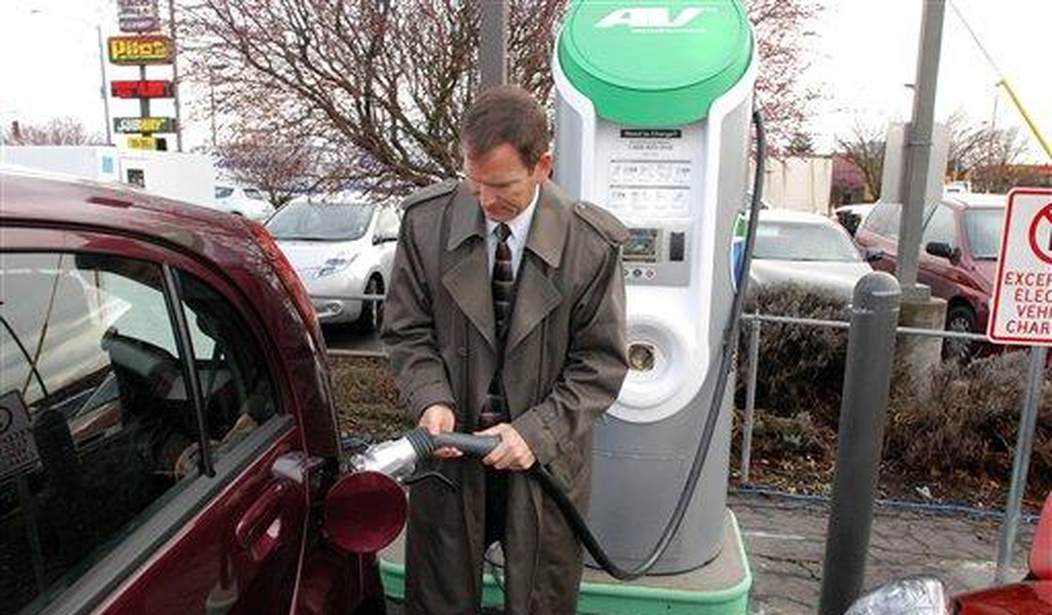
The Sword of Damocles hanging over auto manufacturing and sales in the European Union was officially lifted only a few minutes ago.
Official: EU scraps 2035 new ICE car sales ban
It's kind of interesting how - let mix my metaphors here now - the Brussels Brahmins split the baby to supposedly appease the industry, which catches serious grief here for their 'heavy lobbying,' while bowing to the brutal reality check of what the ban was going to do to the collective European economy. That is not emphasized as much. In fact, it's not even discussed, as no one likes to admit, especially the Imperial EU hierarchy, that they've been running high on unicorn fart power instead of fact-based decisions for their regulation spewing.
Combustion cars will be allowed to remain on sale after 2035 in the European Union under major changes put forward by the continent’s top legislators.
The lifeline to car makers follows intensive lobbying from European governments and some of the industry’s biggest marques, including Volkswagen, Renault, Mercedes-Benz, BMW and Stellantis.
The European Commission’s new, more lenient rules amend the total ban of new combustion cars that was due to come into force from 2035.
Under the proposals, total tailpipe CO2 emissions from that year must be reduced by 90% – rather than 100%, compared to 2021. The previous 100% level effectively banned the sales of non-EVs from 2035.
The Commission said that this allows hybrids and combustion vehicles to remain on sale past 2035.
What's interesting about the finalized rule is that there is no end date for the sale of internal combustion vehicles (ICE) and hybrids. I believe you could call that 'a tell.'
...Notably, the proposals do not include an end date for the sale of combustion-powered vehicles meaning they could continue to be sold indefinitely.
Or, at the very least, another nod to reality on the ground, as one EU commissioner basically admitted.
'Restoring Europe's industrial leadership' is a tall order as long as Europe's political leadership continues constantly undercutting it.
...Stéphane Séjourné, the Commission’s executive vice-president for prosperity and industrial strategy, called the changes “a lifeline for the European automotive industry”.
He added: “We are pulling every lever at our disposal – simplification, flexibility, European preference, targeted support and innovation. Together, these measures are our commitment to restoring Europe’s industrial leadership while leading the global transition on climate.”
The EV market was shifting regardless of what the EU wanted to impose on its citizens, and nowhere was the shift more apparent than in the US, where administrations and philosophies that were 180° degrees apart swapped power.
There’s been a tonal shift when it comes to EVs. It’s not an assertion, either. Ford has shifted its focus toward hybrids, as have several other automakers. Where we once thought electrification would dominate automakers’ lineups, we’re now seeing a regression to meet consumer demand.
The expiration of federal tax credits dramatically dented EV sales and is something automakers point to as a reason they’re no longer as bullish on EVs. Now, a new study underscores that auto brands likely saw this curve in the road before any of us. Where car buyers once planned to switch to an EV, there’s now a massive dearth in interest.
A new study from CDK Global on consumer sentiment shows interest in EVs among gas-powered vehicle drivers has dropped 20%. When asked if they planned to purchase an EV in the future, only 11% of respondents who drive ICE autos said they do, down from 31% in 2024’s survey. Similarly, in 2024, 54% of hybrid drivers said they were planning to switch to EVs; in 2025, that group’s interest in switching to a fully electrified car stands at 35%, down 19% year over year.
Interestingly, plug-in hybrid drivers are still quite interested in a fully electric vehicle. 54% of respondents who currently drive PHEVs said they would switch to an EV in the future, down only 4% from last year’s survey (58%). Speculatively, this suggests that a PHEV is a bit of a toe-dip into electrification for many and helps better frame the benefits of full electrification than vehicles that rely on gasoline.
As Ed touched on briefly the other night, Ford has announced they're taking a massive writedown and completely rejiggering, if not nearly eliminating, their EV and EV battery operations. And, in line with what EU President Von der Leyen said in her statement when the ICE reprieve was announced today, they're canceling unpopular larger EV sizes in Europe to concentrate on smaller, affordable models.
Chinese hot breath on their necks?
Perhaps.
...The company said yesterday it would stop producing most larger EV models as customer demand had turned out lower than expected.
Instead, it will focus on offering its larger models, such as the iconic F-150 pickup truck, with both classic combustion engines and hybrid motors. The fully electric F-150 Lightning model will be cancelled.
Ford also said it no longer intended to produce a previously planned new electric commercial van for the European market.
Its electric vehicle devision – Ford e – will henceforth focus on developing smaller, more affordable vehicles.
“This is a customer-driven shift”, said Ford president and CEO Jim Farley. He added: “The operating reality has changed.”
The carmaker also said it had ended its joint venture with South Korean battery maker SK On. The two companies had struck a deal to jointly manufacture EV batteries in the US in 2022.
Ford said it would convert its underutilised EV battery production facilities to enter a new business offering battery energy storage for data centres and electric grid infrastructure.
The major strategic shift will heavily impact Ford’s baseline in the coming years. Altogether, the company said it will incur costs of $19.5 billion (€16.6 billion) due to write-downs of assets, necessary adaptations to production facilities and other factors.
While the future looks rosy at the moment for lovers of hybrids on the continent, the risible Labour party in Britain is doing its best to kill off plug-in hybrids (PHEV) in the British Isles.
Busy taxing everything that moves, Finance Minister Rachel Reeves came up with the idea to have PHEVs pay both the regular fuel taxes accrued when one fills up, as well as a per-mile tax for the privilege of having that tiny little battery, which gives them their convenient but minuscule 40 to 60-mile electric range.
What a racket.
Naturally, under this scheme, PHEVs are suddenly looking like a 'must dump it quickly' vehicle. No one wants to take it in the shorts the first time, let alone twice.
...But PHEVs are about to become the nation’s least-wanted car. From 2028, those who bought plug-in hybrids for their green credentials will become the most heavily taxed motorists.
They will be saddled with an “illogical” 1.5p per mile charge as part of the Government’s new road pricing initiative. As well as mileage charges, they will continue to pay fuel duty at the pumps, in effect being taxed twice for every mile they drive.
Electric vehicles (EVs) will attract a higher 3p per mile rate, but as drivers do not pay fuel duty, the principle of a pay-per-mile tax has been met with tacit acceptance. Self-charging hybrids, meanwhile, that don’t plug in are not affected by the new per-mile charge, and will continue paying normal fuel duty.
Car dealers believe fed-up PHEV owners will rush to sell as demand inevitably dips in the lead-up to 2028, when pay-per-mile is introduced.
Geoffrey Troughton, who owns a Ford Kuga PHEV, said: “Who’s going to want to buy a plug-in hybrid when you can just avoid the tax with a different car?” he asked. “I’ll be charged simply because my car has a plug, whereas self-charging hybrids won’t. It’s an illogical and ridiculous tax.”
It's said that the battery mileage is so feeble that many PHEV owners rarely, if ever, plug their cars in to use the battery, preferring to run on the gasoline motor.
One owner in the article says that if he drives to visit friends in England from his home in Scotland, it's about a 1000-mile round trip, of which 900 miles is on his gasoline engine. Perhaps only 100 of it on battery power.
But after 2028, he's going to be taxed by the government for every mile of the trip, on top of the fuel taxes he paid coming and going.
“I find that absolutely crackers and unfair.”
I wonder if he voted for Labour?
As Ford drops EVs in the US and the EU waters down their ban on ICE, the British government is throwing £2.5 billion more into EVs in a desperate attempt to get EVs up and running in the UK.
— Net Zero Watch (@NetZeroWatch) December 16, 2025
More money down the drain on Net Zero tech. #CostOfNetZero pic.twitter.com/4IZI5vMwrU
Probably won't this next time.
Another chink in the 'good for the environment' argument that precipitated the earlier, unpopular, and mandated transition to electric vehicles is provided by the Norwegians, of all people.
For one thing, they play at being green as a cucumber while drilling, baby, drilling.
While the rest of Europe shivers under the self-imposed austerity of net zero mandates, Norway in the frozen north is keeping the lights on and the bank vaults full as it avoids the “green” ideological quicksand that has defined the continent’s energy policy.
Despite pressures to decarbonize, Norway has increased efforts to exploit oil and natural gas reserves. The crown jewel of this fossil fuel renaissance is the Johan Castberg field. Located in the Barents Sea, 100 kilometers north of the 20-year-old Snøhvit natural gas field, Johan Castberg is expected to be a beast of a producer—450 million–650 million barrels over 30 years, with a peak daily capacity of 220,000 barrels.
And the investments don’t stop there. The Norwegian government—ignoring the wailing of the United Nations—has initiated plans for its 26th round of oil and gas licensing. Targeted will be “frontier areas”—little-explored regions that can reward high risk with massive returns. While the U.K. suffocates its North Sea industry with windfall taxes and regulatory hostility, Norway is effectively saying, “If you won’t drill, we will.”
There are, for all the oil and gas rigs offshore, boatloads of EVs on every city street. How so this?
The government's filthy oil lucre helped citizens pay for them, thereby salving guilty consciences and doing all the appropriate virtue signaling.
...Despite the country’s embrace of fossil fuels, “greens” enthusiasts often point to Norwegians’ widespread adoption of electric vehicles as a model for other countries. However, as is often the case, the pretense of a “green” utopia is promoted through a deception.
The gleaming EVs filling the streets of Oslo are subsidized by the government’s oil revenue.
The Norwegian sovereign wealth fund—known as the Government Pension Fund Global—is the largest of its kind in the world. As of November, its assets were valued at over $2 trillion. On paper, that is $340,000 for every Norwegian.
It is a delicious irony that the climate activists’ favorite “model” nation is funded by the very substance they despise. Every time Norwegians plug in an EV, they are effectively accepting a handout from drillers at Johan Castberg. The “green” lifestyle is a luxury purchased with petrodollars.
And they are all truly electric - no hybrids.
But crunch time for the handouts is coming, and it makes one wonder if we're going to see ICE vehicles begin to repopulate the streets of Oslo when the sticker shock hits because?
The subsidies are over as the Norwegian government has determined they're just about full up on EVs.
RUT-ROH
'That Goal Has Been Achieved': Norway's Shift To EVs Is Nearly Complete
The end of the $7,500 federal tax credit for electric vehicles in the U.S. was definitely premature since the market is not even close to reaching a turning point in the shift to EVs. It was a useful incentive that made a difference. But in Norway, the EV shift has happened almost completely, so the subsidy phaseout will happen because government officials say the country no longer needs it.
Most new cars bought in Norway have been electric for a few years, and that won’t change once the government no longer actively incentivizes people to go electric. New EVs bought in the Nordic nation are exempt from import duties, paying road tax, registration tax and value-added tax (VAT). The latter alone is 25% so it makes for significant savings for the buyer.
This is all money that the Norwegian government could have collected, but instead opted not to in order to help accelerate EV adoption. And accelerate it did, with EV sales outpacing combustion cars for a few years now. The proportion of new cars that are electric grows from month to month and in September it reached 98.3%. These are pure electric vehicles, so they do not include plug-in hybrids.
Oh. Most new cars being electric 'won't change' once the government no longer 'actively incentivizes people' to buy electric?
REALLY?
Considering how generous the tax savings and giveaways are, and what the plans are for slimming down as they phase them out...OUCH.
...If you buy a new EV in Norway and it exceeds 500,000 crowns ($49,600), you will pay full VAT for anything above that value. So if a vehicle costs 600,000 crowns ($$59,500), then you have to pay 25% tax on the 100,000 crowns ($9,920) over the limit, so an additional 25,000 crowns ($2,480).
For an electric vehicle costing 500,000 crowns, Norwegian buyers save 125,000 crowns ($12,400) in tax, which makes it one of the best EV incentives available anywhere in the world. This is before factoring in any of the exemptions, which sweeten the deal further.
Now there is a proposal to lower the threshold for the all-important VAT exemption as of next year, where only vehicles costing less than 300,000 crowns ($29,800) would be fully exempt. EV buyers would pay full VAT for anything over. This means most vehicles among the top 10 best-selling models would no longer qualify, so the price the buyer would end up paying would be significantly higher than today.
When Big Daddy government stops paying for your vehicle, do you still want the same, or do you buy what you can afford?
Or - here's a thought - what you really wanted?
This is going to be interesting to watch, especially as it was all a virtue-signalling LARP to begin with.
At HotAir, we’ve been dealing with real government suppression of free speech for YEARS. Despite the threats and consequences, we refuse to go silent and remain committed to delivering the truth.
But we can't do it without your support.
Please help Ed, David, John, and me continue fighting back against government censorship by joining our terrific HotAir VIP community today. Use promo code FIGHT to receive 60% off your membership.
And thank you so much again for being here with us at HotAir.









Join the conversation as a VIP Member