









Democracy (shush, pedants - I'm talking about the small-"d" version, "elected representative government", not the capital "D" "50%+1 vote" variety) is a fragile thing. Our founding fathers knew that it was always a few bad decisions away from reverting to the tyranny of the dictator, the mob, or the tribe.
They knew that maintaining a democracy required not only institutions dedicated to maintaining the function and appearance of that democracy - courts, elections, legislatures, executives, media - but actual trust in those institutions. People had to believe the courts were, if not perfect, as least conscientiously just; that elections were fair and transparent; that legislatures enacted, even if indirectly and broadly, the will of the people; that the executive branch wasn't quietly arrogating itself absolute power; that the media was more concerned about holding governmenbt accountable than with currying favor to maintain "access" (and post-media job opportunities).
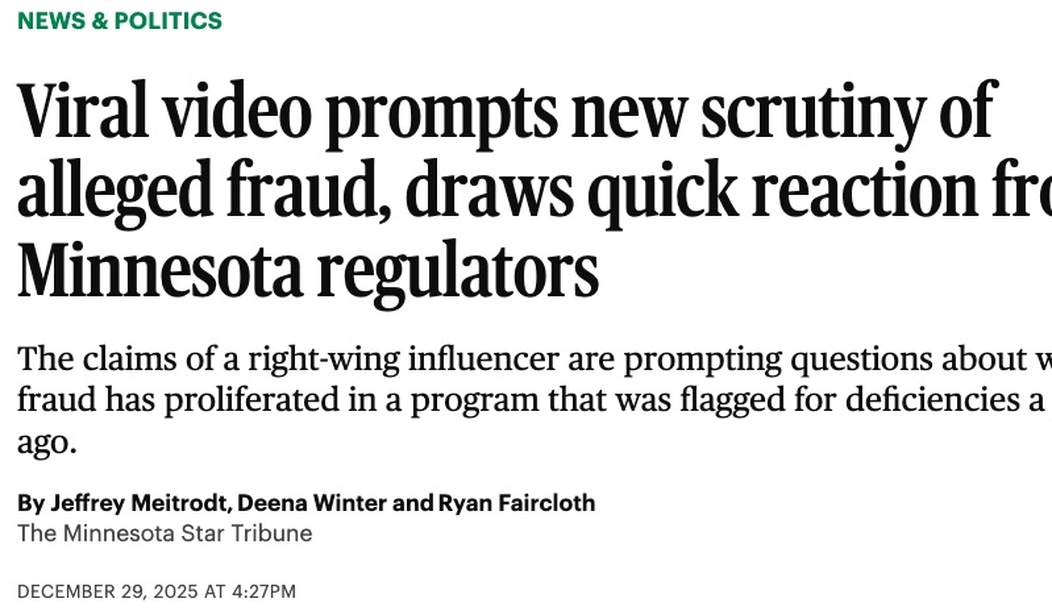
And the fraud issue - focused on Minnesota, but metastasizing across the country in recent weeks - is exposing some serious fault lines in America's trust, not of government, but of the institutions that keep government focused on its very few legitimate missions.
This woman sums up the issues in many cruxes, in re her native Brazil:
Great rant.
— QE Infinity (@StealthQE4) December 31, 2025
I think many are starting to feel this way.
You go girl! pic.twitter.com/Gro3sQW7Uw
Money quote:
People are starting to feel stupid. They think "well, I'm here, I'm playing by the rules, I'm working hard, I'm providing for my family, I'm doing th hard work, and I'm the idiot. You see the memes online, and we laugh - "I'm on my way to work, ,thinking that I should have just opened a daycare center in Minnesorta and made millions" - it's funny, but it's deeply sad. because the next thing is "why am I even doing this?" And that's the part that no-one wants to talk about, because this kind of feeling shapes culture.
And it's funny, kinda:
If you’re working today, understand that in 2026 you could have more freedom with just a little more hustle: resolve to open a daycare center in Minnesota next year.
— Matt Beebe (@TheMattBeebe) December 31, 2025
But it also gives people the appearance that the institutions are picking winners and losers; the government is deciding who it favors, and the media that is supposed to keep government accountable for such a toxic decision, isn't.
And some of the assumptions that flow from that impact one's trust, not merely in government and its attendant institutions...:
It's becoming increasingly undeniable that every left-coded "government program" that woke Christians used empathy to defend and demand we support...
— William Wolfe 🇺🇸 (@WilliamWolfe) December 29, 2025
Daycare, healthcare, refugee resettlement, welfare, etc.
Are all just fraudulent ponzi scheme kickbacks for godless Democrats
...but one's fellow citizens:
Falling birth rates among whites because we have to work and scrape by paying into a system that gives billions to foreigners who can outbreed us by a mile since they don’t have to worry about money. https://t.co/BqsVKIGq3b
— Bo French (@BoFrenchTX) December 31, 2025
Which is a pretty ugly thing to think about the people you're supposed to try to share a country with.
But as citizens of any totalitarian country will tell you (and believe me, we should be listening to them), when one doesn't trust the people who run things, or the people who write about the people who run things...
📰 Americans’ confidence in the mass media has edged down to a new low, with just 28% expressing a “great deal” or “fair amount” of trust in newspapers, television and radio to report the news fully, accurately and fairly.
— The White House (@WhiteHouse) November 28, 2025
The Fake News. pic.twitter.com/u3VgywdnLe
...then rumor, conventional wisdom, and "misinformation" will fill the vacuum.
The existence of those institutions isn't enough. The USSR had a legislature. North Korea has "media". Red Chinda has courts. Somalia has a government. Brazil has a constitution with all sorts of high-sounding phrases about justice and equality. Nobody (outside of American academia or the Democratic Socialists of America, anyway) trusts any of them to do the right thing by democracy.
And a few more decades, or years, of institutions we can't trust is all that separates the US from being just another Brazil.
And then, all that matters is not being the last pig to the trough.
All that matters is not being the sucker.