






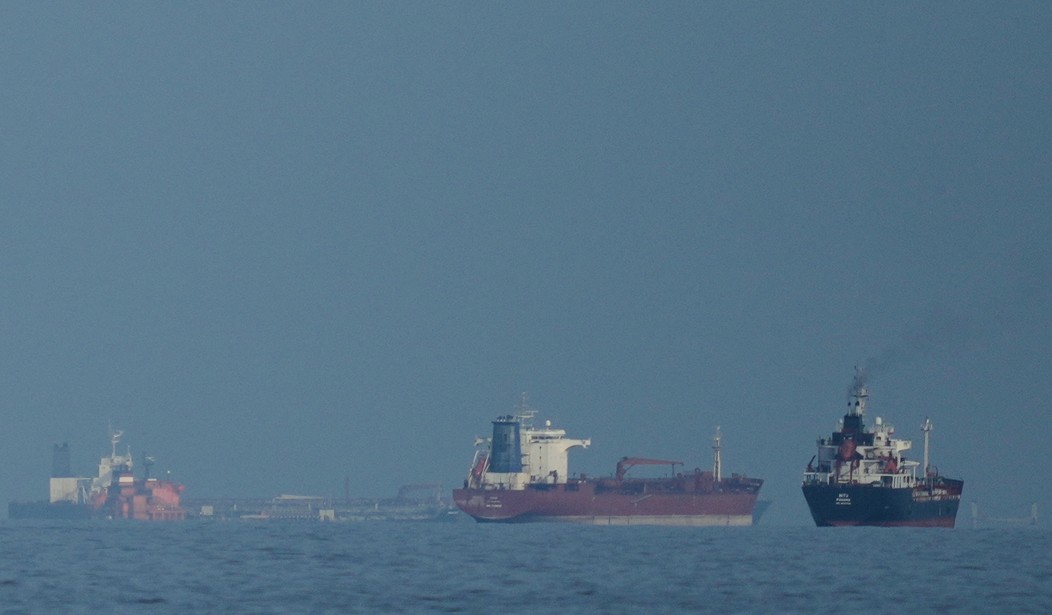
If you've looked at gas prices lately you already know the conflict with Iran is still having a big impact on prices at the pump. However, there's a genuine disagreement over how much oil is currently making it through the Strait of Hormuz. This week the Trump administration has claimed that the total amount of oil passing through the strait is approaching pre-war levels. Here's a CNN report from yesterday.
The US military escorted 40 commercial vessels carrying 18 million barrels of oil through the Strait of Hormuz, marking a wartime high as Iran and the US exchanged a new round strikes on Tuesday, two US officials familiar with the operations told CNN.
Prior to the launch of the war just over six months ago, roughly 20 million barrels a day were passing through the strait...
Even though Tuesday’s operation was a success, officials are under no illusion that a swift solution to the conflict is close, and energy companies are still wary about the huge risks involved in sending their ships through the strait, even with military escorts. And energy prices remain high, causing turbulence in the global bond market.
Backing this up, there are some indications that Iran's ability to see and attack ships crossing the Strait is more limited these days.
The Islamic Republic’s ability to surveil the Strait of Hormuz and lay mines in the vital waterway has likely been significantly degraded by American attacks, the Institute for the Study of War (ISW) assessed, noting that increased oil flows through the strait on September 1 suggest Iran is having difficulty preventing some commercial vessels from using the southern route.
United States officials told Axios on Wednesday that approximately 40 vessels carrying millions of barrels of oil transited the strait on September 1.
US Energy Secretary Chris Wright also confirmed that oil tankers transported over 17 million barrels of oil through the strait on August 31, the highest volume of oil exports through the waterway since the start of the US-Israel war with Iran.
However, there are companies that attempt to keep track of traffic in the Strait and their estimates of the number of ships passing through are much lower.
Ship-tracking service Kpler reported that "traffic declined sharply," with just five ships crossing on Monday, the same day that the US and Iran exchanged fire for the first time in a month. The data platform documented a mix of official ships as well as shadow vessels using concealment tactics...
The IMF and Oxford University have documented fewer than five oil tanker crossings per day and overall crossing numbers in the single digits for weeks — far below the pre-conflict level of roughly 120 vessels (including dozens of tankers) per day.
Maritime crude oil tracker TankerTrackers.com on Wednesday offered its latest estimate of crude oil movement specifically, saying that since a ceasefire between the US and Iran broke down in mid-July, an average of about 4.9 million barrels of oil have passed through the strait per day.
So who is right here? Well, there's a possible wrinkle in the tracking done by these companies which is that many of the ships passing now turn off their identification beacons in order to avoid being targeted. Presumably the U.S. is telling them to do this as it escorts them.
Before the war, more than 130 ships crossed the strait on an average day. Data from maritime-traffic companies indicate that even at the height of the U.S.-supported escort operation, crossings remained far below prewar levels. Kpler, for example, reported that only 10 ships crossed on Wednesday, August 26, with an average of about 15 a day over the preceding 10 days.
But international media, including CNN, have highlighted an important complication: tankers making the crossing are increasingly shutting off their Automatic Identification System, or AIS, transponders to make themselves harder for Iran to locate and attack.
That means conventional ship-tracking services can miss some vessels. The companies also use satellite imagery, but that monitoring is not complete.
So the companies that track this may be missing some ships and that could account for at least part of the difference. Also, a Goldman Sachs' analysis seems to support the idea that a lot more oil is getting through than was the case earlier in the conflict.
Despite skepticism surrounding some of the Trump administration’s numbers, recent analysis from Goldman Sachs lends support to the broader claim that Persian Gulf oil exports have recovered significantly.
Goldman analysts estimated in late August that exports of crude and petroleum products had risen to about 15 million to 16 million barrels a day, roughly two-thirds of prewar levels and well above the 5 million to 6 million-barrel trough reached in March.
The analysts also estimated that flows through Hormuz itself could be close to U.S. government estimates of 8 million to 10 million barrels a day. A key reason is the growing use of covert tanker crossings and ship-to-ship oil transfers.
Of course it's tremendously expensive for the U.S. military to continue all of these nighttime escorts. We can't continue this indefinitely and Iran knows that. Their goal is to maximize problems and hope Trump backs off over concern about the midterms.
Meanwhile, even as some amount of oil is getting through the Strait, none of it belongs to Iran. Their ability to export anything has been completely cut off for about seven weeks.
For the first time on record, Iran has gone about seven weeks without shipping meaningful crude exports through the Strait of Hormuz, as a U.S. naval blockade succeeds where years of sanctions failed by cutting off one of Tehran's main sources of foreign-currency earnings.
Unlike previous sanctions campaigns, when Iranian crude continued reaching buyers despite restrictions, the current blockade has stopped fresh crude cargoes reaching China, Tehran's only major remaining oil customer, increasing pressure on government finances and foreign-currency reserves.
Since the U.S. reinstated its blockade on Iran on July 14 as part of their six-month conflict, no Iranian crude cargoes have successfully transited the Strait of Hormuz to China, according to Kpler, Vortexa and TankerTrackers.com.
As you can imagine, this is doing a number on Iran's already struggling economy.
The collapse in exports is draining one of Iran's main sources of foreign-currency income and could force Tehran to finance spending by printing money, risking even higher inflation, Kpler analyst Homayoun Falakshahi said.
The International Monetary Fund estimates Iran's inflation rate at nearly 70% this year, the world's third-highest after Venezuela and Sudan.
That inflation rate may even be a bit low. Some estimates put it closer to 85 percent, with food inflation closer to 130 percent. Iran's economy is being choked to death by the U.S. blockade. The only question is whether they tap out or keep pretending they can win this fight.
Editor's Note: Do you enjoy HotAir's conservative reporting that takes on the radical Left and woke media? Support our work so that we can continue to bring you the truth.
Join HotAir VIP and use promo code FIGHT to receive 60% off your membership.


Join the Conversation
VIP members get the ability to comment on articles.