








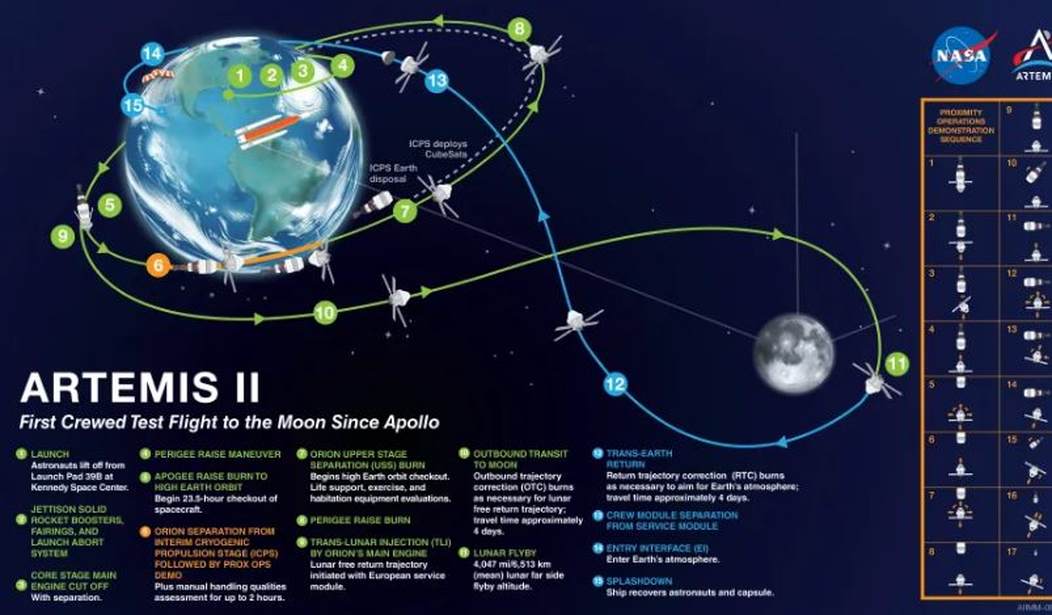
Astronauts haven't been to the moon since 1972 but if all goes well a manned mission to the moon will lift off as soon as next month. It's called Artemis II and the plan is to take four astronauts and send them into space on a trajectory that will wrap around, but not orbit, the moon. Just this weekend, the rocket that will launch the astronauts made its way to the launch pad.
After many months inside the VAB being stacked and prepared for launch, the NASA SLS rocket has come outside fully as it rolls out to LC-39B ahead of the Artemis II Crewed mission to the moon.
— Elisar Priel (@ENNEPS) January 17, 2026
Follow along on @NASASpaceflight ongoing rollout coverage https://t.co/VaZjMhdiuN pic.twitter.com/UmclgELzyB
For the next couple weeks NASA will be running tests at the launch pad.
On Saturday morning, a mammoth crawler began transporting the Space Launch System vehicle, the Orion capsule and the launch tower — 14 million pounds altogether — from the Vehicle Assembly Building to the launchpad 4.2 miles away...
It reached the launchpad at 6:42 p.m. Eastern. Now, final preparations will begin — hooking up connections for electrical power and propellants and performing checks of key systems...
That will lead up to a dress rehearsal of the countdown in early February. The rehearsal will include filling the rocket’s propellant tanks with liquid hydrogen and liquid oxygen, performing the same tasks that will precede launch but stopping the countdown with 29 seconds left before the point when the engines would ignite. The propellant tanks will then be drained, and NASA engineers and officials will review the data.
An exactly launch date hasn't been set, but the earliest window for launch is February 6, less than three weeks from now.
The earliest possible launch date is Feb. 6 with other opportunities through Feb. 11. “We have zero intention of communicating an actual launch date until we get through” the dress rehearsal, Mr. Isaacman said.
If Artemis II does not launch by then, the next launch window would open in March.
If the dress rehearsal goes smoothly, NASA will aim to launch in February. “I know the teams are prepared,” Mr. Isaacman said. “I know this crew is prepared.”
Once the rocket launches, the Orion spacecraft will orbit the earth a couple of times and then head for the moon.
The initial launch will be similar to Artemis I as SLS lofts Orion into space. With crew aboard this mission, Orion and the upper stage, called the interim cryogenic propulsion stage (ICPS), will then orbit Earth twice to ensure Orion’s systems are working as expected while still close to home...
After the burn to enter the high Earth orbit, Orion will separate from the upper stage, which the crew will use as a target for a manual piloting test called the proximity operations demonstration...
While still close to Earth, the crew will assess the performance of the life support systems necessary to generate breathable air.
Orion also will test the communication and navigation systems to confirm they are ready for the trip. While still in the elliptical orbit around Earth, Orion will briefly fly beyond the range of GPS satellites and the Tracking and Data Relay Satellites of NASA’s Space Network to allow an early checkout of agency’s Deep Space Network communication and navigation capabilities.
After completing checkout procedures, Orion will perform the next propulsion move, called the translunar injection burn, where Orion’s service module will provide the last push needed to put the spacecraft on an outbound trip of about four days and around the far side of the Moon, tracing a figure eight that will extend more than 230,000 miles from Earth before returning home.
Artemis II will circle around the moon but won't go into orbit or attempt to land, making it similar to the Apollo 8 mission back in 1968.
Artemis II’s mission profile draws some parallels to Apollo 8, which launched in 1968 and took humans to the vicinity of the moon for the first time. That mission, too, did not land on the lunar surface. It was, however, the first crewed launch of the Saturn V rocket and the first time astronauts were able to see and photograph the far side of the moon.
Like Artemis II, Apollo 8 launched at a time when the program’s lunar lander — called the Apollo Lunar Module — was not ready for a crewed flight. As a result, NASA changed the mission profile from lunar lander training to translunar navigation training. (Lunar lander training ultimately happened during Apollo 9.)
So when do we plan to actually land on the moon? Well, the plan is for that to happen on the Artemis III mission which is tentatively scheduled for 2028. But whether we make that deadline or not partly depends on Space X which is developing the lunar lander.
In any case, there's a decent chance we'll be seeing this launch next month and we'll be seeing some fresh video of astronauts circling around the moon a few days later. You can read more about astronauts Reid Wiseman, Victor Glover, Christina Koch and Jeremy Hansen at this link.
For the first time in more than half a century, a rocket and spaceship that will carry astronauts around the Moon is rolling out to 39B.
— NASA Administrator Jared Isaacman (@NASAAdmin) January 17, 2026
Today’s rollout is a critical step toward that mission and achieving President Trump’s vision when he first established the Artemis Program.… pic.twitter.com/EX2PkxFsEd
Editor’s Note: Do you enjoy Hot Air's conservative reporting that takes on the radical left and woke media? Support our work so that we can continue to bring you the truth.
Join Hot Air VIP and use promo code FIGHT to receive 60% off your membership.



Join the Conversation
VIP members get the ability to comment on articles.