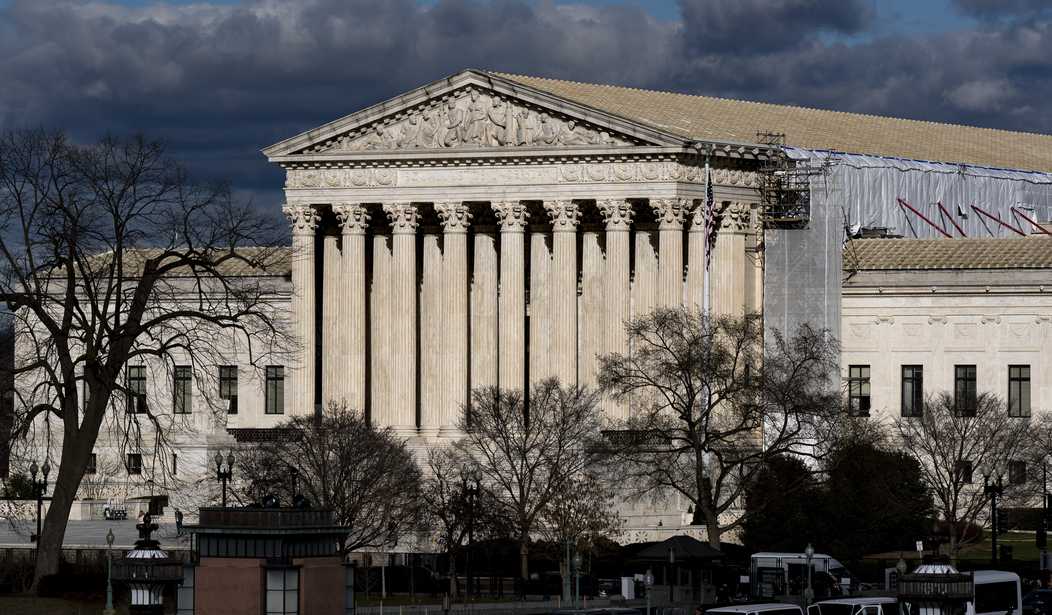
Today, oral arguments are taking place at the Supreme Court in two similar cases involving trans athletes. The first case is from Idaho and involves a college student named Lindsay Hecox who ran track in high school and continued to run in college at Boise State. For a time, Hecox was a bit of a left-wing celebrity but last September Hecox had a change of heart and dropped out of competition.
Hecox then asked the Supreme Court to drop the case, which had been making its way through the courts since 2020, on the grounds that it was now moot since Hecox was no longer competing.
“From the beginning of this case, I have come under negative public scrutiny from certain quarters,” Hecox said her Sept. 2 request to the court. “I also have observed increased intolerance generally for people who are transgender and specifically for transgender women who participate in sports.”
A judge rejected that request and suggested the request was an attempt to manipulate the process.
A federal judge in Idaho on Tuesday denied a request from the transgender Boise State University student who asked that the court dismiss her case against Gov. Brad Little over the state’s law banning transgender women and girls from women’s sports. The student, Lindsay Hecox, last month filed a notice to dismiss the lawsuit, which is pending review by the U.S. Supreme Court. In the ruling, U.S. District Judge David Nye said the state has a “fair right to have its arguments heard and adjudicated once and for all” and that dismissing the case would leave “critical questions in limbo.”
“The court feels this mootness argument is, as above, somewhat manipulative to avoid Supreme Court review and should not be endorsed,” Nye wrote in a footnote in the ruling.
There's also a second case arising out of West Virginia where a trans girl named Becky Pepper-Jackson has been competing in track events including shot put and discus. The Washington Post has a story about Pepper-Jackson's case up today.
She later began taking puberty-delaying medication so she would not undergo male puberty. And at the end of the sixth grade, she started taking estrogen to undergo female puberty. Because of her treatment, Pepper-Jackson never underwent male puberty, according to her legal brief.
Pepper-Jackson’s lawyers argue that this fact is crucial. She has “physiological musculoskeletal characteristics of cisgender girls and none of the testosterone-induced characteristics of cisgender boys,” they wrote in a brief to the court.
Being from a family of runners, Pepper-Jackson wanted to run cross-country, but in 2021 her middle school principal told her mom that Pepper-Jackson couldn’t join the team. Only months earlier, West Virginia had passed a ban on trans women playing on women’s sports teams. Pepper-Jackson and her mother sued, and lower-court rulings have allowed her to compete as her case plays out.
Despite the claim that Pepper-Jackson has no physical advantage, there's a record of success in events that rely partly on strength which is interesting.
During middle school, Pepper-Jackson ran near the “back of the pack” in cross-country, according to her brief. Her track and field coach told her she would not make the team as a runner, so the coach suggested she try shot put and discus...
At her first meet in 2022, Pepper-Jackson placed 36th out of 45 in shot put, according to a legal brief. At a subsequent meet, she placed 15th out of 25 in discus. She gradually improved. During the 2024 season, she placed first in shot put in six consecutive meets, often outdistancing her closest competitors by several feet, according to her athletic records...
Pepper-Jackson says her success was a result of hard work and practice. But lawyers for West Virginia say she “improved faster” than her teammates because she has an unfair physical advantage. Her “participation displaced hundreds of girls and prevented some from competing in end-of-season championship meets,” lawyers for the state wrote.
So this is yet another instance where a trans athlete claims no advantage but it routinely beating out actual girls by a substantial margin.
CNN reports there are a long list of well-known athletes on both sides of these cases.
The long list of figures represented in the friend-of-the-court briefs include household names like Megan Rapinoe, Layshia Clarendon and Sue Bird, who have lined up behind the trans athletes challenging the bans, and Olympic stars Summer Sanders, Donna de Varona and a host of other high-profile athletes expressing support for the states...
On the other side of the field, more than 100 athletes, coaches and parents – including nearly three dozen Olympians – are pressing the court to back the state bans, arguing that they ensure an “equal opportunity” for cisgender women athletes.
“By ruling in favor of West Virginia’s and Idaho’s laws, this court can reaffirm that women should not lose their equal opportunity to compete in sports on a level playing field,” their attorneys told the court.
Oral arguments are taking place as I write this. First up today was the Hecox case. Early on, Justice Sotomayor is arguing the case shouldn't be before the court.
Justice Sonia Sotomayor pressed the Idaho solicitor general on why the court was even hearing this case, given that the plaintiff – Lindsay Hecox – has said she does not intend to play collegiate sports in the future...
“There’s no reason to question the sincerity of that belief,” Sotomayor said of Hecox’s submission that she intends to focus on her studies rather than sports.
“Now, every other promise she has made in this litigation…held true until this case and the negative attention that she received,” the liberal justice said...
Justice Ketanji Brown Jackson also brought up the mootness issue, noting that Hecox will graduate college in May, likely before the court will deliver its opinion.
They'd rather have no decision than a negative one. But as noted above, a judge did suggest that the last-minute attempt to withdraw the case seemed "somewhat manipulative."
Because it's a given that the court's three liberals will all rule in favor of the plaintiffs and against state bans, court watchers are keeping an eye on Justice Gorsuch to see if he might be a swing vote.
After a series of questions from the court’s liberal justices, Gorsuch asked whether transgender status should be treated as a “discrete and insular class” subject to heightened scrutiny, citing a history of discrimination in immigration, family law and other areas.
Gorsuch said, “There’s another way to think about the case … that transgender status should be conceived of as a discrete and insular class, subject to heightened scrutiny in and of itself given the history of du jour discrimination against transgender individuals in this country.”...
Idaho’s attorney argued that while transgender people have faced discrimination, it does not compare to the systemic barriers faced by groups such as women and African Americans, and that laws cited by challengers do not expressly classify based on transgender status.
Still as arguments in the Hecox case came to an end, the NY Times' court reporter suggests the division on the court seems pretty clear.
The first of the day’s two arguments was a sort of warm-up act, involving a case that was possibly moot and presenting narrower issues than the one that will follow. But the court’s conservative majority showed no signs of an inclination to strike down state laws barring transgender athletes from participating in girls’ and women’s sports. And the three liberal justices mostly retreated to a narrow defense, arguing that even if the laws are constitutional in most cases, the two plaintiffs may be able to pursue “as applied” challenges to show that they themselves do not possess unfair advantages.
Arguments in the Hecox case ran longer than expected. The court has now moved on to the Pepper-Jackson case out of West Virginia. Here's why this case is different.
The first case addressed a student who had gone through puberty before transitioning, so she had experienced all the benefits of a surge in testosterone. That includes a bigger heart and lungs that equal a larger heart and lung capacity. In this second case, the student transitioned in the third grade and has said she never went through male puberty.
Outside the court, Riley Gaines is speaking in support of women athletes.
.@Riley_Gaines_ addressed our rally a few minutes ago! pic.twitter.com/CSmlkpm7TB
— Alliance Defending Freedom (@ADFLegal) January 13, 2026
Some counter-protesters are doing their best to drown her out.
D.C. (Jan. 13) — Leftist activists blast music to try to disrupt and drown out the female athletes speaking outside the Supreme Court as the Justices hear oral arguments for the case brought by two males suing Idaho & WV for banning males in female sports. pic.twitter.com/3k4c2jWW2l
— Andy Ngo (@MrAndyNgo) January 13, 2026
Back inside, Justice Kavanaugh is arguing in favor of basic fairness for female athletes.
Justice Brett Kavanaugh said that the court cannot look past what he characterized as the “harm” that transgender-inclusive sports policies impose on cisgender women and girl’s sports teams, signaling his sympathy for states that have enacted bans on trans athletes competing on teams that match their gender identity.
“One of the great successes in America over the last 50 years has been the growth of women and girl’s sports. And it’s inspiring,” said Kavanaugh, who for years coached his daughter’s basketball team and emphasized that during his confirmation hearings in 2018.
And speaking of activists like Riley Gaines, Justice Alito has an interesting question:
Justice Samuel Alito asked an attorney for the challenge to Idaho’s law whether female athletes who opposed trans women’s participation in their sports were “bigots.”
“Looking to the broader issue that a lot of people are interested in, there are an awful lot of female athletes who are strongly opposed to participation by trans athletes in competitions with them,” Alito said. “What do you say about them?”
Attorney Kathleen Hartnett, who is representing the transgender woman who brought the lawsuit against Idaho’s statute, said that accusation is not being made in the case. The challenge is not focused on “animus,” Hartnett said, but rather on the law not being an appropriate fit for the perceived issue.
Justice Alito also asked Hartnett if a trans person who has not had hormone treatment, i.e. a boy, should be allowed to compete.
He also posed a hypothetical in which a person born as male said they identified as a woman and wanted to play on the girls team, but had not gotten medical treatments to suppress their male hormones or otherwise affirm their female identity.
Hartnett said that in a scenario where a person still has the biological advantages of being a male, a school could ban them from woman’s sports.
“Is that person not a woman, in your understanding?” Alito continued to press. “The person says, ‘I sincerely believe I am woman. I am, in fact, a woman.’ Is that person not a woman?”
He's really challenging the idea of self ID and the mantra that "trans women are women." Here's the audio.
🚨 HOLY SMOKES. SCOTUS Justice Sam Alito just EVISCERATED the attorney's argument for a transgender male trying to compete in girl's sports
— Eric Daugherty (@EricLDaugh) January 13, 2026
Every word. Masterful.
ALITO: Let's say a school has a boy and girl track team. A male student with no puberty blockers or female… pic.twitter.com/Doejb48Jg4
When challenged, the lawyer representing Hecox says she isn't willing to define the terms man or woman.
Lawyer representing Hecox refuses to define “man” and “woman,” leading Justice Alito to ask how courts are supposed to determine if there’s been sex-based discrimination without knowing “what sex means.” @FDRLST pic.twitter.com/aIHYnfrqfS
— Shawn Fleetwood (@ShawnFleetwood) January 13, 2026
Arguments have now been going on for 3 hours. I'm not sure how much longer they are going to go but I'm out of time so that's it for now. I may come back with some wrap-up takes once arguments end.
Editor’s Note: Do you enjoy Hot Air's conservative reporting that takes on the radical left and woke media? Support our work so that we can continue to bring you the truth.
Join Hot Air VIP and use promo code FIGHT to receive 60% off your membership.












Join the conversation as a VIP Member