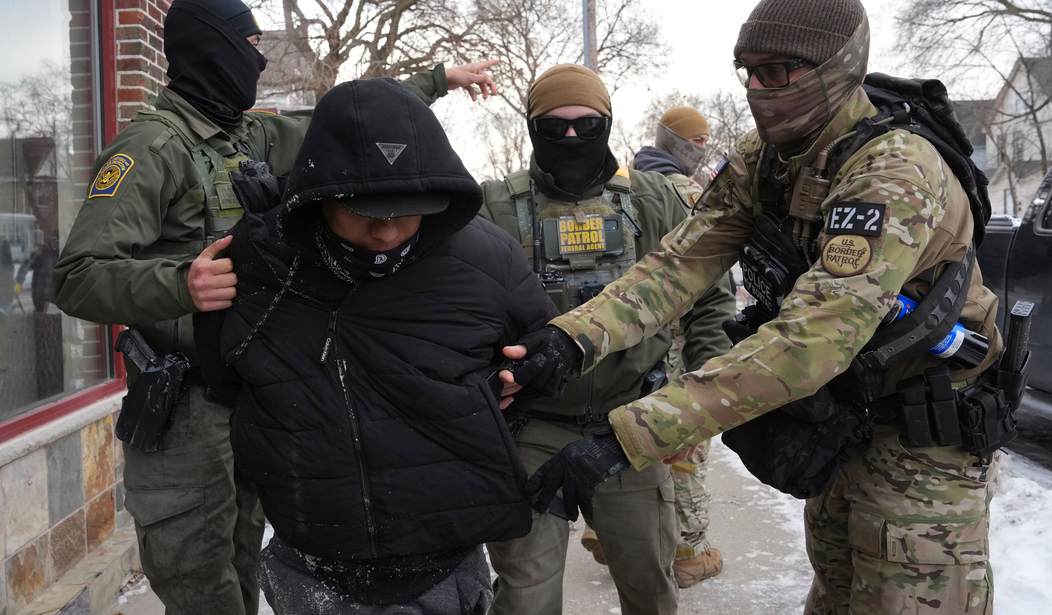
The Washington Post published a story this morning titled "They say they’re monitoring ICE arrests. Feds say they’re breaking the law." The story is about all of the anit-ICE protesters around the country who have taken to following, filming and blowing whistles whenever ICE agents are nearby. The general thrust is that, legally speaking, protesters can do those things so long as they don't physically interfere with any ICE operations.
But what's most interesting about the story is the way it carefully tiptoes around the 800 pound gorilla in the room. We all understand that the reason the Post is running this story now is because of the shooting that killed Renee Good last week. The obvious question that needs to be asked and answered is this: Was what she was doing that morning legal or over the line? The Post story tries really hard not to give a clear answer about that.
The fatal shooting of Renée Good last week, as ICE officers and residents faced off on a residential street here, has brought new attention to these activities. Good’s wife has said the couple came out with whistles that morning to support their neighbors; video shows both women exchanging words with ICE officers before Renée Good starts to move her car and one officer fires.
Federal court rulings say citizens can observe and record police activity in public areas as part of their First Amendment rights, and many of the observers are doing nothing more than that.
But as officers and agents employ aggressive tactics, some activists have blown whistles to warn community members of approaching law enforcement, tried to follow immigration enforcement vehicles or used their own cars to block the roadways — entering murkier legal territory. Some legal experts said such behavior could in theory justify obstruction-of-justice charges, but they added that any such prosecution would be unusual.
Many observers are just observing. But some are entering murky legal territory by using their cars to block roadways. I posted this clip last night.
The media continues to fail the American people in their reporting on the events in Minneapolis.
— Homeland Security (@DHSgov) January 10, 2026
New evidence shows that the anti-ICE agitator was STALKING and IMPEDING a law enforcement operation over the course of the morning.
The evidence speaks for itself. The legacy media… pic.twitter.com/0enstqGkhq
That's Renee Good, sitting in her car which is sideways in the street to block traffic and laying on her horn. She's there for at least 3 minutes.
I have no doubt that the four authors of this Post story have seen that clip. But notice they avoid saying that Renee Good had entered murky legal territory, even though that's the most relevant thing in this story. It's as if they decided they would write about the rules in general but studiously avoid applying those rules to the one person at the core of this. And it just continues that way. No one ever says (or is asked) if Renee Good crossed a line. Instead you have to intuit that for yourself.
“Could a prosecutor make a credible case that a person is interfering if they’re blocking an agent’s car or slowing them down? Yes, but whether that’s a crime that deserves seven to eight years in prison is a different conversation,” said Paul Butler, a former federal prosecutor who teaches at Georgetown University Law Center.
Where is former federal prosecutor Paul Butler coming up with 8 years? Well, the former DOJ prosecutor who posts on X and Substack as ShipWreckedCrew offers a possible answer by spelling out the law that covers impeding a federal agent.
Title 18 U.S.C. Sec. 111 is a federal criminal statute involving interference with federal law enforcement:..
Section 1114 includes within its designation “any officer or employee of the United States or of any agency in any branch of the United States Government (including any member of the uniformed services) while such officer or employee is engaged in or on account of the performance of official duties….”
Subsection (a)(1) makes it a federal crime: assault, resist, oppose, impede, intimidate, or interfere with such employees while they are engaged in or on account of their performance of their official duties.
Without more, such a crime is subject to a maximum penalty of up to 1 year in prison — a misdemeanor.
However, where such acts involve “physical contact” with the officer, or an intent to commit another felony, the maximum penalty increases to 8 years — a felony.
I'm not 100% sure that's what Butler is referring to but it seems probable. But notice he's sort of leaving out details. Interference on its own is just a misdemeanor. So parking your car sideways in the street and creating a traffic jam specifically to hinder ICE agents is probably not an 8-year case, it's a one-year case. It only becomes a felony if there is physical contact. And in this case there was physical contact because she hit an agent with her car. But again, the Post doesn't want to apply the law to Renee Good in this story about the law and Renee Good, so we just have to draw conclusions ourselves.
Finally, the Post comes really close to asking someone the core question, but once again the authors don't specifically connect it to Renee Good.
David Loy, legal director of the nonprofit First Amendment Coalition, said that members of the public have the right to blow whistles or follow ICE vehicles at a sufficient distance and alert members of their community, but that protesters cannot physically stop an officer from doing his or her job.
“It doesn’t create a right to commit traffic violations or physically attempt to block a law enforcement vehicle,” he said. “But there is a right to follow and document what they’re doing.”
Protesters can follow but they can't impede. That's the rule. What the authors are bending over backwards to avoid saying is this: Renee Good crossed a line when she created a traffic mess with her car. This was probably a misdemeanor until she hit an agent with her car at which point it became a felony.
Even the Minnesota groups organizing these protests understands there's a legal line here (though I don't really believe them when they claim they are trying to stay on the legal side of that line).
“They are trained to just be there to observe, take notes and record, not to obstruct,” [Yeng] Her said. “That way, we have evidence.”
But that's not what Renee Good was doing. She wasn't just taking notes or filming, she was obstructing traffic. It's pretty amazing the Post got all the way through this long story without saying that directly.
Editor’s Note: Do you enjoy Hot Air's conservative reporting that takes on the radical left and woke media? Support our work so that we can continue to bring you the truth.
Join Hot Air VIP and use promo code FIGHT to receive 60% off your membership.








Join the conversation as a VIP Member