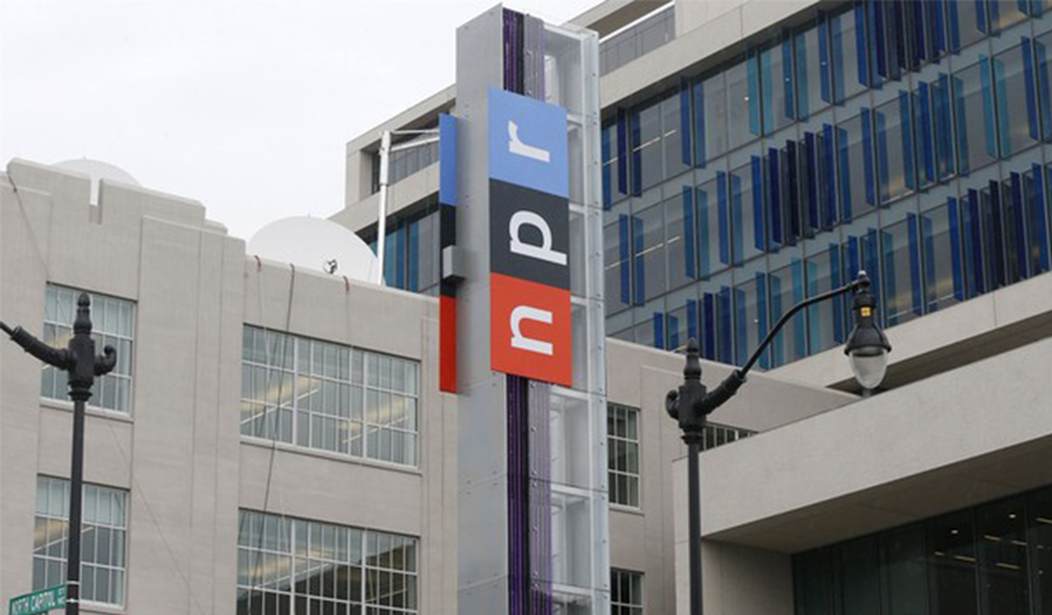
The Corporation for Public Broadcasting (CPB) was the organization that funneled federal money to National Public Radio and the Public Broadcasting System, the radio and TV arms of a public system created in 1967. Of course, back in 1967 most televisions received 3 broadcast channels plus one UHF channel. So the idea of adding a channel funded by congress might not have seemed so crazy.
But the whole project became increasingly absurd as cable television, satellite radio and streaming online eventually took over. Thirty years ago, in 1996, many people had access to hundreds of TV channels and the need for public broadcasting seemed past its prime.
The other issue with the CPB, and the one that eventually ended it, was that it spent decades airing biased political content on a daily basis. I've mentioned before that I was a regular listener to WAMU in Washington, DC back in the early 1990s. Even then the bias from many of NPR's shows, especially the locally produced ones, was outrageous.
That bias, which public broadcasting never admitted, was obvious to anyone who looked. Last year, an NPR veteran wrote an essay for the Free Press spelling out how the network has lost trust with many Americans.
It’s true NPR has always had a liberal bent, but during most of my tenure here, an open-minded, curious culture prevailed. We were nerdy, but not knee-jerk, activist, or scolding...
Back in 2011, although NPR’s audience tilted a bit to the left, it still bore a resemblance to America at large. Twenty-six percent of listeners described themselves as conservative, 23 percent as middle of the road, and 37 percent as liberal.
By 2023, the picture was completely different: only 11 percent described themselves as very or somewhat conservative, 21 percent as middle of the road, and 67 percent of listeners said they were very or somewhat liberal. We weren’t just losing conservatives; we were also losing moderates and traditional liberals.
Again, I think the trend was obvious 35 years ago but it certainly got worse in the last few years as wokeness and identity politics became the norm in many newsrooms.
There’s an unspoken consensus about the stories we should pursue and how they should be framed. It’s frictionless—one story after another about instances of supposed racism, transphobia, signs of the climate apocalypse, Israel doing something bad, and the dire threat of Republican policies. It’s almost like an assembly line.
The mindset prevails in choices about language. In a document called NPR Transgender Coverage Guidance—disseminated by news management—we’re asked to avoid the term biological sex.
Yesterday, having been defunded by the Trump administration, the Corporation for Public Broadcasting shut itself down for good.
The Corporation for Public Broadcasting — which helped fund NPR, PBS and many local radio and TV stations — is officially shutting down, months after Congress passed spending cuts that stripped it of more than $1 billion in funding.
CPB's board of directors voted to dissolve the private, nonprofit corporation after 58 years of service, the organization announced in a news release Monday.
“For more than half a century, CPB existed to ensure that all Americans—regardless of geography, income, or background—had access to trusted news, educational programming, and local storytelling,” said Patricia Harrison, CPB's president and CEO.
The idea that CPB was invested in "trusted news" over the past decade is a fantasy but it's one that PBS and NPR were fully invested in. Over the past year they actually sued the Trump administration claiming their defunding was "viewpoint discrimination."
President Trump has repeatedly expressed his disapproval of editorial decisions reflected in programming offered by NPR and PBS. He has disparaged NPR's news and other content as "left-wing propaganda." His Executive Order states that our coverage is not "fair, accurate, or unbiased," building on prior statements making clear the President's disapproval of NPR's news coverage and editorial choices. The intent could not be more clear — the Executive Order aims to punish NPR for the content of news and other programming the President dislikes...
This is retaliatory, viewpoint-based discrimination in violation of the First Amendment.
That was written by NPR's Katherine Maher, well known for her firm commitment to attacking white men, capitalism and the gender binary. As for the claim NPR is unbiased, even she had a hard time defending that in congressional testimony.
🗣️: NPR’s Katherine Maher admits it’s ‘concerning’ that 100% of her editorial board—87 members—are registered Democrats, with zero Republicans.
— Congressman William Timmons (@RepTimmons) March 26, 2025
NPR’s blatant partisan imbalance is unacceptable—taxpayers should not be forced to foot the bill for a one-sided echo chamber. pic.twitter.com/BMWnxq9Ffe
All that to say, it's good news that the CPB is no more. That does not automatically mean that PBS and NPR will be shutting down, though some stations and channels may eventually run out of money.
PBS has had staff cuts and NPR has reportedly made budget cuts. But for local stations that relied on CPB for a large share of their budgets, the federal funding cuts have been devastating.
Major foundations, including Knight, MacArthur and Ford, have pledged tens of millions of dollars in emergency funding to keep the most vulnerable stations afloat, but some are already considering dropping national programming or shutting down entirely.
NJ PBS, New Jersey’s public television network, announced in September that it may close next year, while Arkansas Public Television dropped its PBS affiliation — just as several public radio stations have dropped their NPR affiliation — showing that federal defunding has destabilized a system scrambling for answers.
Everyone has the right to speak. No one has right to a steady stream of government money to amplify their speech.