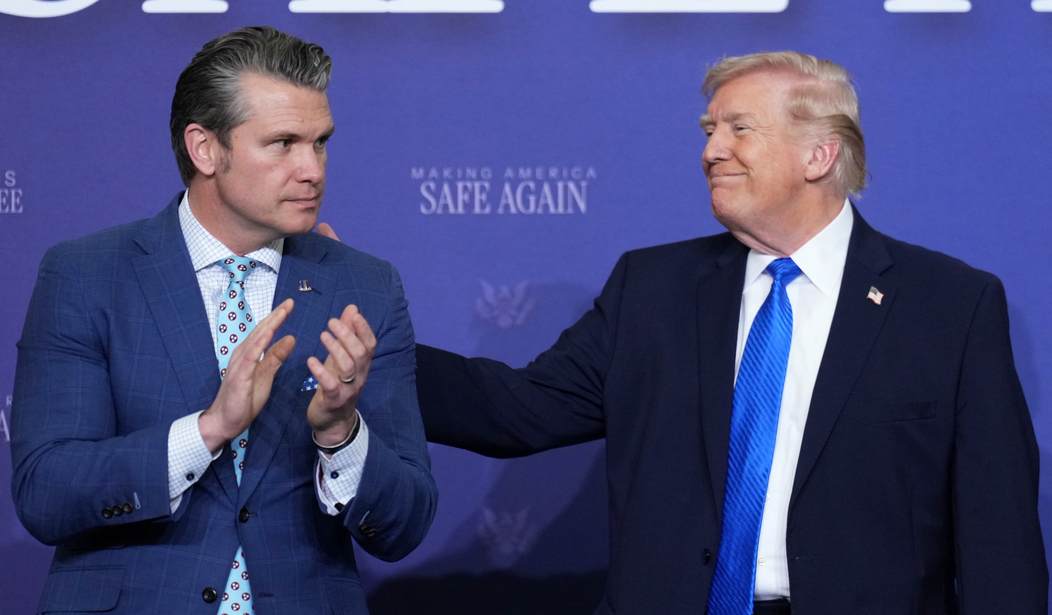
Over the last 24 hours, the White House has offered a mélange of mixed messages on the Iran war. Donald Trump vented earlier today about erstwhile allies and threatened to leave them holding an expensive Hormuz bag for their pusillanimity. Secretary of State Marco Rubio suggested yesterday that the US has already achieved victory, to which we'll return shortly.
This morning, however, War Secretary Pete Hegseth told reporters that the US has not finished yet, and that bigger operations may still be afoot. Using the spectacular video of massive explosions last night in Isfahan, Hegseth warned the regime remnants that cutting a deal now would be "wise. ... President Trump does not bluff and he does not back down":
.@SecWar PETE HEGSETH: "If Iran is wise, they will cut a deal. President Trump doesn't bluff and he does not back down."
— FOX & Friends (@foxandfriends) March 31, 2026
"You can ask Khamenei about that." pic.twitter.com/TE6dFEG37C
Hegseth insisted that the US would "negotiate with bombs" until the Iranians finally started negotiating in good faith. Hegseth made that demand in connection to Iran's store of highly enriched uranium, but likely applies to traffic through the Strait of Hormuz and missile systems as well. The alternative may or may not include boots on the ground, an option that Hegseth refused to rule out:
Defense Secretary Pete Hegseth said the coming days of the conflict would be decisive, and that the number of projectiles launched by Iran in the past 24 hours represented the lowest during the war. ...
Separately, the U.S. hit a large ammunition depot in the Iranian city of Isfahan with 2,000-pound bunker buster bombs, an official said, while the United Arab Emirates suffered one of the most intense days of Iranian attacks since the first week of the war. ...
Defense Secretary Pete Hegseth said the U.S. would “negotiate with bombs” until Iran relinquishes its ambitions. "We would much prefer to get a deal. If Iran was willing to relinquish material they have and ambitions they have... great, that's the goal. We don't want to do more militarily than we have to," Hegseth said.
"Our job is to ensure that we compel Iran to realize that this new regime, this regime in charge, is in a better place if they make that deal," he added. Asked about the progress of talks with Tehran in general he deferred to U.S. negotiators. "We stand right there next to our negotiating team—always willing and prepared to put them in an even better position,” he said, without elaborating.
That raises the issue of who's negotiating. Trump claimed yesterday that the US was dealing with "a new, and more reasonable, regime" that delivered on safe passage for thirty oil tankers over the last few days. Rubio corroborated that claim yesterday morning on ABC's Good Morning America:
Marco Rubio on Iran:
— Clash Report (@clashreport) March 30, 2026
There are clearly people there talking to us in ways that previous leaders in Iran have not spoken to us before.
Some of the things they’re saying they’re willing to do — we have to see if they can actually do them.
We have to test that very strongly. pic.twitter.com/E8WvGYWq3r
Rubio also claimed in the same interview that the regime in Tehran had begun to fracture:
Secretary of State Marco Rubio said on Monday, March 30, that “fractures” have emerged within Iran’s leadership, as Washington engages in sensitive, undisclosed negotiations aimed at ending the conflict.
Speaking on ABC’s 'Good Morning America', Rubio refused to identify the individuals the United States is engaging with, citing concerns for their safety.
“I’m not going to disclose to you who those people are because it probably would get them in trouble with some other groups of people inside of Iran,” Rubio told host George Stephanopoulos. ...
“Look, there’s some fractures going on there internally,” he said. “If there are people in Iran who now, given everything that’s happened, are willing to move in a different direction for their country, that would be great.”
None of these messages is directly contradictory to the others, but they certainly don't fully align either. Trump sounds like he wants to abruptly leave; Hegseth wants to go the full Curtis LeMay; Rubio wants to talk with rational alternatives. Either this is the most incoherent winning side of a war in human history, or there's a strategy in place.
Eli Lake argues vociferously for the latter. Trump and his team are waging "psychological warfare" against the Iranian regime, Lake declares, and it's working:
Trump is waging psychological warfare with the remnants of a battered regime. Israel has killed 16 top regime leaders since the fighting began on February 28. These include Supreme Leader Ali Khamenei, national security adviser Ali Larijani, and minister of intelligence Esmaeil Khatib. Then there are the lower-level commanders in the Revolutionary Guard Corps and Basij state militia who have perished in drone and missile strikes. The current supreme leader, Mojtaba Khamenei, has not been seen in public since he ascended to the post held by his father.
“If you are sitting in Tehran, you are underground if you are in the leadership tier,” Joel Rayburn, former U.S. Army colonel and senior diplomat in Trump’s first term, told me. “You know if you can be located you will be killed. Your command and control is severely disrupted, and now you see the United States is a few days away from having a half a division worth of ground forces in the Gulf region and you can offer no resistance. Your leverage is waning.”
In such an environment, who wants to be the leader of a “new and more reasonable regime”? For the true believers left, like the recently promoted Ahmad Vahidi, who now heads Iran’s Revolutionary Guard Corps after the former chief was killed, negotiations with Trump are tantamount to capitulation. For the unlucky Iranian president, Masoud Pezeshkian, who is stuck with managing an economy that’s ground to a halt, Vahidi’s escalations are national suicide.
Hence the emphasis by Rubio on "fractures," Trump's assertion that the US is secretly negotiating with a new and more reasonable set of leaders, and the pressure from Hegseth to apply more military force on the "fractures." The vacuums at the top and the damage to the military-industrial complex have the regime almost at a tipping point, Lake argues, and it won't take much more to push it into collapse:
But if one assesses that Trump’s real aim in the war is a “new and more reasonable regime,” then there is a method to his madness. Trump sees Iran’s regime on the verge of collapse. By announcing that he has been privately offered terms of surrender, the president is hoping to speed the unraveling of the Islamic Republic already underway.
We'll see within the next few days and weeks. Right now, the ambiguity may be accelerating internal divisions in the regime's top ranks, with everyone sensing the music's about to end and that chairs will be in short supply when it does. The question is whether we have evidence of a crisis point in the regime's existential status – and we may have some, as I'll detail in a later post. Stay tuned.
Editor's Note: For decades, former presidents have been all talk and no action. Now, Donald Trump is eliminating the threat from Iran once and for all.
Help us report the truth about the Trump administration’s decisive actions to keep Americans safe and bring peace to the world. Join Hot Air VIP and use promo code FIGHT to get 60% off your membership!






Join the conversation as a VIP Member