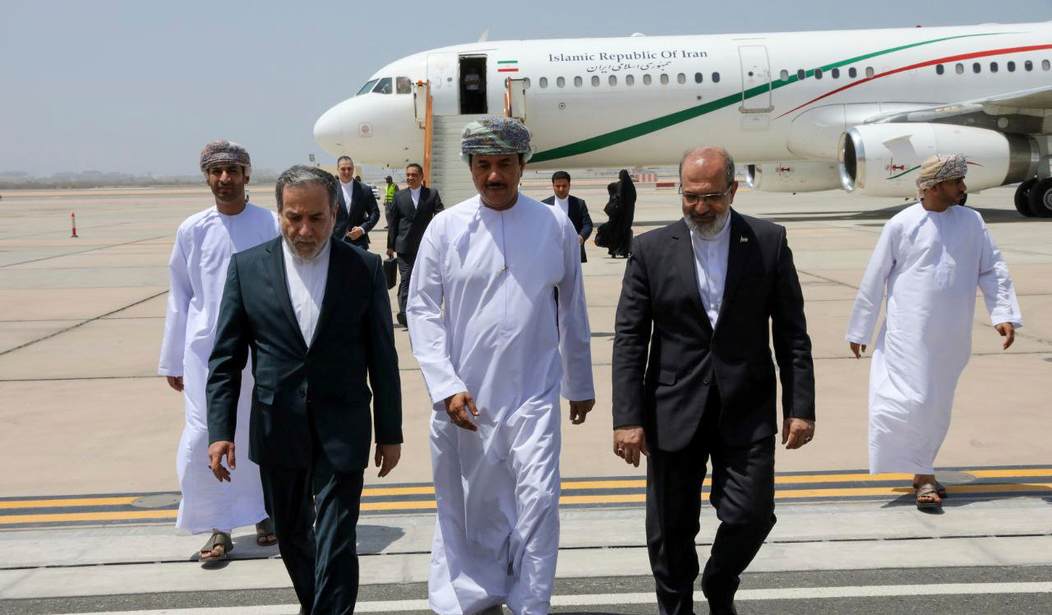
This will be great, wasn't it?
After demanding that discussions with the US to stave off a military clash get moved from Turkey to Oman, the talks appear now to have ended before they began. Two rounds of preliminary and indirect discussions have now ended, Iranian state TV reports, with the negotiators returning to their countries for "consultations":
Iran's foreign minister: Negotiators will return to capitals for consultations, talks will continue. https://t.co/d7rVPvMPLk
— Idrees Ali (@idreesali114) February 6, 2026
Apparently, the two sides never met directly, let alone negotiated. Denizens of corporate America know too well the concept of the pre-meeting meeting, and according to the Jerusalem Post, two of those took place in Oman. And then the meeting itself got ... postponed? Canceled? Rescheduled? It's not at all clear:
Oman's Foreign Minister Badr bin Hamad al-Busaidi held separate meetings with Iranian Foreign Minister Abbas Araghchi and the Trump administration's special envoy Steve Witkoff, who was accompanied by special advisor Jared Kushner. Previous Iran‑US talks have used a shuttle-diplomacy approach.
"The consultations focused on preparing the appropriate conditions for resuming diplomatic and technical negotiations, while emphasising their importance, in light of the parties’ determination to ensure their success in achieving sustainable security and stability," Oman's Foreign Ministry stated.
An Iranian official told Reuters the direct talks had not officially started, and that Iran’s demands had been conveyed to the US via Oman. The official said indirect negotiations "possibly" would begin after a meeting between the top US negotiator and Oman’s foreign minister.
That's clearly not the case if the negotiators are flying back to their respective capitals for "consultations." It seems that "Iran's demands" created an impasse that requires a review by those with more plenary authority. And that can only mean that Iran insists on limiting the talks to their nuclear-weapons programs, while the US insists that Iran's ballistic-missile systems, terror proxies, and violent oppression of its people remain on the table for negotiations.
The Wall Street Journal later reported that the obvious was ... the obvious:
Tehran stuck to its refusal to end enrichment of nuclear fuel in talks Friday between senior U.S. and Iranian officials, but signaled a willingness to keep working toward a diplomatic solution that could head off an American strike.
According to Iranian state media, Foreign Minister Abbas Araghchi told his U.S. counterparts that Tehran wouldn’t agree to end enrichment or move it offshore, rejecting a core U.S. requirement.
Abbas Araghchi tried to put a good face on the misfire:
Iran’s top diplomat said that indirect talks with the United States held in Oman on Friday were “a very good start” but negotiators now must speak with their leaders.
Foreign Minister Abbas Araghchi made the comment in a live interview from Muscat, Oman, on Iranian state television. Araghchi described the talks as taking place over multiple rounds and that they were focused primarily on finding a framework for further negotiations.
No, it clearly was not a good start. Both sides sent high-ranking officials with clear authority to discuss a deal in detail. Araghchi is Ali Khamenei's deputy on these issues, and Donald Trump sent Steve Witkoff and his son-in-law Jared Kushner. If Iran wanted to discuss a broad deal, the pieces were in place without any need to physically return to Tehran for "consultations." Araghchi wants to paint this as positive to give his allies room to lobby Trump for more time before he decides on military options to punish Khamenei's regime for the massacres of thousands of Iranians last month.
Oman's chief negotiator is also attempting to put the best spin on a failure:
Very serious talks mediating between Iran and the US in Muscat today.
— Badr Albusaidi - بدر البوسعيدي (@badralbusaidi) February 6, 2026
It was useful to clarify both Iranian and American thinking and identify areas for possible progress. We aim to reconvene in due course, with the results to be considered carefully in Tehran and Washington. pic.twitter.com/OWctzf2CXA
To put it in Hillary Clinton's terms: They came, they saw, and they left.
So what's next? Time is on Trump's side in this case. The delay has allowed more ant-ballistic resources to get deployed in the region, and another carrier group is reportedly en route at the moment to bolster the USS Abraham Lincoln task force for both offensive and defensive capabilities. Iran's recent attempts at provoking the US into an early attack while those defensive systems were on their way didn't work, and it also undermined the push by Arab states in the region to allow Iran time to settle the matter through diplomacy.
Iran has used the time to do its own work too, but that's going much more slowly than the American buildup:
Iran appears to have rapidly repaired several ballistic missile facilities damaged in strikes last year, but it has made only limited fixes to major nuclear sites struck by Israel and the United States, a New York Times analysis of satellite imagery suggests.
The uneven pace of reconstruction offers clues about Iran’s military priorities as the United States amasses forces near it and President Trump weighs new military action. If the United States were to attack, Iran would most likely retaliate with ballistic missiles targeting Israel and U.S. assets in the region. ...
Experts who closely track Iranian nuclear and missile programs corroborated the analysis by The Times, which looked at around two dozen locations struck by Israel or the United States during the 12-day conflict last June. The Times found construction work at more than half of them.
The experts cautioned that the full extent of the repairs remains unclear, given that satellite imagery offers only an aboveground view of the construction.
This time, the priority will be the missile facilities along with their command-and-control locations. The US will likely make more use of the bunker-busters that decisively ended the nuclear-weapons program, a capability Israel did not have in the Twelve Day War in June. The Iranians are now arguing that any strikes will unleash a full-on proxy terror war in the region, but that threat didn't pan out in June, and Israel has steadily degraded Hamas and Hezbollah in the months since. The Iranians are doubling down on a jack-high hand, because their only other option is the collapse of the regime.
How long will Trump wait to take action? He likes weekends for these kinds of operations, so ... stay tuned.
Editor’s Note: Thanks to President Trump and his administration’s bold leadership, we are respected on the world stage, and our enemies are being put on notice.
Help us continue to report on the administration’s peace through strength foreign policy and its successes. Join Hot Air VIP and use promo code FIGHT to get 60% off your membership!








Join the conversation as a VIP Member