








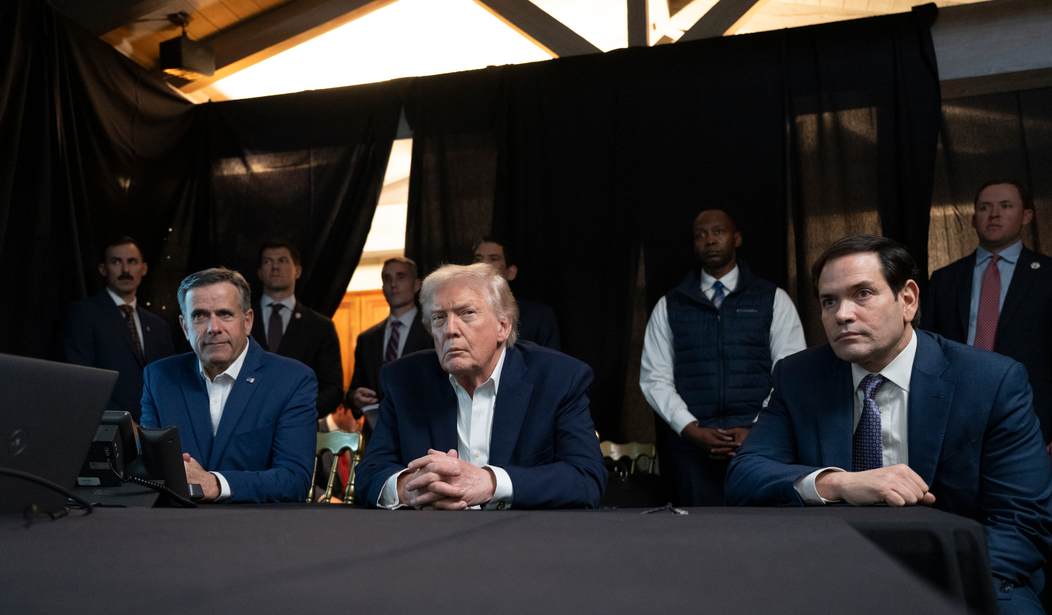
It took almost a year, but the White House finally chalked up its first objective in implementing the newly revitalized Monroe Doctrine. Or, as we call it, the Donroe Doctrine.
Its very first manifestation came almost immediately after Donald Trump's inauguration. Secretary of State Marco Rubio met with Panama president Jose Raul Mulino and told Mulino in no uncertain terms that the US would not allow China to control ports on the Panama Canal any longer. On February 3, 2025, Muloino repudiated Panama's Belt and Road Initiative agreements with China and would force the sale of control of those ports. China began a two-front strategy to reverse that decision, with parallel diplomatic and legal tracks. Diplomacy gave way to trade negotiations, which ultimately proved fruitless.
Late yesterday, so did the legal challenge. Panama's top court annulled the country's contracts with China's CK Hutchinson to operate both ports, effectively severing China from control of the Panama Canal:
The Supreme Court of Panama has annulled a contract for a Hong Kong company to operate two ports at either end of the Panama Canal, handing President Trump a victory for his security ambitions in the Western Hemisphere and denting China’s influence in the region.
The high court said the terms under which CK Hutchison runs the ports of Balboa on the Pacific Coast and Cristóbal on the Atlantic side were unconstitutional, setting the stage for the company’s departure from the port facilities. ...
Once the license is revoked, the government aims to ensure the continuity of port operations by hiring APM Terminals, a unit of shipping firm A.P. Moeller-Maersk, to manage the facilities until it opens a bidding process with new license terms, possibly separating the two ports, said Panama’s pro-American President José Raúl Mulino.
“Our ports are one of the strategic pillars for the national economy and a key link for international trade,” Mulino said in an address to the nation early Friday.
The departure of CK Hutchinson cuts China from any control of the ports. In a twist of irony, however, A.P. Moeller-Maersk is based in Copenhagen ... as in Denmark ... as in the country we're pushing hard to gain more control of Greenland. That will hand a tiny bit of leverage to the Danes in the negotiations, but Maersk also relies heavily on protection from the US Navy for its global shipping business, not to mention access to American ports and commercial traffic. This will almost certainly be nothing more than an amusing sideline in the months to come, but it may pop up from time to time in the Greenland discussions.
Maersk's control of the ports will only be temporary, anyway. Mulino has already declared that Panama will open itself to bids for normal contracts for managing the two ports at either end of the Panama Canal:
Panamanian President José Raúl Mulino said that until the court’s ruling is implemented, the state maritime authority would work with Hutchison’s Panama Ports Company at Cristobal and Balboa to assure continued smooth operations. He did not say when that would take place.
In the transition, a local subsidiary of A.P. Moller-Maersk (MAERSK-B.CO) will operate the ports until a new concession can be bid and awarded, Mulino said.
This also raises questions about the future of Hutchinson. One potential solution to the impasse had been a purchase of Hutchinson away from its China-based ownership, which would then have allowed a transition away from Chinese control of the Panama Canal and dozens of other ports. Beijing threw a spanner in the works by demanding that controlling ownership remain with another China-based company, Cosco. The sale of Hutchinson would have been more lucrative while it still controlled the Panama Canal. Now the incentives have been reduced, although now the incentives for selling Hutchinson may also be reduced now that the issue with Panama no longer exists.
The New York Times notes that Cosco's involvement in the sale is likely a no-sale with Washington, even apart from the Panama Canal:
While COSCO may not have had a direct role in the Panamanian ports under the deal that was being negotiated with BlackRock, analysts said its involvement in the other 40 or so ports in the deal would allow China to be more assertive globally than if CK Hutchison had held onto them.
Ryan Berg, a director of the Americas program at Center for Strategic and International Studies, a research organization, said getting CK Hutchison out of Panama while giving COSCO a role in the other ports would be “a Pyrrhic victory for the United States,” because of COSCO’s close ties to China’s government and navy.
Under those conditions, BlackRock probably would decline the investment. CCP control of the company would make them unable to exert real control over the company, and given the nature of the Donroe Doctrine, the risk of losing more ports under US economic pressure would ramp up considerably with the structure of this proposed "acquisition."
China insists that it will fight this decision in the courts, but ...
China's Ministry of Foreign Affairs said Chinese companies will pursue legal action to maintain their rights to operate on the Panama Canal, calling the decision "contrary to the laws governing Panama's approval of the relevant franchises."
Just as with the US, though, decisions by Panama's Supreme Court are not appealable. They can start a lawsuit, perhaps, or use diplomatic and trade pressure to get Mulino to reverse his position. After seeing what happened to Nicolas Maduro, however, Mulino is probably less inclined than ever to get on the wrong side of the US and the Donroe Doctrine.
Editor’s Note: Thanks to President Trump and his administration’s bold leadership, we are respected on the world stage, and our enemies are being put on notice.
Help us continue to report on the administration’s peace through strength foreign policy and its successes. Join Hot Air VIP and use promo code FIGHT to get 60% off your membership!


Join the Conversation
VIP members get the ability to comment on articles.