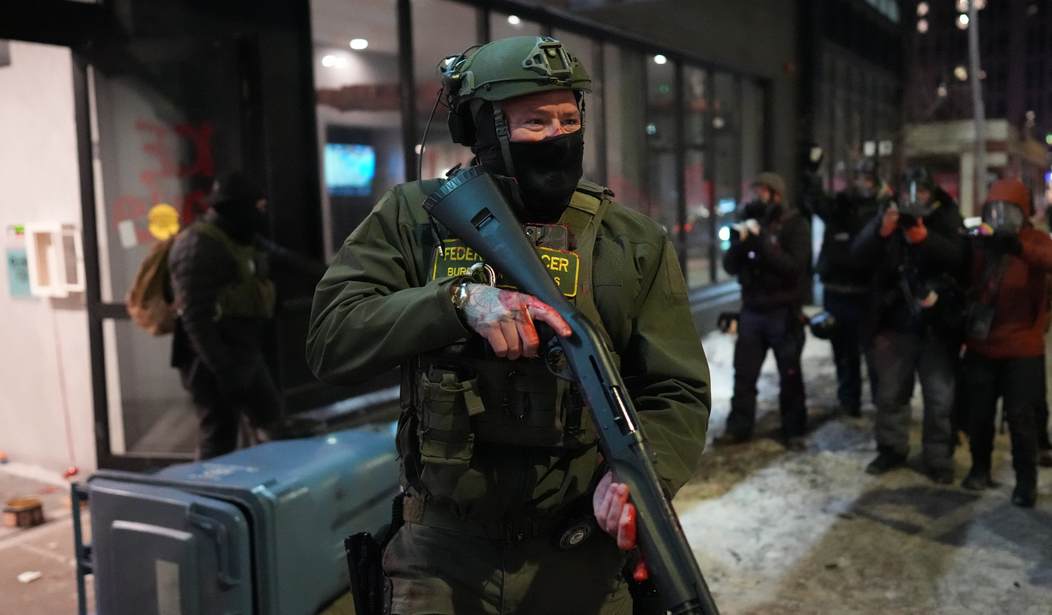
Forget the 2-1 partial dissent in Tincher v Noem et al. This case would have produced no other result under review. Thanks to a federal district judge who got way out over her skis, the Department of Homeland Security had to challenge a temporary restraining order that essentially forbade them from enforcing federal law under conditions so ambiguous that it essentially repealed federal law.
The Trump administration appealed the preliminary injunction last week, and the Eighth Circuit appellate court granted an emergency stay. Late yesterday, they made it official, albeit still temporary. The three-judge panel ruled that Judge Katherine Menendez' ruling was not just wrong on the law, it also was wrong on the evidence. The ruling noted the "strong showing" that the government would win the appeal at a full trial, and explained why in brief but excruciating detail:
We accessed and viewed the same videos the district court did. See Scott v. Harris, 550 U.S. 372, 380–81 (2007) (explaining that an appellate court should “view[] the facts in the light depicted by the videotape”). What they show is observers and protestors engaging in a wide range of conduct, some of it peaceful but much of it not. They also show federal agents responding in various ways. Even the named plaintiffs’ claims involve different conduct, by different officers, at different times, in different places, in response to different behavior. These differences mean that there are no “questions of law or fact common to the class,”Fed. R. Civ. P. 23(a)(2), that would allow the court to decide all their claims in “one stroke,” Wal-Mart Stores, Inc. v. Dukes, 564 U.S. 338, 350 (2011); cf. A.A.R.P., 605U.S. at 97–98 (issuing a temporary injunction because every member of the putative class needed to receive the “same” constitutionally adequate notice before removal from the country).
Second, in addition to being too broad, the injunction is too vague. See Fed.R. Civ. P. 65(d)(1)(B)–(C) (explaining that an injunction must “state its terms specifically” and “describe in reasonable detail . . . the act or acts restrained orrequired”). Directions not to “[r]etaliat[e] against persons who are engaging inpeaceful and unobstructive protest activity” or “[s]top[] or detain[] drivers . . . where there is no reasonable articulable suspicion” are simply commands to “obey the law,” which are “not specific enough.” Daniels v. Woodbury County, 742 F.2d 1128,1134 (8th Cir. 1984) (explaining that such injunctions do not provide “a clear idea of what conduct is prohibited”); see Sessler v. City of Davenport, 990 F.3d 1150,1156 n.3 (8th Cir. 2021) (deciding that a prohibition on “restricting and limiting [theplaintiff’s] rights to peacefully share his message” would be “an obey-the-law injunction”); Elend v. Basham, 471 F.3d 1199, 1210 (11th Cir. 2006) (declining to order an injunction to “ensure there’s no violation of the First Amendment” because it would “merely command the [defendant] to obey the law”).
The majority pointed out that Menendez' injunction, which amounted to an order to obey the law as it already stands, basically made her the arbiter of DHS operations in a manner that violated Article II and Article III boundaries:
Even the provision that singles out the use of “pepper-spray or similarnonlethal munitions and crowd dispersal tools” requires federal agents to predictwhat the district court would consider “peaceful and unobstructive protest activity.”The videos underscore how difficult it would be for them to decide who has crossed the line: they show a fast-changing mix of peaceful and obstructive conduct, with many protestors getting in officers’ faces and blocking their vehicles as they conduct their activities, only for some of them to then rejoin the crowd and intermix with others who were merely recording and observing the scene. See Bernini v. City ofSt. Paul, 665 F.3d 997, 1003 (8th Cir. 2012) (acknowledging “the practical dilemma faced by officers responsible for reacting to large group activity”). A wrong call could end in contempt, yet there is little in the order that constrains the district court’s power to impose it. See Schmidt v. Lessard, 414 U.S. 473, 476 n.2 (1974) (warning that “[t]he judicial contempt power is a potent weapon” that should not be “founded upon a decree too vague to be understood” (citation omitted)). “[F]ederal courts do not exercise general oversight of the Executive Branch,” CASA, 606 U.S. at 861, and the structural injunction imposed here, given its breadth and vagueness, is too big a step in that direction.
I would argue that this defect in particular was a feature for Menendez rather than a bug. She crafted this order with the purpose of having the greatest range of oversight possible over DHS operations in Minneapolis. Menendez fully intended to use the authority of judicial contempt in this case to force DHS to defer to her direction, in a manner similar to other judicial activists on district court benches over the past year. The Eighth Circuit panel just called out Menendez on her overreach. Even the lone dissenter didn't disagree with that point, nor on the overall imposition of the stay; he only dissented on the basis that parts of the injunction should have waiting for a full hearing, especially on class identification.
Jonathan Turley calls this a big win for the Trump administration, although still a temporary victory. He also points out that Menendez isn't finished:
In a significant victory for the Trump Administration, a panel of the United States Court of Appeals for the Eighth Circuit lifted the injunction of U.S. District Judge Katherin Menendez, who prevented officers from arresting, detaining, pepper-spraying or retaliating against protesters in Minneapolis without probable cause. ...
Notably, Judge Menendez is the same judge reviewing an even more sweeping motion for an injunction to enjoin ICE operations, a filing from Minnesota Attorney General Keith Ellison that I have criticized as constitutionally meritless.
Power Line's Scott Johnson offers up an I told you so, along with a warning about Menendez:
I wrote about Judge Menendez’s 82-page order granting the preliminary injunction in “The Menendez obstruction” and followed up in “The Menendez miasma.” I thought Judge Menendez’s order was a glorified if dangerous joke. Eighth Circuit Judges Shepherd and Stras find the preliminary injunction defective in all the respects anticipated here. Judge Gruender concurs in part and dissents in two respects. ...
The brief panel opinion finds Judge Menendez’s preliminary injunction too broad, too vague, and, oh yeah, threatening irreparable harm by causing cause federal agents to hesitate in performing their lawful duties. Other than that, A-okay.
Yesterday Judge Menendez heard oral argument in the state’s joke of a lawsuit against DHS under the Tenth Amendment. Judge Menendez is bidding to make herself a joke.
On that point, allow me to quote the final line of Stephen Sondheim's classic, Send In the Clowns: "Don't bother, they're here." At least the Eighth Circuit isn't willing to turn itself into a clown show.
Editor's Note: Radical leftist judges are doing everything they can to hamstring President Trump's agenda to make America great again.
Help us hold these corrupt judges accountable for their unconstitutional rulings. Join Hot Air VIP and use promo code FIGHT to get 60% off your membership!








Join the conversation as a VIP Member