Chalk up another economic win for Donald Trump. Mark down another embarrassment for the predictions of 'experts.' And move the U-word up the ranks of word usage in the Trump administration ... again.
Whether this means much in terms of electoral power in the midterms remains to be seen.
However, the dramatic improvement in the US trade deficit validates the core argument behind Trump's tariff policies, and it negates the counterargument that the trade deficit had little to do with economic policy. As the Wall Street Journal reports today, the fall in the trade deficit shocked experts as it plunged even below the levels seen during the pandemic.
In fact, the October trade deficit hit its lowest level since the first year of the Obama administration:
The U.S. trade deficit shrank dramatically in October to its lowest level since 2009, the Commerce Department said Thursday, an unexpected twist in a year of volatile trade flows that have been buffeted by the Trump administration’s steep tariffs.
American imports fell to $331.4 billion in October, while exports increased to $302 billion. That yielded an October deficit of $29.4 billion, an imbalance nearly 40% smaller than September’s.
Analysts polled by The Wall Street Journal had been expecting to see a $58.4 billion deficit—a large forecasting miss. Like much other recent economic data, the trade figures were delayed by last fall’s government shutdown.
Nor is this an anomaly, despite the apparent shock of the analysts on Wall Street. The Bureau of Economic Analysis report shows that trade deficits have dramatically shrunk since the first-quarter rush to import goods ahead of Trump's tariffs in April:
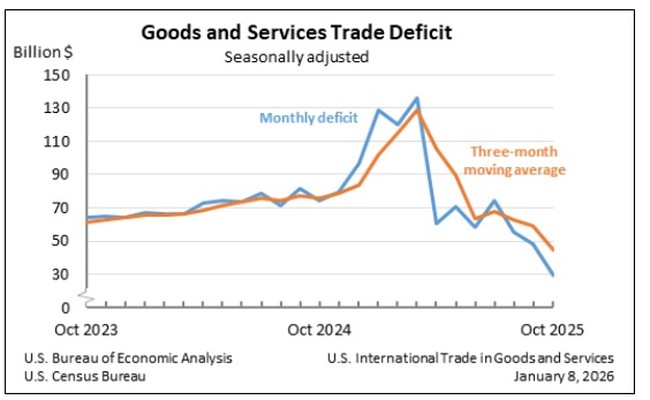 The spike in Q1 makes year-on-year analyses tricky. The activity over the three-month period ending in October 2025 speaks more to the momentum in trade relations. But even with that large spike in Q1 (and a ramp-up in late Q4 after Trump won the election), the year-on-year figure shows significant improvement:
The average goods and services deficit decreased $15.0 billion to $44.4 billion for the three months ending in October.
• Average exports increased $6.0 billion to $293.4 billion in October.
• Average imports decreased $9.0 billion to $337.8 billion in October.
Year-over-year, the average goods and services deficit decreased $31.3 billion from the three monthsending in October 2024.
The imposition of tariffs would create a decrease in imports, so that is no surprise. However, the bigger surprise is that the tariff wars have not impacted American exports, at least not to push them into negative territory. Exports actually grew by $7 billion in October 2025 alone, and have increased $20.5 billion over the past year even accounting for that spike.
Interestingly, this data was delayed for a few weeks due to the government shutdown. That took place during the entirety of October and November, and the expectation has been that the shutdown will have a substantially negative impact on the Q4 GDP rating, due out late next month. However, the reduction of the trade deficit alone will provide a major boost to real GDP ratings for Q4, even if this trend flattens out for the rest of the quarter.
This isn't the only pleasant surprise in economic data today. Productivity has hit a six-year high, and unit labor costs have actually dropped in October despite the supposed inflationary impacts of immigration enforcement on the labor market:
Experts are stunned as U.S. economic productivity surges 4.9%, marking its highest level in nearly six years. pic.twitter.com/fcqDSH02yj
— Breaking911 (@Breaking911) January 8, 2026
Experts are getting stunned a lot lately, it seems. Keep an eye out for the use of "unexpected" in various forms in reporting on these figures.
CNBC made the obvious point, to its credit:
Still, the decelerating imbalance “will provide a much needed boost for fourth quarter economic growth that has been hit hard by the Federal government shutdown,” wrote Chris Rupkey, chief economist at Fwdbonds.
“The U.S. appears to be winning the trade war with tariffs curbing the imports of foreign goods, but America’s trading partners are not holding any grudge as they continue to buy more American goods and services,” he added. “So far the forecasts for a U.S. recession are coming up dry as productivity continues to backstop growth.”
Indeed, third-quarter productivity rose at a 4.9% clip, according to a separate report Thursday from the Bureau of Labor Statistics.
The rise in productivity helped push unit labor costs down 1.9% for the period, far more than expected and an indication that the labor market is not putting any upward pressure on inflation.
All of these indicators contribute to a narrative of economic success. However, it's not clear whether these alone will impact voters in the midterms, even if these trends continue. Voters tend to react to more direct economic data, such as the overall GDP growth rate, the Consumer Price Index and its inflation rate, wage growth above inflation, and especially job growth and energy prices. Thus far, Trump's policies are generating mixed-to-positive signals on those indices, but job growth has been particularly sluggish. GDP has been spectacular, however, and the pressure on the Federal Reserve to lower rates may finally boost job creation in 2026.
The other caveat to the trade deficit report is the Supreme Court. Trump has not yet commented on today's report, but did recently remark that he hopes the court will support his use of the International Emergency Economic Powers Act (IEEPA) to leverage tariffs for better trade agreements. We may find out the answer to that tomorrow:
The nation’s highest court is poised to rule Friday on a case that could redefine the scope of President Donald Trump's trade agenda.
The cases stem from lawsuits filed by an educational toy manufacturer and a family-owned wine and spirits importer challenging Trump’s tariffs. The court must decide whether the International Emergency Economic Powers Act (IEEPA) gave the president the power to impose the tariffs, or whether the move overstepped constitutional limits. ...
The Supreme Court decision comes as tariff revenue and the economic stakes tied to it have surged to record levels.
The White House has claimed that it has other authorities under which it can apply tariffs in trade negotiations, but that IEEPA gives it the cleanest application. Whether or not it works is not the issue before the Supreme Court, but it may be the point that Trump can make when it comes to the midterms. He certainly has a case to argue to voters, based on the economic data we are now seeing.