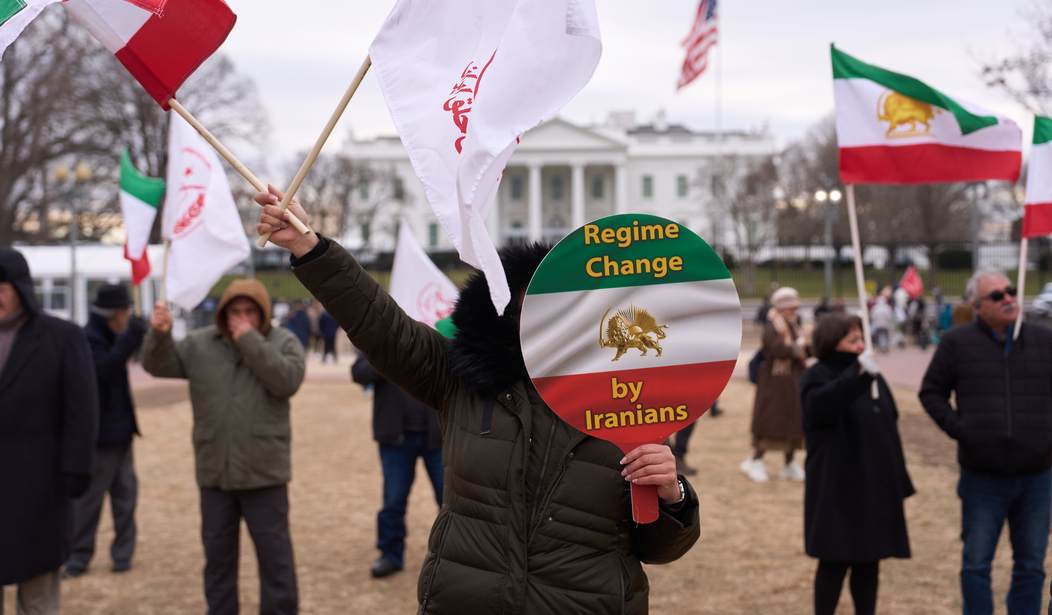
Note to American media: Perhaps give us a little less Greenland, and a lot more Iran. Even by the if it bleeds, it leads standard, the lack of interest in what may well amount to the end of an era in the Middle East is puzzling.
Protests have rocked the regime in Tehran, and have spread to all provinces while intensifying in the capital. CBS News has kept up with developments and reports that three dozen people have already been killed in the eruption against the mullahcracy. The IRGC has detained thousands already, but the protests continue to expand:
At least 36 people have been killed amid major anti-government demonstrations across Iran, a U.S.-based rights group says. The Iranian government is trying to quell the unrest, and reacted angrily to President Trump's veiled threat of a U.S. armed intervention.
The Human Rights Activists News Agency, which gave the death toll based on its network of contacts in the country, said in its daily report on Tuesday that at least 36 people "have been confirmed killed during the past ten days of protests. Among them were four individuals under the age of 18, as well as two members of security and law enforcement forces."
HRANA said more than 2,000 protesters had been arrested, "however, the actual number of detainees is estimated to be significantly higher."
The unrest has penetrated to the merchant class, which has until recently backed the regime:
The organization shared video on Tuesday that it said showed clashes between protesters and security forces at Tehran's Grand Bazaar — a center of commerce in the capital where shop owners have long backed the regime.
The protests began more than a week ago in Tehran as business owners took to the streets to vent their frustration over soaring inflation in the nation, whose economy has been crippled by U.S. and international sanctions for years. But the anger spread quickly to more than 250 locations in at least 27 of Iran's 31 provinces, according to the Washington-based HRANA, with social media videos showing violent clashes between protesters chanting anti-government slogans and security forces every night since.
The involvement of the bazaaristas, as Middle East Forum's Gregg Roman refers to them below, may well be decisive. For more than a century, the merchant class has provided the catalyst by which failing regimes in Iran collapse. They remained either on the sidelines or in support of the mullahs in 2009, 2019, and 2022 during popular uprisings originating from different kinds of initiating events. With the merchants throwing their support to the popular revolt, the IRGC and the Basij will get very isolated if the pressure continues to build.
Today's protests were the largest yet, Newsweek reports:
Large-scale anti-regime protests swept across Iran on Wednesday in what rights groups described as the biggest day of unrest so far.
Security forces fired tear gas at demonstrators in Tehran’s Grand Bazaar as parallel clashes and strikes erupted nationwide, including in the holy city of Mashhad. More protests are planned for Thursday, signaling that the unrest shows no sign of easing. ...
The breadth of the unrest and the speed with which it has spread across Iran underscore a level of public anger that goes beyond isolated economic protests, pointing instead to deeper frustration with governance, corruption and living conditions. The involvement of bazaar merchants—a powerful social and economic force with a historic role in past revolutions—suggests the movement is no longer confined to the streets, but is beginning to disrupt the country’s economic core.
Ali Khamenei attempted to blunt the economic complaints by cashiering the head of Iran's central bank after the currency collapse. That didn't have much effect, and the attempts have grown more desperate. The Iranian regime tried to pacify the population with the promise of a stimulus payment to make up for the massive loss of capital due to spiraling inflation and the rial's collapse, but ... it turned into an insult instead:
In response to the unrest, the Iranian government this week, announced plans to provide a monthly payment to each citizen of roughly $7. Government spokesperson Fatima Mahajerani said the measure is intended to “preserve families’ purchasing power, curb inflation, and ensure food security.”
Most Iranians, however, face basic monthly expenses exceeding $200, highlighting the limited scope of the payment amid widespread economic hardship.
This is the most precarious position in which the mullahs have been in the 47-year history of the "Islamic Republic." Iran has built a terrorist empire in the Middle East, with tentacles reaching into South America, Europe, and north Africa. And yet while the American media has covered the uprising, they have only done so begrudgingly. The fall of the mullahs could entirely remake the region, but again, our media seems more interested in Greenland than Iran at the moment when increased attention and pressure could tip the balance.
Earlier today, Gregg Roman and I discussed the situation in Iran, its origins, and the different factions attempting to merge together to eject the mullahs. But how can that be accomplished without collapse and destruction? What can the West do, and what shouldn't they do? Just how embedded is the IRGC and Basij in the economy? Gregg has some great insights into the history of regime changes in Iran, as well as plenty of cautionary advice for the West about imposing regime change from the outside.
The Ed Morrissey Show is now a fully downloadable and streamable show at Spotify, Apple Podcasts, the TEMS Podcast YouTube channel, and on Rumble and our own in-house portal at the #TEMS page!










Join the conversation as a VIP Member