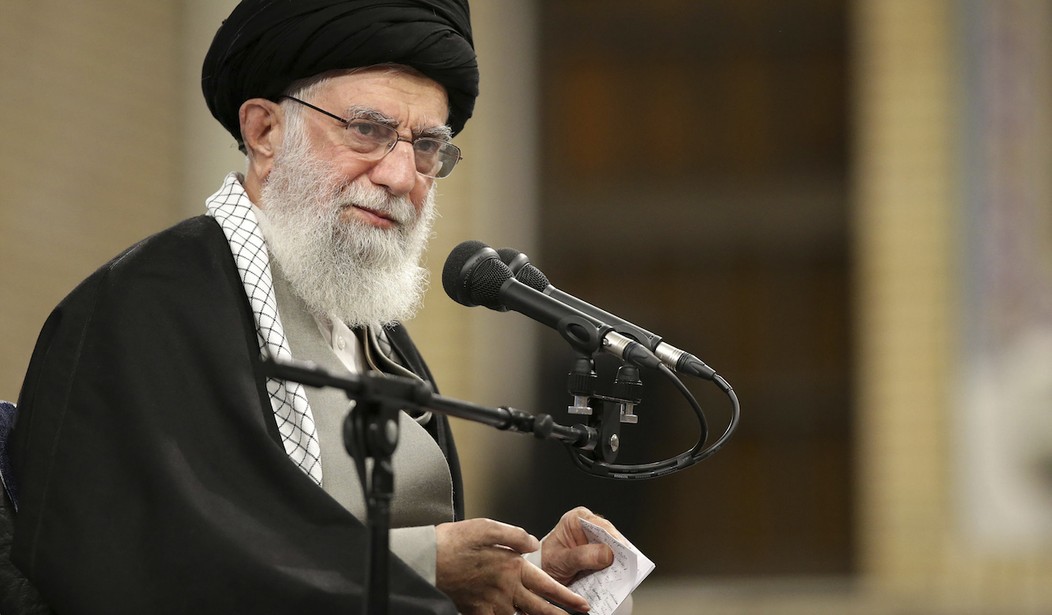
Given what's happening already in Iran, the better question might be whether Donald Trump could beat the Iranian people to the punch.
The question of Iran shows just how dramatically Trump has reset the American direction of global affairs. Until this year, US foreign policy in this hemisphere had produced a malign neglect with a dash of convenient finger-wagging. The Biden Regency had reversed the first Trump term policy toward Nicolas Maduro, dispatching John Kerry to snuggle up to the dictator for climate-change goals. The Biden Regency had also reversed course on Iran, ending the Trump I policy of "maximum pressure" and returning to the Obama-era appeasement of the JCPOA.
In 2025, however, Trump has not just reset back to pre-Biden policies, but shifted to direct intervention to decisively deal with threats in both arenas. Trump gave Iran an ultimatum after the mullahs attacked Iran, then took the shocking step of directly destroying Iran's nuclear-weapons infrastructure – and then forced Ali Khamenei into a cease-fire agreement with Israel. He took aim at Iranian interests again in capturing Maduro and hauling him into federal court this morning, likely exposing Hezbollah to US counterterrorism operations while the Maduro regime staggers.
As I wrote earlier, Iran's theocracy now has its worst existential crisis since coming to power in February 1979. They have no nuclear deterrent. Their currency has collapsed. Popular protests keep expanding, and at some point, the IRGC will use lethal force on a large scale to protect Khamenei and his goons, at least in the short run. All of this prompts the question: will Trump yank Khamenei out of Tehran like he did with Maduro?
Earlier today, the Jerusalem Post reported rumors that Trump might stage a military intervention if the IRGC went fully lethal:
The Jerusalem Post has received multiple indications that the US is considering some intervention in the ongoing Iran protests. At the same time, Israel is also checking if the removal of Venezuelan leader Nicolas Maduro will make action against the Iranian regime possible.
It appears that Israel was surprised by America's intervention in Venezuela and that this action scrambled Israeli calculations about what might be possible in the Islamic Republic. ...
There are indications that Washington is weighing some targeted intervention to assist the protest movement to get over the top of the Iranian regime.
Likewise, Israel is also checking if the removal of Maduro will make action against the Iranian regime possible.
The term "intervention" covers a vast spectrum of responses. It's likely that we are already 'intervening' to some extent with support for the protesters and the pro-democracy organizations in Iran. We may have intelligence assets deployed in support of the protests along with the Mossad. In fact, it would be surprising if that weren't the case. However, that kind of support has to remain as sotto voce as possible, as overt intervention can delegitimize true grassroots activism in defense of liberty – although at this stage, the regime's propaganda on such points are likely only credible with the true believers anyway.
The speculation today, however, is on more direct and decisive intervention. Would Trump order the capture of Khamenei under the same authority as he did with Maduro? It would not be difficult to get an indictment against the Ayatollah, just on the basis of the deaths of hundreds of American soldiers in Iraq, not to mention the terrorism committed by Iranian proxies such as Hezbollah and Hamas. The latter killed dozens of Americans in the October 7 massacres, after all, operating under the direction and funding provided by Khamenei. That's a more direct link to crimes than Maduro's.
Nevertheless, the answer to the question is: highly unlikely. It's one thing to stage the Maduro operation, which took place in our own hemisphere and well well-connected to supportable lines of communication. We did succeed at a similar operation in Abbottabad in 2011 when we killed Osama bin Laden, but our operational posture was fairly quiet beforehand, too. However, we don't have a base in Afghanistan any longer for that kind of adventure, and the Turks are not about to let us use Incirlik for a similar operation. The US would have to stage this from either Baghdad or the Persian Gulf, traversing a long distance across parts of Iran with helicopters in order to get into Tehran.
Is it possible? Yes. But the chances of success are remote, and the juice may not be worth the squeeze. We tried a similar style of operation in 1980 to rescue the American hostages being held by Ruhollah Khomeini, and it failed miserably. We have learned much since then, but one of the lessons was keeping a sense of reality about supply lines, terrain, and the feasibility of the mission objectives.
Besides, as satisfying as it would be to see Khamenei having to enter a plea in US federal court, the same juice can get squeezed through other means. The Iranian people can take care of Khamenei, as long as the IRGC gets negated or shut down before they can conduct massacres to preserve the theocracy. The US can make clear that they will hit IRGC assets that participate in violence against street protesters, and follow up with action as necessary. That is much less risky than a forced extraction of a dictator, with much higher prospects of success.
The calculus changes when discussing next steps in this hemisphere, however. Iran may be wondering whether Trump will intervene, but so should Cuba and perhaps Colombia too:
After overseeing a brazen operation to oust Venezuela’s Nicolás Maduro, President Trump is turning his attention to other countries over which he wants the U.S. to exert more control.
In the days since Maduro’s capture, Trump has renewed threats against Colombia, criticized Mexico’s leadership, predicted Cuba’s government would fall and reiterated his desire to take over Greenland.
Trump has privately told aides that he is thrilled with the outcome of the Venezuela operation, according to a senior administration official.
“He’s more resolved, not less, after this success,” Sen. Lindsey Graham (R., S.C.) said in an interview with The Wall Street Journal. “We need to clear up our backyard,” said Graham, who traveled with Trump aboard Air Force One on Sunday night. “The theme here is: securing the border is really important. We need to get to the source of the problem.”
This is still a bit premature, of course. We still have to deal with the aftermath in Venezuela, where the regime is still barely clinging to power. How we resolve that will go a long way to answering whether we will need to intervene in other countries at all, or whether they will see the writing on the wall and begin cooperating with the US.