Donald Trump couldn't have asked for better timing on today's consumer-price index report. Last night, the president argued that his policies would eventually tame inflation rather than stoking it, and asked the nation to remain patient. Less than twelve hours later, that patience paid off in official government data.
Economists had predicted an increased CPI index inflation in today's Department of Labor report, with predictions centering on a rate of 3.1% annualized inflation for November. Surprise!
The Consumer Price Index for All Urban Consumers (CPI-U) increased 0.2 percent on a seasonally adjusted basis over the 2 months from September 2025 to November 2025, the U.S. Bureau of Labor Statistics reported today. Over the last 12 months, the all items index increased 2.7 percent before seasonal adjustment. BLS did not collect survey data for October 2025 due to a lapse in appropriations.
The seasonally adjusted index for all items less food and energy rose 0.2 percent over the 2 months ending in November. From September to November, the index for shelter increased 0.2 percent. The energy index rose 1.1 percent over the same 2-month period and the food index increased 0.1 percent. Other indexes which increased over the 2 months ending in November include household furnishings and operations, communication, and personal care. In contrast, the indexes for lodging away from home, recreation, and apparel decreased over the same 2-month period.
The all items index rose 2.7 percent for the 12 months ending November, after rising 3.0 percent over the 12 months ending September. The all items less food and energy index rose 2.6 percent over the last 12 months. The energy index increased 4.2 percent for the 12 months ending November. The food index increased 2.6 percent over the last year.
The BLS chart for the annualized rates over the last 12 months shows the dramatic drop since September, as well as the gap in October when the Schumer Shutdown prevented the collection of data. It also provides evidence for Trump's claim in his speech last night that the overall inflation picture has improved significantly over the Biden Regency, even if the overall numbers still range above the Federal Reserve's target of 2.0%. Look for the blue X and the red dot to the right:
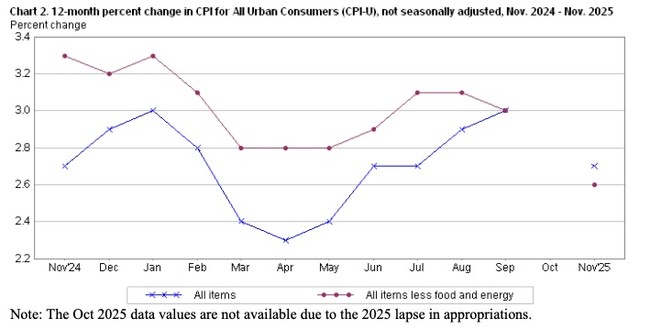 Those show significant improvement over a mild mid-summer spike in prices. The mild spike had raised concerns that tariffs would create inflationary momentum, which has colored much of the political debate since the BLS reported the data. However, the impact on overall prices has been muted at best, and the leverage gained for better trading terms and investment redirected to the US is at least arguably a good return on that investment.
The Wall Street Journal took a more pessimistic view of these numbers, in an analysis that feels written prior to the report's release:
The headline reading was lower than the 3.1% that economists polled by The Wall Street Journal had expected. They had expected a 3.0% increase in core prices.
The Labor Department, which usually publishes its inflation data earlier in the month, didn’t break out changes for October because officials weren’t able to collect prices in the field during the long government shutdown that lasted until Nov 12.
Rising prices have become a concern for more and more Americans, so much so that discontent over affordability has shaped local elections and forced the Trump administration to re-examine its messaging on the economy. While annual inflation is down from the runaway levels of 2022, it is still above the level that policymakers feel comfortable with.
Some companies have already raised prices on consumers as a way to deal with Trump’s new tariffs. Other companies are waiting to see how tariffs settle before raising prices in order not to scare away customers. The start of the year tends to be the time for businesses to adjust prices, so inflation could go even higher from here.
Does anyone else get the feeling that the WSJ expected a much different reading from today's CPI? I certainly do.
CNBC actually embraced the surprise a bit more in its analysis:
Consumer prices rose less than expected in November, giving investors hope that inflationary pressures may be cooling enough for U.S. monetary policy to be eased more than Wall Street anticipates.
The consumer price index rose at a 2.7% annualized rate last month, a delayed report from the Bureau of Labor Statistics showed. Economists polled by Dow Jones expected the CPI to have risen 3.1%.
The core CPI, which strips out volatile food and energy prices, was also cooler than anticipated, increasing 2.6% over 12 months. It was expected to have risen by 3%.
That optimism didn't carry over to its on-air commentary, at least not with their analyst from the Left-leaning Brookings Institute. When the host expressed cheeriness over the report, Wendy Edelberg cast some cold water on the results, claiming that "core goods" had increased 1.4% as a direct result of tariffs, and called it a warning sign for inflation in the future:
That's certainly something to watch, but the "tariff effect" has been in place for several months now. The impact on overall consumer-price inflation has been modest. Furthermore, the decrease in rental prices and decline in energy prices (especially gasoline, a force multiplier in CPI) work against its effect. The overall balance appears to be relatively healthy, and perhaps getting healthier, even though the number still rests above the Fed's preferred inflation targets.
That brings us to the next question: whither the Fed? They have issued two incremental reductions to the prime interest rate since the summer spike over concerns about the job-creation market. The last reduction came with an extraordinary level of dissent on the Fed board, presumably over concerns raised by that summer spike. This data may push the Fed to another incremental cut in their next meeting in January, and probably should. They will wait for their key indicator, the PCE Price Index, which should come over the holidays, so keep a close eye on that data.
In the meantime, expect the White House to take another victory lap after last night's victory lap, with the hope that voters are still paying attention to economic messaging as Christmas approaches.