








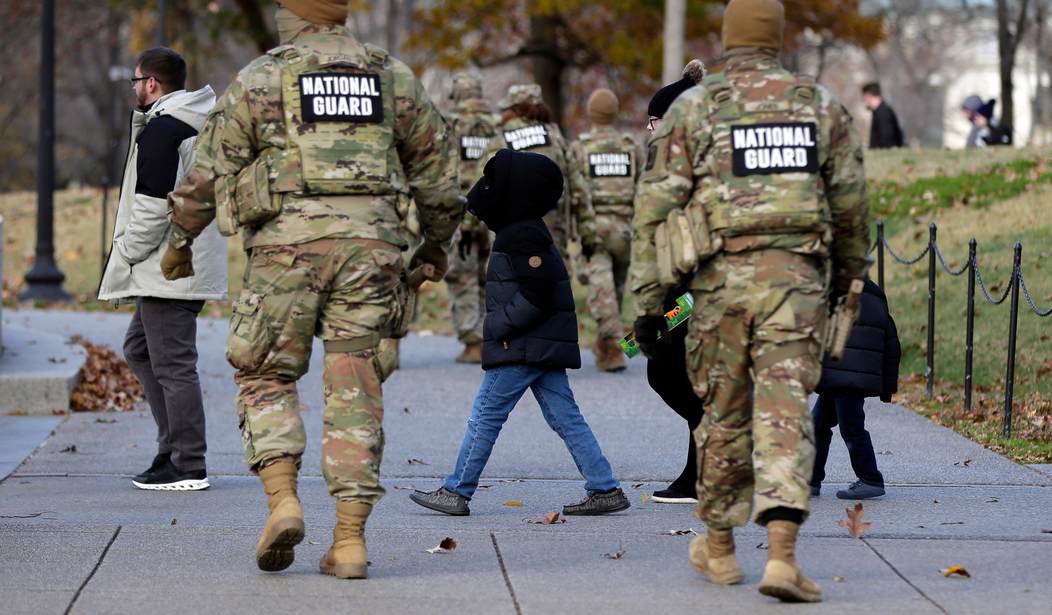
First, the good news. An appellate court has rejected an effort to force the removal of the National Guard from supporting law enforcement in a major urban area. The bad news? The ruling applies to Washington DC, and the panel has limited its findings to the federal nature of the nation's capital.
There is in-between news too, but let's hit the highlights as reported by Politico first:
President Donald Trump can keep National Guard troops on the streets of Washington, D.C. for now, a federal appeals court ruled Wednesday.
But the unanimous three-judge panel — which included two of Trump’s own appointees — raised serious doubts about the lawfulness of deployments in other cities.
The panel said Washington’s unique position as a federal enclave, which lacks the sovereignty of a state, gives Trump virtually unilateral control to deploy guard troops in the nation’s capital. But it said his power was significantly more constrained in the states.
In particular, the judges said it would be “constitutionally troubling” for the president to borrow National Guard troops from one state to conduct law enforcement missions in another “non-consenting” state. That’s precisely what Trump and Defense Secretary Pete Hegseth did in Oregon and Illinois before federal judges intervened to restrict the deployments.
That's actually not "precisely" what Trump did, but we'll get back to that in a moment. It certainly does describe the deployment to DC accurately, however. Trump ordered the National Guard to support and supplement the DC police force in normal law enforcement activities, using his authority under the sovereignty of the federal government in the unique status of the city as a federal district. This has always been clearly a federal jurisiction, one that Congress has not overridden even with so-called "home rule."
Congress itself has not granted DC any official status that would interfere with that jurisdiction, the panel noted in its grant of a stay that allows the deployment to continue:
We now grant the motion for a stay pending appeal. Because the District of Columbia is a federal district created by Congress, rather than a constitutionally sovereign entity like the fifty States, the Defendants appear on this early record likely to prevail on the merits of their argument that the President possesses a unique power within the District—the seat of the federal government—to mobilize the Guard under 32 U.S.C. § 502(f). It also appears likely that the D.C. Code independently authorizes the deployment of the D.C. Guard. ...
Congress made the President the Commander in Chief of the D.C. Guard. D.C. Code § 49-409. The parties agree that, as Commander in Chief, the President “functionally serve[s] in the role of a Governor of a state.” District of Columbia, 2025 WL 3240331, at *12; see Opp’n Br. 1. And like a governor, the President may deploy the Guard only within the bounds of the law. Given the special security needs of the District as the seat of federal government and the Nation’s Capital, Defendants have likely shown that the D.C. Code affords the President authority for this deployment.
To begin, the D.C. Code provides that the President, as Commander in Chief of the D.C. Guard, “shall order out” the D.C. Guard “[w]henever it shall be necessary[.]” ... More to the point, the D.C. Code contemplates in multiple provisions that the D.C. Guard may be ordered to “aid the civil authorities in the execution of the laws[.]”
This is actually very straightforward and comprehensively addressed by the appellate panel. Trump not only has jurisdiction because of DC's status as a federal district, Congress also explicitly (and perhaps redundantly) granted presidents the authority to call out the National Guard, including for law enforcement. It is, as the court also notes, a parallel to the same authority governors have over their National Guard formations.
However, Politico likely over-reads the section it cites while claiming that Trump did "precisely" the same thing in other states when deploying Guard units. This is what the ruling states, emphasis mine:
Deploying an out-of-state Guard to a non-consenting State to conduct law enforcement would be constitutionally troubling to our federal system of government, and courts no doubt have a duty to construe ambiguous text in statutes to avoid serious constitutional questions. See United States v. Hansen, 143 S. Ct. 1932, 1946 (2023); Ashwander v. Tennessee Valley Auth., 297 U.S. 288, 348 (1936) (Brandeis, J., concurring).
But the only issue that was before the district court and is now before this court is whether the President could request such deployments to the District of Columbia, which is not a sovereign State, but instead is a unique federal district that serves as the Capital of the United States and the seat of the federal government. In that specific context, the Defendants are correct that staying the preliminary relief ordered here would not require reading Section 502 to permit a president to call on governors to deploy their Guards into non-consenting States. See Emergency Mot. 19; Reply Br. 8.
This is no small distinction. Trump called out the DC National Guard to conduct law enforcement in the capital, which he has the authority to order. In other jurisdictions, though, Trump ordered National Guard units from both the same and different states to protect federal law enforcement resources and facilities so that those assets could conduct law enforcement themselves. To some, that may be a distinction without a difference, but legally, those are two separate issues. Notably, the ruling mentions several times the authority for the National Guard to act in "protection of federal government functions and property," albeit in the context of a federal district rather than a state.
In other words, contrary to Politico's framing, the DC case is significantly different than the cases from California, Oregon, and Illinois. The difference is why the Ninth Circuit has issued contradictory rulings at times, as has the Seventh Circuit. The Supreme Court will almost certainly have to determine whether the distinctions are large enough to be differences, but it would be a very strange reading of the Supremacy Clause that recognizes the federal interest in protecting its property, personnel, and operations while making federal authority subordinate to the states in seeking to fulfill that mission.
The actual narrow ruling here on direct law enforcement activity within DC is likely why this ruling turned out to be unanimous. It will almost certainly be meaningless in application elsewhere.
Editor’s Note: President Donald Trump is returning Washington, D.C. to the American people by locking up violent criminals and restoring order.
We've covered D.C.'s decay for years. Support us today in our coverage of its comeback. Join Hot Air VIP and use promo code FIGHT to get 60% off your membership!


Join the Conversation
VIP members get the ability to comment on articles.